There’s now a date for when London’s Oxford Street will start being scanned by permanent live facial recognition (LFR) cameras: December, when the annual Christmas shopping rush brings the most people into the street.
That is unless the plan is stopped, which at this point seems unlikely, given that the Metropolitan Police (the Met) have already announced the deployment of the controversial technology on the capital’s busiest shopping destination, and now the Press Association understands that the cameras will “likely” be installed next month.
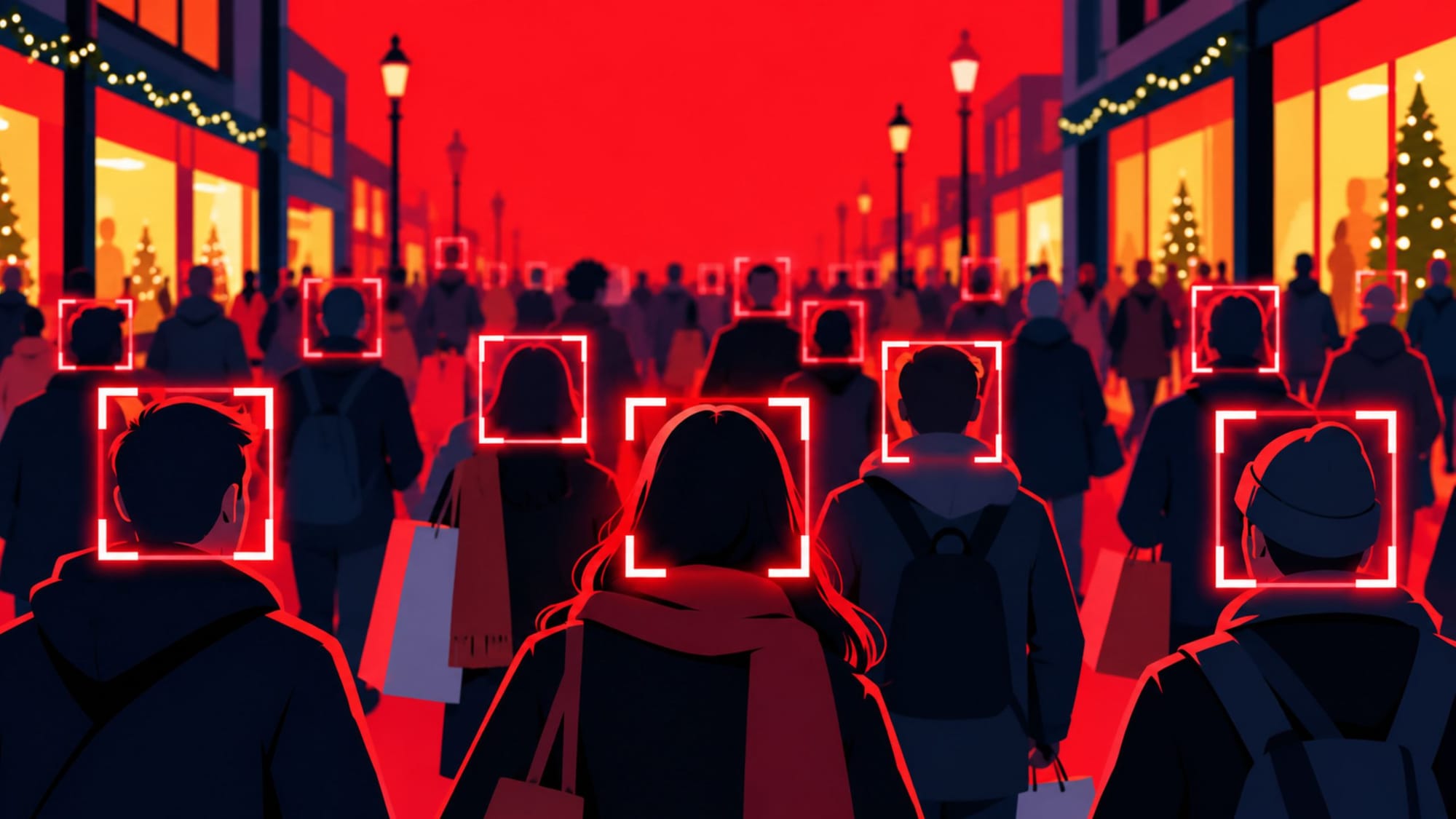
The presence of the cameras will be hard to miss, as they will be scanning every single person who walks down the street, and there are about half a million of those every day – none of whom will be given a choice to “opt out” of the biometric check that will compare their face against a police watchlist.
LFR is “an important tool which is helping us keep London safe,” is how the Met has justified its use of the tech. The plan is not new – it was first announced in the summer – but this is the first time a time frame has been given for when the deployment is to happen.
The street is to be pedestrianized next week, and eventually the whole of it will become traffic-free.
The Press Association is reporting that the cameras will likely be placed on lampposts and other street furniture. It will be one of the first – if not the first – permanent LFR installations in the country, although the Met also plans to place static cameras in the West End and Soho.
The police also claim that their fixed cameras in Croydon “contributed to a 10 per cent reduction in crime and led to 173 arrests – one every 35 minutes.”
The Met says the cameras are only “turned on when officers are present on the ground, and signs will make it clear to the public that a deployment is taking place.”
The Met also says that “conversations remain ongoing with our partners on where we will place the cameras.”
As for the biometric data collected, the Met says that if there is no alert, it is deleted “immediately.” All LFR CCTV footage is deleted within 31 days, and watchlists are deleted within 24 hours.
Met Commissioner Sir Mark Rowley calls LFR “one of the most revolutionary technology advances in policing in recent years,” and the force claims that more than 2,000 arrests have been made since the beginning of 2024 thanks to this tech.
Not everyone is pleased with the plans, with Liberty director Akiko Hart saying that “thousands of Christmas shoppers will have their faces scanned by this unregulated surveillance technology without being given a choice.”
In reality, the number of people affected will be much higher – half a million a day over several weeks – but Hart is right that this is happening without a legal framework to regulate the use of LFR.
“Despite a public consultation on facial recognition closing in February, the Government has yet to publish its response. Yet permanent facial recognition cameras are set to be installed in one of the country’s busiest destinations without a legal framework to protect the public’s rights,” said Hart, adding, “This lack of transparency damages public trust.”
The Home Office had launched a public consultation on a legal framework for police biometrics, including LFR, in December 2025, but has yet to publish a response.
Meanwhile, some politicians continue to cheerlead for more surveillance. On Thursday, Conservative leader Kemi Badenoch told the Police Federation, “We will expand live facial recognition so that instead of spending hours and hours crawling through CCTV, you’ll get a match in seconds.”
In July, London Mayor Sadiq Khan told the London Assembly that the Met was working with the Oxford Street Development Corporation on “how we use LFR in a sensible way.”
At the same meeting, Conservative Assembly member Susan Hall called herself “a massive supporter of live facial recognition” and asked if it could be used to scan people attending protest marches and Notting Hill Carnival.
In August, Liberty’s Ruth Ehrlich said the plan represented “a significant escalation in our nation’s capital,” while Big Brother Watch’s Jasleen Chaggar remarked, “Innocent Londoners who are not suspected of any crime by the police should be able to wander around public spaces without identifying themselves to the authorities.”
Croydon’s own figures show that of the 470,000 people “processed” by the cameras, 99.96 percent had nothing to do with any crime.
Another trial, carried out by British Transport Police in a station, scanned 926,912 faces and led to zero arrests.
In April, the High Court in London dismissed a challenge to the use of LFR by the police that was brought by a youth worker who was wrongly flagged by the system and held outside London Bridge station, and by Big Brother Watch.
After the ruling, Policing Minister Sarah Jones said, “Law abiding citizens have nothing to fear.”
The key point is that LFR is indiscriminate – it scans every face in a crowd, and the majority of those on Oxford Street are law-abiding citizens who will be subjected to a biometric scan, simply because they happen to be on the street.
And while LFR vans deployed in the past would come and go, a camera bolted to a lamppost on the country’s busiest shopping street does not, and the people it scans are overwhelmingly those the police have no interest in – people out doing their Christmas shopping.
This is a key difference between the Oxford Street plan and previous, “targeted” deployments of the tech. And it is happening at a time when the legal framework that the government has promised is still not in place – the response to the relevant public consultation is still unpublished.
The cameras are going up anyway – and by the time the rules and regulations are finally defined and published, the scanning of every face on Oxford Street will have become the normal state of things.