
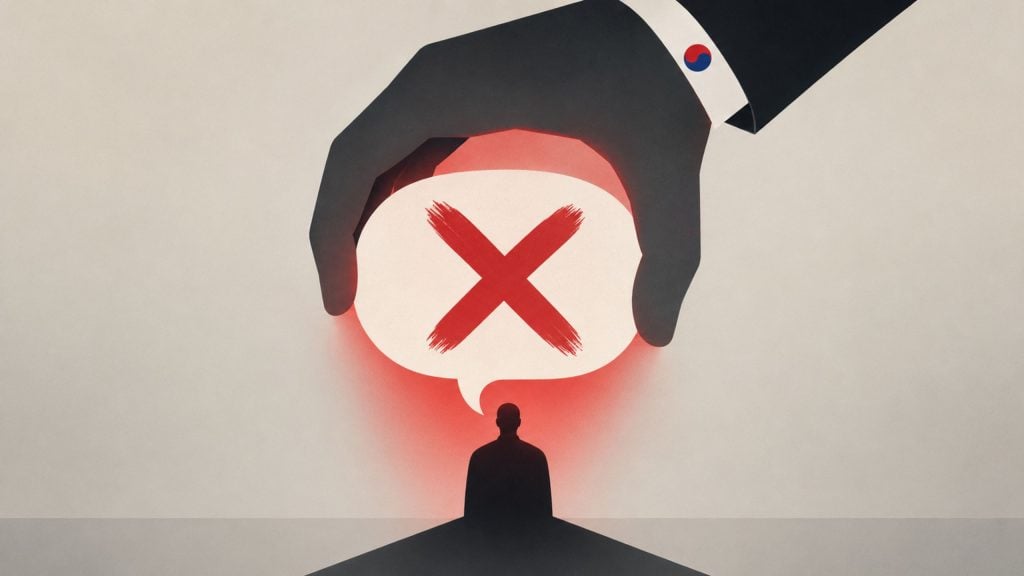
South Korea now fines you for being wrong online, and the state reserves the right to decide what wrong means.
A revision to the country’s Network Act took effect Tuesday, letting courts order anyone with a real audience to pay up to five times a victim’s financial losses for spreading information the government deems intentionally false. Distribute more than twice, and the penalty climbs to 1 billion won, about $660,000.
The measure amends the Act on Promotion of Information and Communications Network Utilization and Information Protection, known at home as the “fake news” law. It targets publishers with more than 100,000 subscribers or monthly views, the threshold where a voice starts to carry. Reach that many people, get accused of lying, and you now write under the shadow of a payout calculated as a multiple of someone else’s claimed loss.
Platforms wear a separate leash. Any service averaging a million or more daily users can be tagged “large-scale” by the Korea Media and Communications Commission, and eight already have been. The Korean four are Naver, Kakao, Nate, and DC Inside. The overseas four are Google, Meta, X, and TikTok. Designation brings homework. The companies must build reporting channels for “unlawful” content, publish transparency reports, and sign agreements with fact-checking organizations that the state gets to approve.
As we’ve seen before, a platform facing fivefold damages will not wait for a court to separate truth from error. It just deletes first. Choi Soo-jin, the People Power Party’s chief floor spokesperson, said the pressure points in a single direction. “To avoid large damages and fines, platforms will have no choice but to preemptively delete posts even before illegality is clearly determined,” she said. “Excessive deletion and de facto prior censorship are structurally inevitable.”
The unanswered question is who defines the lie. The law punishes “false or manipulated information,” yet Korea built no body to rule on what qualifies before the penalties land. Joo Jin-woo, a People Power Party lawmaker preparing a constitutional challenge, called it “rushed legislation that does not even have a body to determine false or manipulated information.” Jeong Jeom-sig, the party’s floor leader and its top legislative strategist in the National Assembly, has vowed to file a constitutional complaint of his own.
Washington noticed. A State Department spokesperson voiced “significant concerns” on Wednesday, warning that “the amendment could lead to excessive content regulation and undermine freedom of expression.” The statement pressed further, saying South Korea “should not impose undue burdens on U.S. companies and must not use the law’s implementation as a mechanism to demand censorship of free expression.”
Korea’s regulator says the platforms, not the government, will make the first call. “Basically, the platforms will be the first to determine whether a post — including satire and parodies — violates their internal guidelines,” said Shin Young-kyu of the Korea Media and Communications Commission.
“Ultimately, the courts will hold the final authority on whether any given content violates the law. As rulings accumulate over time, more concrete standards will emerge.” The reassurance carries an admission. No concrete standards exist yet, so satire and parody get filtered now while the rules are written later, after the posts are gone.
The ruling Democratic Party, which pushed the amendment through the National Assembly in December, insists ordinary people have nothing to fear. “Not a single citizen who shares daily life, expresses legitimate political opinions or sharply criticizes power will be subject to punishment under this law,” said party spokesperson Jeon Su-mi. A promise like that depends on who defines legitimate, and that power now sits with the state and the courts it staffs.
Opposition reaches well past one party. The Journalists Association of Korea, the country’s largest press group, has come out against the law. Korean legal groups and the Computer & Communications Industry Association, a US tech trade body, have too. A petition demanding repeal gathered more than 140,000 signatures before the law even took effect. Any petition clearing 50,000 names in 30 days goes to a standing committee, which can advance it or bury it.
The people who wrote this law get to decide what counts as false, who reached too many readers, and which posts vanish before a judge ever looks. Korea has handed its platforms a single incentive. Delete first, ask questions never. The result is a chilling effect with the force of statute behind it.