

Google has been quietly linking every Google Account signed in on an Android device to the phone number of that device – often without the knowledge of the users, who in many cases had been keeping their secondary accounts separate from their primary phone number on purpose.
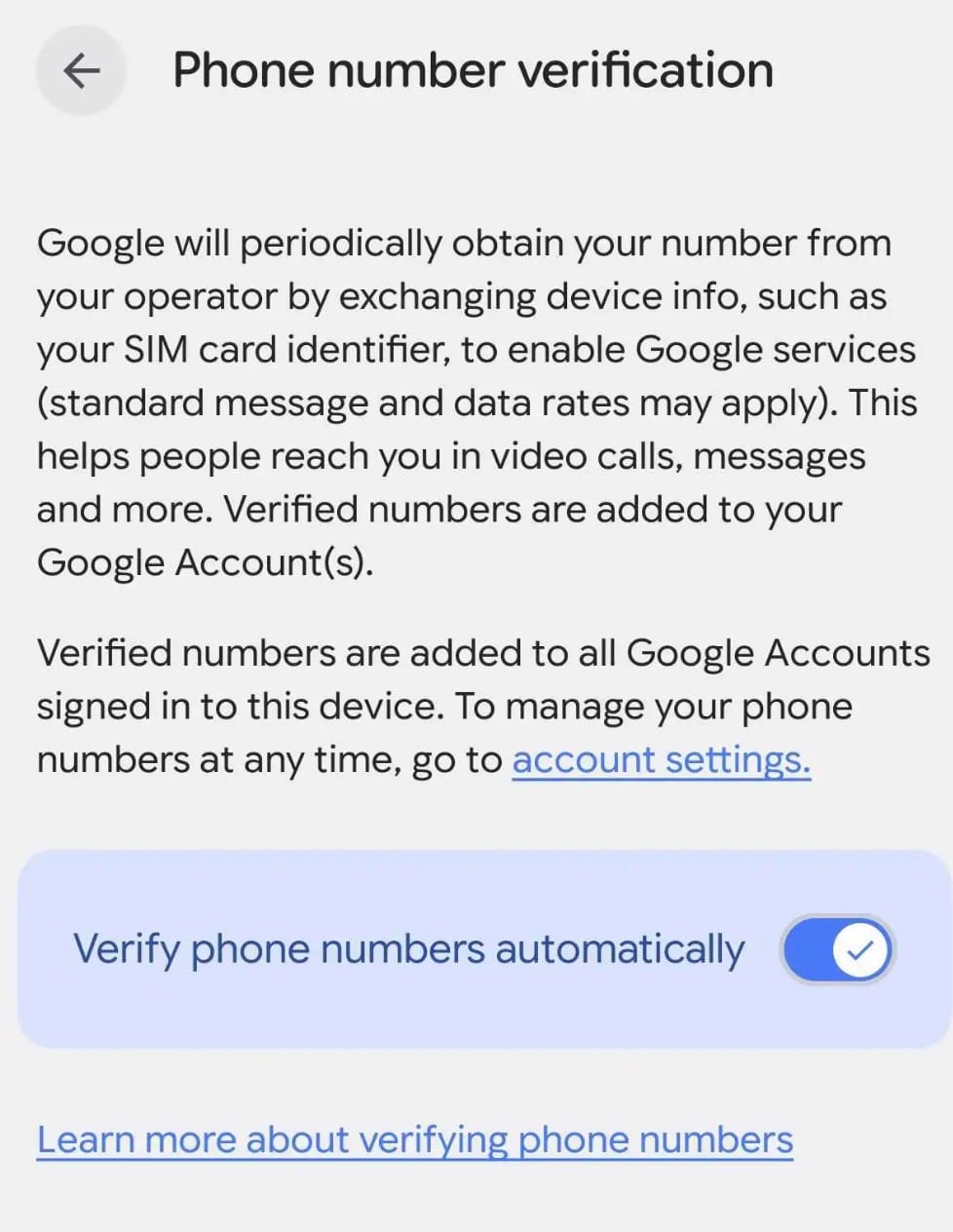
This has been happening thanks to a setting called "Phone number verification," which is switched on by default.
Even if a user turns the setting off, it will only stop future linking of accounts and phone numbers. The numbers that have already been attached to accounts will remain there, and the only way to remove them is to do it manually, account by account.
This has apparently been happening since 2025.
Google itself explains the process on its Android Help page, saying, "On your device, phone number verification is turned on by default. We verify the phone number and add them to all Google Accounts that are signed in on the device."
And: "This applies to both current and future accounts and phone numbers."
The page further explains that "if you add a new Google Account, it links to all numbers on the device. Likewise, a new phone number is added to all accounts."
The only way to manage this is to do it in device settings, Google says, adding, "You can only manage phone number verification in device settings."
A Google Account Help page reveals that "any verified phone numbers for an Android device can be added to any Google Account that is signed into that device."
The page also explains that the number can be used to sign in and to recover an account, and that a "Better ads & Google services" setting "lets your phone number to be used across Google services to show you ads more relevant to you."
In a bid to reassure users, Google adds that it "doesn't sell your personal information, including your phone number, to anyone."
Android Authority writes that the company's support page "was updated sometime between August and October 2025 to add this rather aggressive behavior of turning on phone number verification by default, as well as adding all phone numbers to all Google accounts signed in on the device."
Before that, this wasn't an opt-out feature, the report said.
Android Authority staff checked their phones and found the toggle "quietly enabled across their active devices." The feature affects not only primary accounts but also "secondary profiles, work accounts, and throwaway handles."
The site said that this "poses obvious privacy headaches for anyone who intentionally segregates their primary SIM from secondary accounts."
Kaspersky shared a similar view, noting that "The operating system does not offer built-in tools to separate numbers for different accounts on a single device." And that the system "makes it easier to link multiple phone numbers to a user who has multiple Google accounts."
Kaspersky also warned that "there's no guarantee that any data already collected will actually be deleted."
A user on X, going by the name of A–Lin, said that the problem with this is that "you think a secondary account isn't linked to a phone number, but it actually is. Google will then find it easier to link these accounts together."
Some users on Reddit claim that Google disabled a secondary account after they submitted a phone number, or refused to let them create another account because the number "has been used too many times." But these are unverified claims, and it is not known if they are accurate.
Kaspersky noted that the phone number verification setting "sometimes turns itself back on automatically." A Reddit user reported the same in April, but Android Authority said they could not replicate it.
To turn off the setting, users need to go to Settings, Google, All services, Privacy & security, Phone number verification, and switch off "Verify phone numbers automatically." Then they need to remove the number from each account under Personal info, Contact info, Phone.
However, switching off phone number verification means losing RCS chats in Google Messages.
Reclaim The Net has previously reported about the importance of phone numbers in online tracking, and how they have become "a proxy for identity." We wrote that "The number becomes a bridge between online identity and offline activity, linking disparate datasets into a unified profile."
In 2025, Google paid Texas $1.375 billion over claims it kept tracking locations "despite users believing the feature was off."
The latest revelation about Google's actions is not surprising, given the company's history of using obscure settings and defaults to achieve its goals, but it is particularly egregious because of the purpose many people have for keeping separate Google accounts.
They do it for a reason, but a default setting on Android devices has been quietly joining them with the one identifier that is hardest to change – a phone number.
While there is a way to turn the setting off, it works only going forward. The cleaning up of already linked accounts is left to the user, who has to remove the number from each account, one by one.