In January 2021, two USAID officials, Lorri Anne Meils and Josh Machleder, discussed in a Google chat how their agency’s anti-"disinformation" efforts were effectively letting Big Tech – specifically, Facebook and Twitter – off the hook.
The fix, according to these bureaucrats, wasn’t to stop the government from financing projects that flag content for censorship, but to get the platforms to share the burden and start paying for it, too.
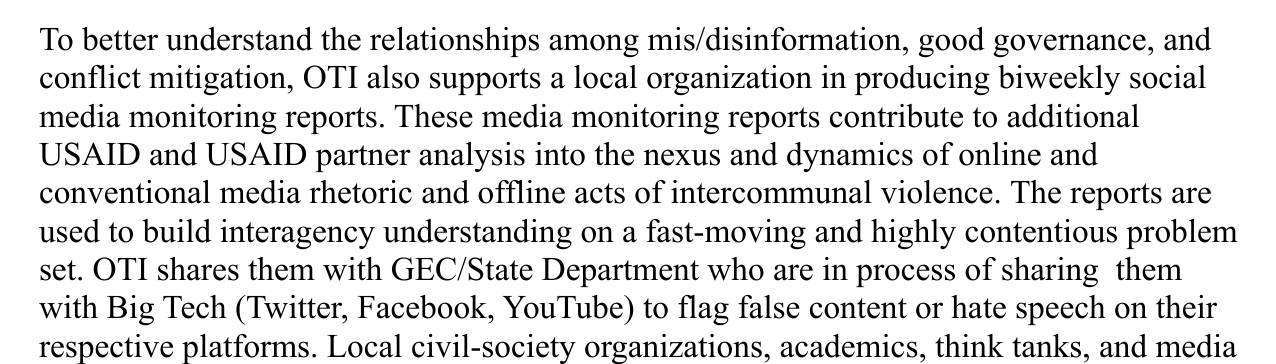
What USAID’s money is used for is to support local organizations that monitor and flag content to major social media platforms, as explained in a February 22, 2022, information memo prepared for the agency’s Administrator. The example given is Ethiopia, where USAID’s Office of Transition Initiatives (OTI) pays a local group for “biweekly social media monitoring reports” – which are then shared with the Global Engagement Center (GEC) at the State Department, and, as the memo has it, “who are in process of sharing them with Big Tech (Twitter, Facebook, YouTube) to flag false content or hate speech on their respective platforms.”
Another example is Ukraine and Moldova, where USAID’s work “enabled troll-hunting organizations to report more than 200 inauthentic accounts to Facebook, which later disabled these accounts.”
A one-pager for the "Friend or Foe?" program, piloted in Kenya in 2018-2019, states that its goal was to "counter disinformation efforts and support independent journalism through improving the signals that drive algorithmic decision-making in online platforms and that moderate or censor content." The program was carried out by Article 19, Meedan, NDI, and Graphika. The same document touches on the fairness of this work, noting that “the removal of legitimate and credible information” is a concern.
The conversation was part of the USAID Files released on the agency’s website in November 2026. The chat took place on Sunday, January 24, 2021, when Meils asked Machleder to help her come up with an “if asked” answer for a “murder board” they were preparing for a principal (who is never named in the chat).
Her premise was that “our work basically lets FB and Twitter off the hook for supporting these matters” and “forced the tax payers to bear the burden.”

Machleder’s response was to suggest that USAID work with the companies to make them pay more, rather than stop using taxpayer money to fund these projects. He wrote, “maybe suggesting a GDA or other way that US taxpayers aren’t completely footing the bill” – and added, “for the damage they cause.”
GDA stands for Global Development Alliance, a public-private partnership model that USAID uses to collaborate with private entities. Meils responded with “i LOVE a GDA”.
The chat does not mention the principal by name, and it’s not clear whether the cost sharing answer was ever used, or if a deal with Meta was ever signed at the terms mentioned in the documents. The two staff members were not whistleblowers in the sense that they wanted to stop the anti-disinformation work, but rather make sure that social media platforms pay more for it.
As Meils put it, “there needs to be some way higher leverage to squeeze cash out.”
The two officials were also under the impression that the platforms were giving only token financial support – $250,000 donations. She called this “bananas” and “totally extractive.”
Machleder’s contribution to the chat was to add that USAID “can and should consider burden-sharing arrangements with social media platforms to address these harms by financing activities to mitigate them.”
An undated draft confirmation Q&A prepared for a nominee - with a note in the margin saying it was "assigned to Joshua Machleder" - shows that the idea of making the platforms pay was developed into a potential answer to be given at a hearing.
The answer that was drafted is: “I believe it is important to cost-share with social media, and will explore such arrangements with social media platforms to address harms to democracy and human rights through jointly-financed activities to mitigate them.”
This included providing “cutting edge tools and skills to provide actionable data for social media platforms, such as Facebook” as well as “situation rooms” to monitor these platforms during elections.
The memo states, “USAID believes it should co-own foreign disinformation efforts because it overwhelmingly owns the relevant programming by dollar amount.”
The document reveals that USAID’s media-related programs in Ukraine alone had a budget of $60 million, including money spent on content monitoring.
Ahead of Power’s confirmation hearings, briefing notes said, “we need more resources given the scale of the crisis.”
A data sheet compiled in May 2021 with Machleder among the contributors, details some of the activities and their cost: $24.7 million for the Ukraine Transformation Communications Activity, implemented by Chemonics, described as promoting “alternative narratives.”
In Georgia, a $7.5 million program implemented by Zinc was set up to map disinformation sources and spread counter-messages. In Indonesia, USAID paid for custom software to find “socially harmful content.”
The data sheet doesn’t provide a reliable total of how much the anti-disinformation work costs, as it contains a mix of project ceilings, partial information, and blank spaces.
The data sheet does show that most of the activities are geared towards supporting journalism and media development, as well as media literacy. The memo from February 2022 states that the goal of the work is to build resilience “rather than engage in information/psychological operations.”
The goals for 2023, as stated in one of the documents, are to “reinforce tech partnerships with Google, Meta, and Microsoft to address information manipulation and other safety issues.”
There’s no mention of these companies paying a share of the cost – rather, USAID said it was looking for a new mechanism to fund activities with a ceiling of $20 million.
The documents also show that while the initial idea was to make the platforms pay more, at least in 2022, USAID was happy to partner with Meta (Facebook) on a digital literacy project in Indonesia, where the company would contribute less money than the agency.
In the first year of the activity, USAID was to contribute $250,000 in cash, while Meta would give $70,000 in cash and $180,000 “in-kind.” In the second year, USAID’s contribution would remain the same, while Meta’s cash contribution would rise to $100,000, and in-kind contribution to $150,000.
In the past, Reclaim The Net covered USAID's "Disinformation Primer" documents, the agency's extensive media empire, and the model used in Georgia to get accounts taken down, as well as trusted flaggers that nobody can audit.
It was not the fact that the US government was effectively using taxpayers’ money to fund the work of organizations that flagged content to Big Tech that bothered these two officials. The issue was that the platforms were not chipping in enough.