Six weeks after Elon Musk bought Twitter, Google told a room full of US government counter-disinformation officials that the company might reconsider how it treats Twitter in its search if the social platform handled moderation differently around elections.
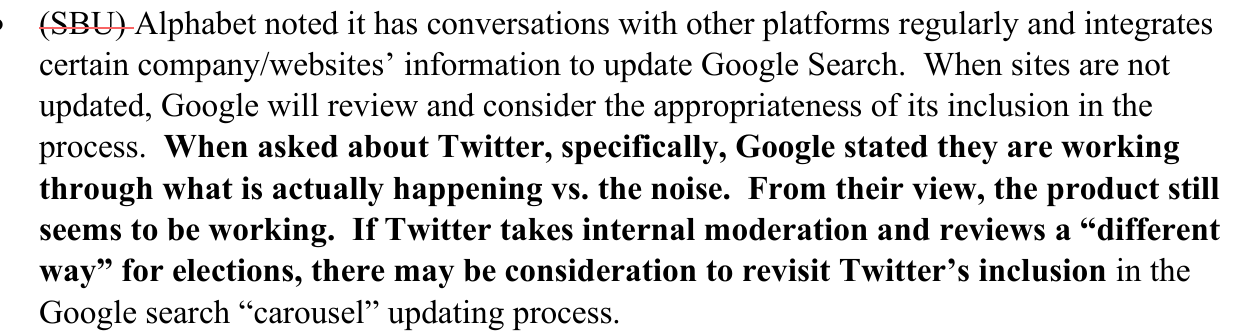
“When asked about Twitter, specifically, Google stated they are working through what is actually happening vs. the noise. From their view, the product still seems to be working.”
The company then added that if Twitter were to handle “moderation and reviews” of content differently during elections, that might prompt Google to “revisit Twitter’s inclusion in the Google search carousel.”
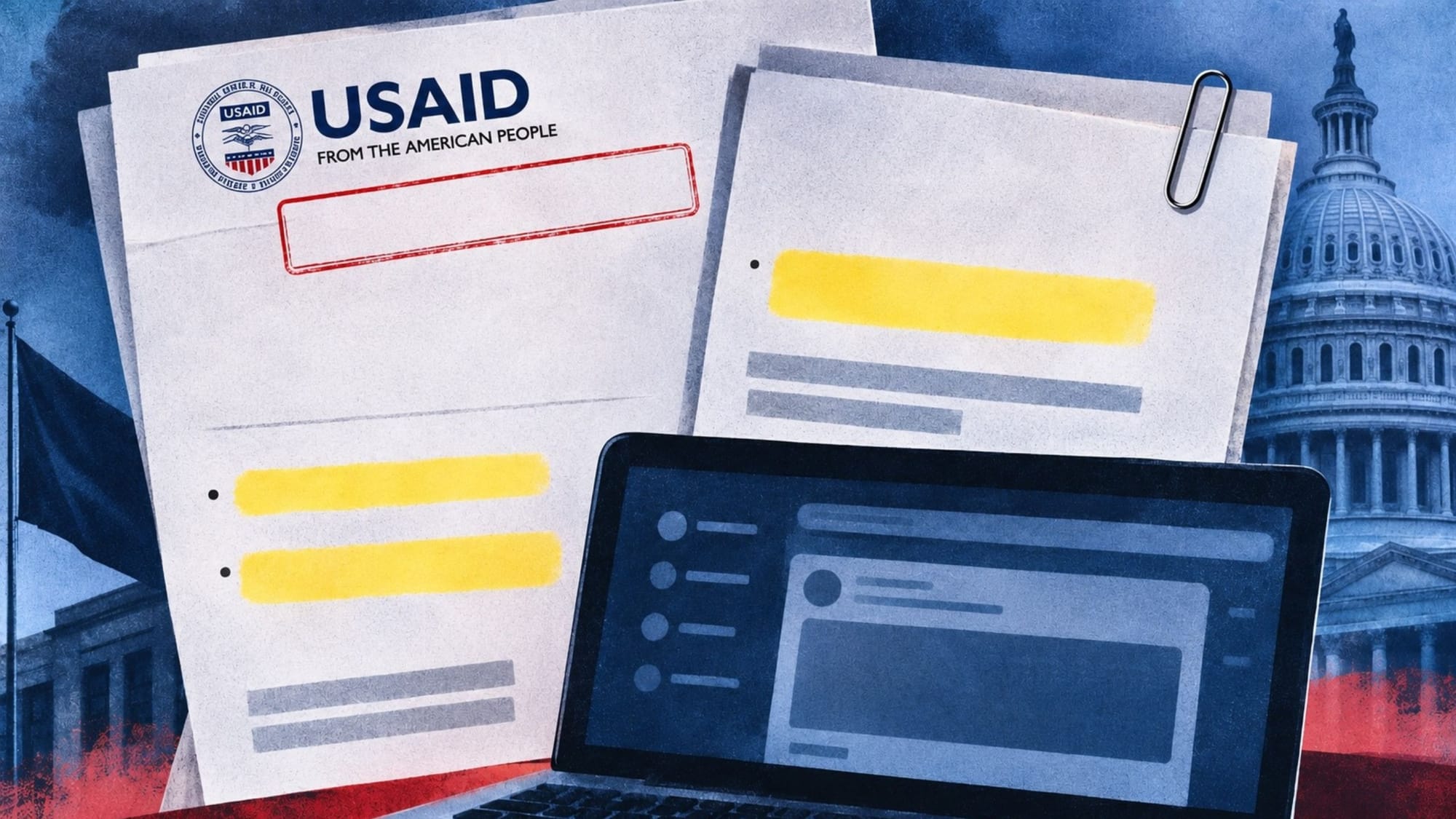
The meeting was held on December 7, 2022, in the State Department briefing room. The documents that show this come from the USAID Files published this month and include a State Department memo marked “SENSITIVE BUT UNCLASSIFIED”, as well as emails and a USAID question sheet with Google’s answers.
The memo was written by the State Department’s Global Engagement Center (GEC) and is based on notes from the meeting that are described as State’s record of what Google said, not a transcript. The meeting was attended by Google’s Trust & Safety VP Laurie Richardson and TAG director Shane Huntley, while the State Department had representatives from a dozen of its bureaus there, as well as USAID’s Vera Zakem and an unnamed person from the Department of Homeland Security (DHS).
The memo does not reveal who asked the question about Twitter, and there is no record of any official in the meeting asking Google to take any action against the platform. The meeting was held six weeks after Musk’s acquisition of the company was confirmed, on October 27, 2022.
Nothing in the newly published documents shows that Google ever followed through on what it said regarding Twitter, and the memo does not clarify what “carousel” means in the context of Google Search. Twitter’s new owner was not named in the documents.
“Alphabet noted it has conversations with other platforms regularly and integrates certain company/websites’ information to update Google Search,” the memo said. “When sites are not updated, Google will review and consider the appropriateness of its inclusion in the process.”
When it came to Twitter, the issue was not its freshness – but rather, how it handled moderation and reviews around election time.
The notes were taken by the State Department’s Global Engagement Center – which has been in the news before as the government entity that had flagged thousands of accounts to Twitter – and which was eventually shut down in December 2024, as we covered.
We previously covered earlier USAID Files pieces: the existence of an inclusion list that the State Department opposed, and efforts to keep Big Tech’s work with the government out of the media.
Google’s position is that “gray area speech, which can ultimately be harmful, is very difficult to address with specific policies, however, making authoritative voices and content critical.”
The company also revealed that it relies on “third parties that can support and corroborate results or information” – and that these are “critical to Alphabet’s Trust & Safety infrastructure.”
Google is also working on automating more of its moderation, in order to “scale response to disinformation and amplify authoritative content.”
As for the 2024 US election, Google is concerned that “if the Associated Press was unable to call an election how can that information be validated?”
The documents also show that Google’s TAG unit identifies and traces “threat signatures” and hands them over to Trust & Safety, which then acts on content that is linked to these “signatures” – even if that content is in the “gray zone.”
This is how Google explained it: “This helps Alphabet refrain from having to review each video; clips where the content may fall in a gray-zone, but the signature is linked to threat actors, is critical to scaling and addressing possible platform abuses.”

The process of determining what a “signature” is and how it is linked to “threat actors” was not explained.
In a background note, the memo mentions that TAG “terminated 76 YouTube channels as part of an investigation into coordinated influence operations linked to Brazil.” The note does not say if this was brought up during the meeting or requested by any of the officials present.
The meeting also heard that Google “saw fewer threats (focusing on foreign only) than expected during the 2022 U.S. and Brazil elections,” but this has prompted the company to come up with “comprehensive policies and new tools/levers to address mis/disinformation.”
As for the meeting with the State Department and USAID, it was not a one-off. The documents show that there is a “standing monthly call” between the government and YouTube/Google.
In an email sent on November 10, 2022, YouTube’s Josh Blumenfeld reached out to USAID to offer a briefing on “misinformation and raising authoritative content, and how proposed reforms to Section 230 could impact these efforts.”
In another email, this one sent in May 2022, USAID asked Google to name a contact who could help escalate review of content that undermines human rights and safety. Google named Ria Strasser-Galvis, who was also present at the December 7 meeting.
At the time, Google also told USAID that it would “only assess and/or take action on concerns they raise based on our existing policies and procedures.”
Google also asked for more meetings – “such an event held with Seniors quarterly would be great” – and proposed a “red teaming/threat ideation/hackathon collaboration between State, USAID, and Alphabet.” The documents do not show if either of these ideas was accepted.
In the wake of the meeting, GEC’s Alexis Frisbie sent a readout of the meeting to USAID’s Vera Zakem, who then forwarded it to ten of her colleagues on December 13, saying, “I did ask Google to follow up with an updated list of countries they are focusing for 2023 and 2024.”
Zakem had previously worked at Twitter, and in July 2022, she reached out to the social platform to say, “As a former Tweep, and now in my new role in the admin and at USAID, I’d love to connect.”
In the same email thread, a USAID colleague asked Twitter, “What are the processes/timelines for content to be taken down or persons to be taken off?”
The documents show that Google already has “priority countries/regions of focus for Alphabet in 2024” – and that these include the US, the European Parliament, and India. “Alphabet is already in preparation mode for these elections,” the memo reads.
However, the fact that a social platform’s different moderation might affect its search engine ranking – and that this is something Google would even mention in a meeting with government officials – is significant.