
Documents published on the USAID website show that an email from an Office of the Director of National Intelligence (ODNI) official introduced the Global Disinformation Index (GDI) to USAID in June 2022.
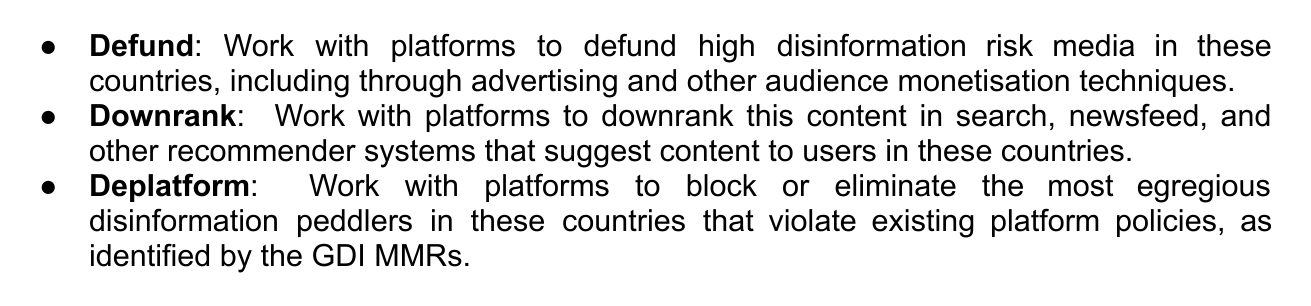
Just weeks later, USAID gave GDI a list of 10 countries to focus on and GDI came up with a plan to "Defund," "Downrank" and "Deplatform" local news outlets that would be marked as high risk for "disinformation" based on private site-by-site risk ratings that GDI would provide to USAID.
These and other documents, which include a concept note, a call for partners, and a slide deck, are available on usaid.gov.
They show that the US intelligence official sent the introductory email to GDI's Danny Rogers and Clare Melford on June 10, 2022. The official's name is redacted in the email, but the signature block reads "Office of the Director of National Intelligence."
The email said, "I'm writing to introduce my friend Johnny Walsh, DAA for Democracy, Human Rights, and Governance at USAID."
The official described GDI as "the best organization I know working on the commercial, for-profit side of the disinformation challenge," and said that USAID was building "a portfolio around countering disinformation."
"At a minimum they should be aware of the capabilities you have and hear your theory of the case for how to reduce the pernicious spread of political disinformation," the email reads.
Three days later, on June 13, Walsh replied to the email to add Vera Zakem, "our new Senior Advisor for Tech and Democracy and overall lead on disinformation."
Zakem wrote that she had "followed your work closely over the last couple of years," and Melford responded by saying that GDI would be "very interested to hear more about how USAID is thinking about the challenge also."
Walsh writes, "Here are the 10 countries we particularly have in mind as homes to promising democratic openings, that need help before they backslide."
The list includes Zambia, Malawi, Tanzania, Dominican Republic, Ecuador, Honduras, Nepal, Maldives, Moldova, and Armenia.
Walsh asked GDI to come up with “a one-pager on whether/how we might collaborate to help them.”
Rogers replied that they would "put together a concept note focused on the countries you outlined, so thank you for the list."
This note was prepared in August 2022, and it details how GDI would conduct six-month reviews of news sites in Moldova, Zambia, and Armenia.
The output would be "Risk ratings per site that can be shared privately with USAID (as well as with licensees of GDI's data)" - and a public report.
The plan to "Defund", "Downrank" and "Deplatform" these outlets is explained as follows: "USAID has indicated that its growing relationships with the large online platforms, including Alphabet and Meta, offer an opportunity to take action in these three countries based on the data that GDI's MMRs produce."
The note then spells it out: "Defund: Work with platforms to defund high disinformation risk media in these countries"; "Downrank: Work with platforms to downrank this content in search, newsfeed, and other recommender systems"; and "Deplatform: Work with platforms to block or eliminate the most egregious disinformation peddlers in these countries."
GDI's "Dynamic Exclusion List" is "embedded in the systems of thirteen global ad tech companies, including IAS, Peer39 and Oracle."

The concept note also reveals that GDI defines disinformation as "adversarial narratives" by which actors "seek to delegitimize governments, principles, practices, and policies."
In other words, criticism of a government can be branded as disinformation and punished by being defunded, downranked, and deplatformed - and the ratings that determine this would not be publicly disclosed, but shared "privately" with USAID, and presumably other licensees of GDI's data.
The August 2022 concept note for USAID has a footer that reads, "a company limited by guarantee in England & Wales".
Documents published by USAID also include a 2023 call for partners that GDI issued, which states that the first pilot of the company’s risk ratings was in 2019, and assessed news domains in the UK and South Africa.
The countries that GDI was looking to expand to were listed, with European ones starting with "The United Kingdom."
GDI's stated mission is "to catalyse industry and government to defund disinformation."
The organization also claims that its method is "not an attempt to identify and label disinformation sites or trustworthy news sites."
It does produce "risk ratings" that determine which outlets should be defunded, downranked, and deplatformed.
The call for partners also reveals that GDI pays a "research honorarium of approximately USD20,000" to those who work with it.
Another email in the USAID files shows a mailing list tagged [ACAN], where a video of UK satirist Jonathan Pie talking about "Londongrad" was shared.
One of the recipients, Nate Sibley, then made a claim about Pie's past (that we have not verified and cannot state as fact).
Rogers replied to that by saying, "I had no idea - what an insidious world, wow."
USAID’s Meral Karan sent an email on January 13, 2023, saying, “They came in and met with us a few months ago – would be interesting to connect back with them again.”
The reason for the email was that a USAID adviser at U.S. Special Operations Command (SOCOM) had sent her the call for partners GDI had issued.
A slide deck in USAID’s files shows Rogers pitching to the agency “Policy Interventions to Counter Disinformation.”
The suggestions include antitrust, privacy regulation, and platform liability reform. One of the slides is dedicated to Section 230 of the Communications Decency Act, which “essentially makes internet platforms immune to legal liability for both the content that users post and the decisions they make to remove that content.”
“Fact checking is not enough,” the slide says, adding that the platforms “remain legally immune” and that their algorithms “amplify conspiracy theories.”
It is not clear from the documents whether USAID ever paid for any of the services GDI pitched to the agency. A search for GDI on USAspending.gov did not produce any results, and no published reviews of news sites in Moldova, Zambia, or Armenia were found.
GDI describes itself as "steadfastly bipartisan" and committed to "neutrality" - but the activities described in the USAID documents, as well as some of the email exchanges, suggest that the organization's "theory of the case" is that of working with governments, as well as tech platforms, to "defund disinformation" - as it defines it.
We have previously covered GDI for receiving a $100,000 grant from the US State Department's Global Engagement Center, for paying a public college to produce an online blacklist report, and for facing scrutiny over its ties to government.
In December 2025, the US imposed visa restrictions on several individuals around the world accused of involvement in censorship - including Clare Melford.
GDI is the group that runs blacklists that are used by corporations to decide which news outlets to advertise with, and which to shun. In other words, it provides a private service that can be used to censor media outlets – but this time, the service was offered privately to a government.