A US government aid agency, USAID, came up with a plan to have Google and YouTube treat a list of handpicked media outlets more favorably in search, recommendations, and ads.
This was revealed in a USAID planning paper, "Big Tech Engagement Action Plan", published this month among the USAID Files on the usaid.gov website. The document reads like a draft, with empty action sections and tracked changes.
The paper's Key Recommendation 1 is that tech companies implement an inclusion list for "verified actors." And, the document says, those lists "should be private and managed in a decentralized manner through trusted third-party implementers."
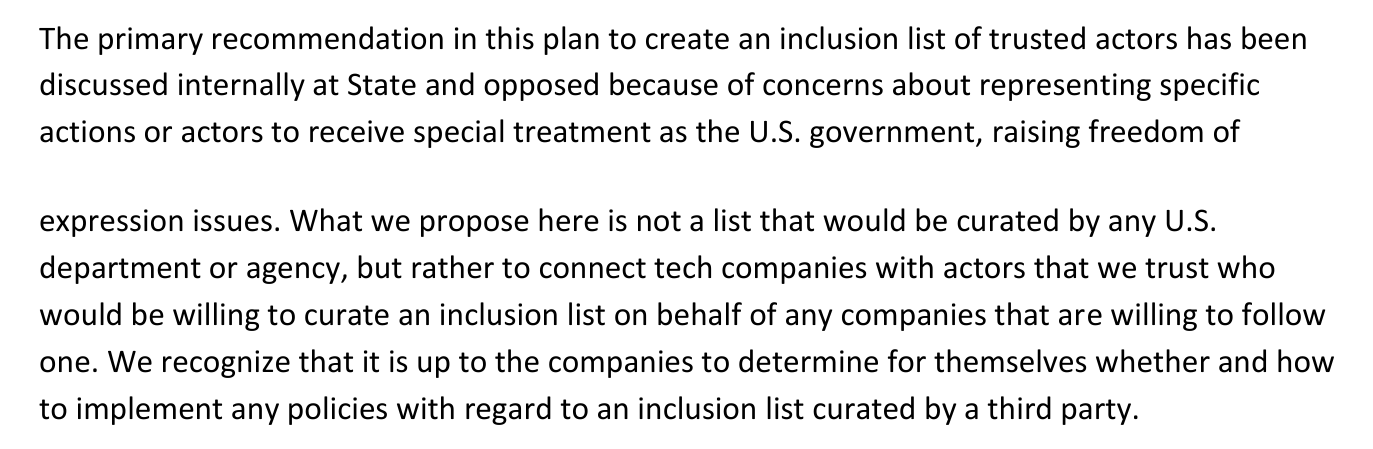
The State Department reacted to this idea by saying it was "discussed internally at State and opposed because of concerns about representing specific actions or actors to receive special treatment as the U.S. government, raising freedom of expression issues," USAID noted.
USAID saw a way to work around this by having an NGO, not the government, hold the list: "What we propose here is not a list that would be curated by any U.S. department or agency, but rather to connect tech companies with actors that we trust who would be willing to curate an inclusion list on behalf of any companies that are willing to follow one."
The State Department also wanted USAID to discuss the plan with the National Security Council (NSC) before engaging with Big Tech.
The case the USAID paper makes is that independent media and civil society groups in Russia are subjected to Kremlin censorship, but also, as a result of sanctions and US tech companies pulling their services from the country, they lost access to those platforms as well.
USAID's partners "face effective censorship from two sides," the paper says, adding that "denial-of-service policies" do not generally affect supporters of Putin's regime, but "significantly handicap those who oppose the war."
The real problem the paper is trying to address is how to help these anti-war outlets reach their audiences despite the internet blocking.
The plan was to have Google, YouTube, and others treat these handpicked media outlets better in search, recommendations, and ads.
For YouTube, the ask was to let these groups monetize their content even inside Russia, and "buy and publish ads in Russia and target content to users in Russia."
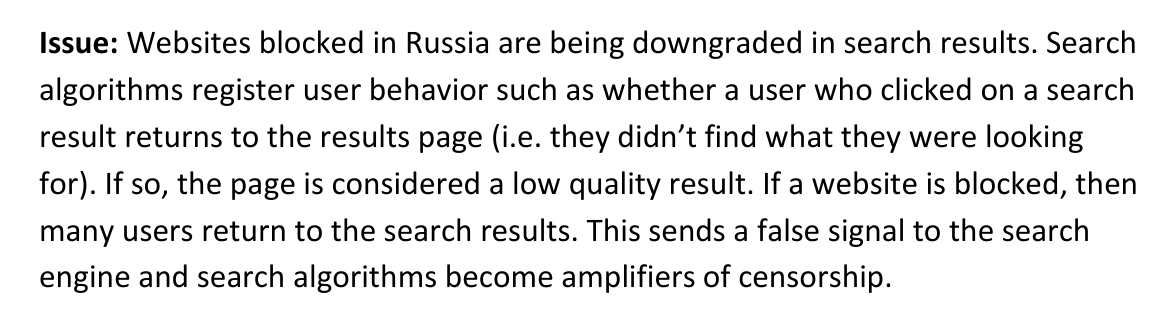
Google was asked to make sure its search algorithms do not downgrade blocked sites, because when users cannot access them, they bounce back, and "search algorithms become amplifiers of censorship."
Meta was asked to review its recommendation algorithms and "minimize the possibility of shadow bans for the organizations on the inclusion list."
MailChimp, Slack, SSL certificate authorities, and TechSoup were also on the list of companies that should keep serving groups "on the inclusion list."
The paper does not only ask for a list that would give a boost to some, but also for algorithms to be tweaked to downgrade others. For example, Google is asked to "review recommendation algorithms to ensure they do not promote pro-war or government controlled content."
Later in the paper, the language becomes even stronger, asking Google to "review the algorithms so that they would demote pro-war" content "and/or government controlled content."
"Implement an exclusion list that Google Discover can use to avoid recommending domains that are sources of propaganda."
The paper does not explain how any of this would be consistent with the free expression concerns that the State Department raised when the idea of a list was first discussed.
Another document, this one a prep note for a planned January 2024 meeting between USAID head Samantha Power and YouTube CEO Neal Mohan at Davos, shows that the idea of an inclusion list was still alive.
The note asks Power to inquire if Google would allow groups on this list, "created and managed by an independent and trusted press freedom NGO like Internews," to buy and publish ads inside Russia, and target content to Russian users.
The note also asks if Google would make sure that pages belonging to entities on this list are not downgraded in search results. Internews, a USAID-funded media NGO, is named here as a possible holder of the list, but the document does not say if it agreed to that role.
In a spring 2022 call between USAID and Google staff, USAID asked Google how it could "streamline feedback from across U.S. departments / agencies, particularly on issues of concern?"
Google replied that it uses systems to "uprank content to surface authoritative information and then downrank less authoritative information." USAID also inquired if "certain vetted partners" could be allowed to monetize their content on YouTube inside Russia, but was told that the company was "not making exceptions."
In January 2024, YouTube CEO Mohan met with USAID officials and told them that sanctions were the reason the company could not monetize Russian traffic, "there was no way around this."
Mohan also said that what was more important than content moderation was YouTube's way of "raising/elevating content from legitimate and veritable sources."
Nothing in the documents shows that Google or YouTube agreed to create or follow an inclusion list.
We previously covered USAID’s media funding network in a February 2025 piece looking into the agency’s media funding. We also covered Internews and its government funding in February 2025, and the Global Disinformation Index ad blacklist that was accused of political bias in February 2023. In 2020, we covered Big Tech’s practice of boosting so-called authoritative sources.
The problem of censorship and the need to support those suffering under it is real – but the solution cannot be to create more of the same problem, just with a different list, and a different gatekeeper.