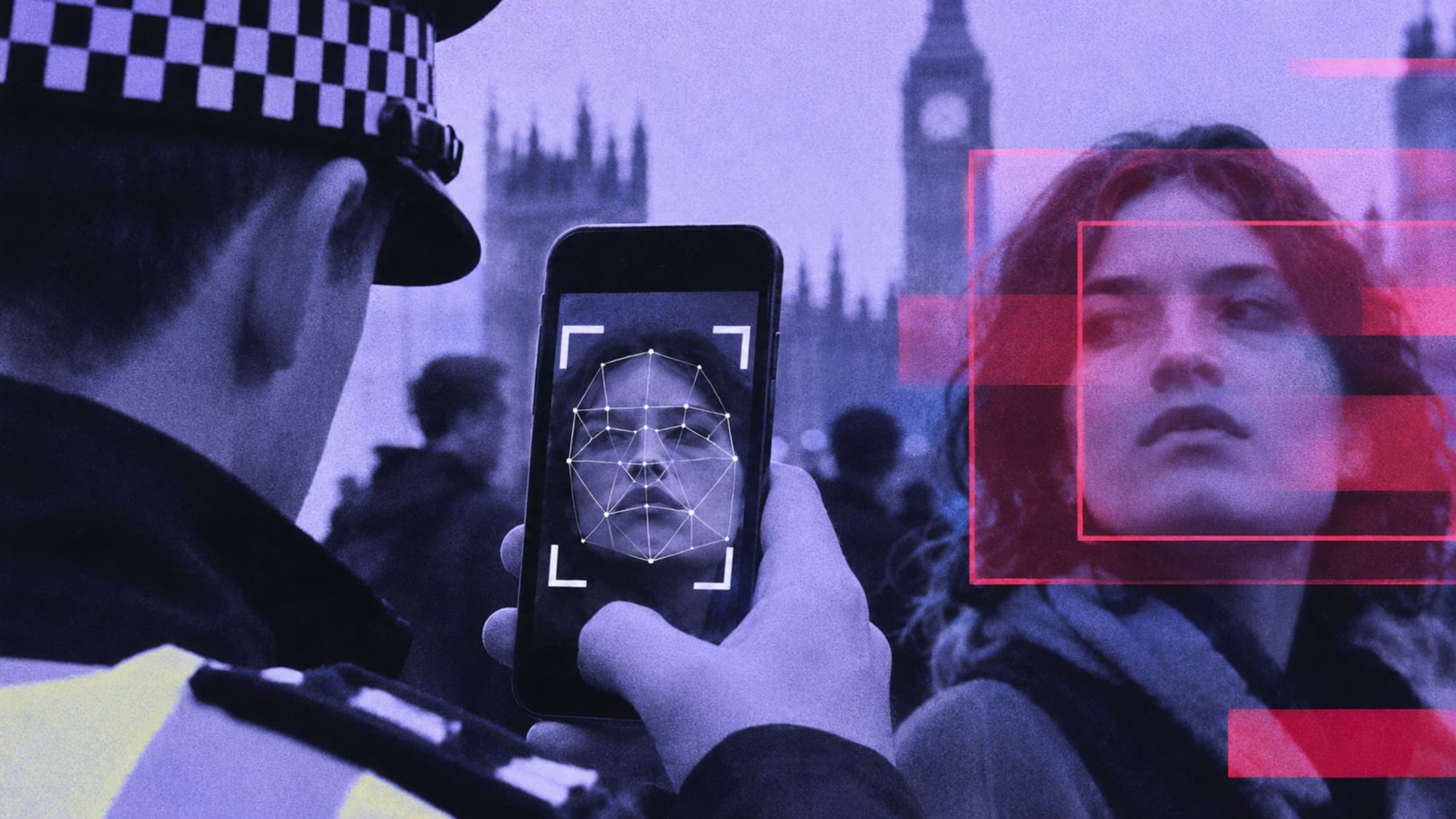
The London Metropolitan Police has started a six-month pilot of what it calls Operator Initiated Facial Recognition (OIFR). This means that 100 trained officers will be using a phone app to take photos of people during their shifts, both on the street and in custody suites.
The app will then compare the face in the photo against the Met's database of custody images (mugshots of people who have been arrested). This is not the first time Londoners have been subjected to facial recognition, but this time the technology is in the hands of individual officers.
Previously, it was used in fixed cameras or vans, which is bad enough, but this is a much more insidious, and from the police point of view, convenient way to deploy the highly controversial biometric surveillance method.
The police will seek "real and informed consent" for taking a photo, but it's not like anyone can say no: the policy states that a refusal does "not of itself prevent the taking of a photograph."
Refusing to cooperate may not result in arrest or detention "in isolation," but it may, the policy says, be one of the factors that lead to that outcome.
The Met is selling this as a way to "identify wanted offenders more quickly, protect vulnerable people and alert officers to known risks, such as a history of knife possession," as Commander Nick John put it.
The policy spells out a much wider range of scenarios where people can be photographed on the street, including those suspected of committing a recordable offense, those breaching bail or court orders, those seen as a national security risk by counter-terrorism officers, those who are "vulnerable" or at risk, and those who are "deceased, grievously injured or unresponsive."
The Met's press release announcing the pilot mentions only two scenarios: people unknown to the police who are suspected of committing a recordable offense and refuse to identify themselves, or those who are believed to have given false details. The second scenario is people who are arrested or detained. The example given is that of a drunk woman who was walking into traffic and could not identify herself.
The policy also reveals that people's privacy rights will be interfered with, and that officers are to "proceed on the basis that there is always some interference with the subject's privacy rights."
The police will only have to tell people that they are taking their photo, and that it will be used for OIFR, "wherever reasonably practicable" - and if that is not possible, they can inform them afterwards. People in their homes or private vehicles must be informed first.
The privacy section of the policy does pay lip service to "a chilling effect on the willingness of some individuals to take part in a lawful assembly," as well as places of worship, but it's unclear how the Met plans to act on this.
The database that OIFR searches is that of custody images, which is problematic in and of itself, as it is known to contain pictures of people who have not been convicted of any crime, but were simply arrested.
This is a long-standing issue: in 2012 the High Court ruled that police were unlawfully keeping photos of people released without charge, but a 2021 report by biometrics commissioner Fraser Sampson found that forces continued to "retain the vast majority of their custody images indefinitely, regardless of whether the individual has been convicted of an offence."
The Met's policy states that custody photos of children between the ages of 13 and 15 can stay searchable for up to 10 years.
The Met’s facial recognition lead Lindsey Chiswick said in December 2025 that photos of people with no match would be deleted “straight away.”
The photos taken by officers will be deleted within 31 days if there is no match, the policy says, but during the pilot, data will be kept for testing, and for up to 30 days after the six-month period is over.
The handheld OIFR is now being tested in a pilot run by the Met, but the force has already used live facial recognition at a political rally for the first time in May, while in October, the British Transport Police revealed the results of its six-month live facial recognition trial at London stations, with dismal results: 537,697 people scanned, one alert - and that was a false one.
In April, the High Court dismissed a challenge to the Met's use of live facial recognition, brought by two campaigners, and the policing minister subsequently announced a national rollout.
In March, the Lords voted down an amendment that would have prevented the DVLA driving license photo database from being used for facial recognition searches.
The proliferation of facial recognition is not limited to the UK, or Europe. In Canada, the Edmonton police force has been using body cameras to scan people's faces against a watchlist of about 7,000 people - and the force's own assessment of the technology has been that it is "proactive surveillance."
The Home Office responded to a consultation on the matter in November, saying that the government intends to introduce a new statutory framework, and create a single oversight body to keep an eye on the police use of biometrics, facial recognition, and similar tech.
The Home Office has not yet come up with the rules that would govern police use of facial recognition, but the Met is not waiting for that.