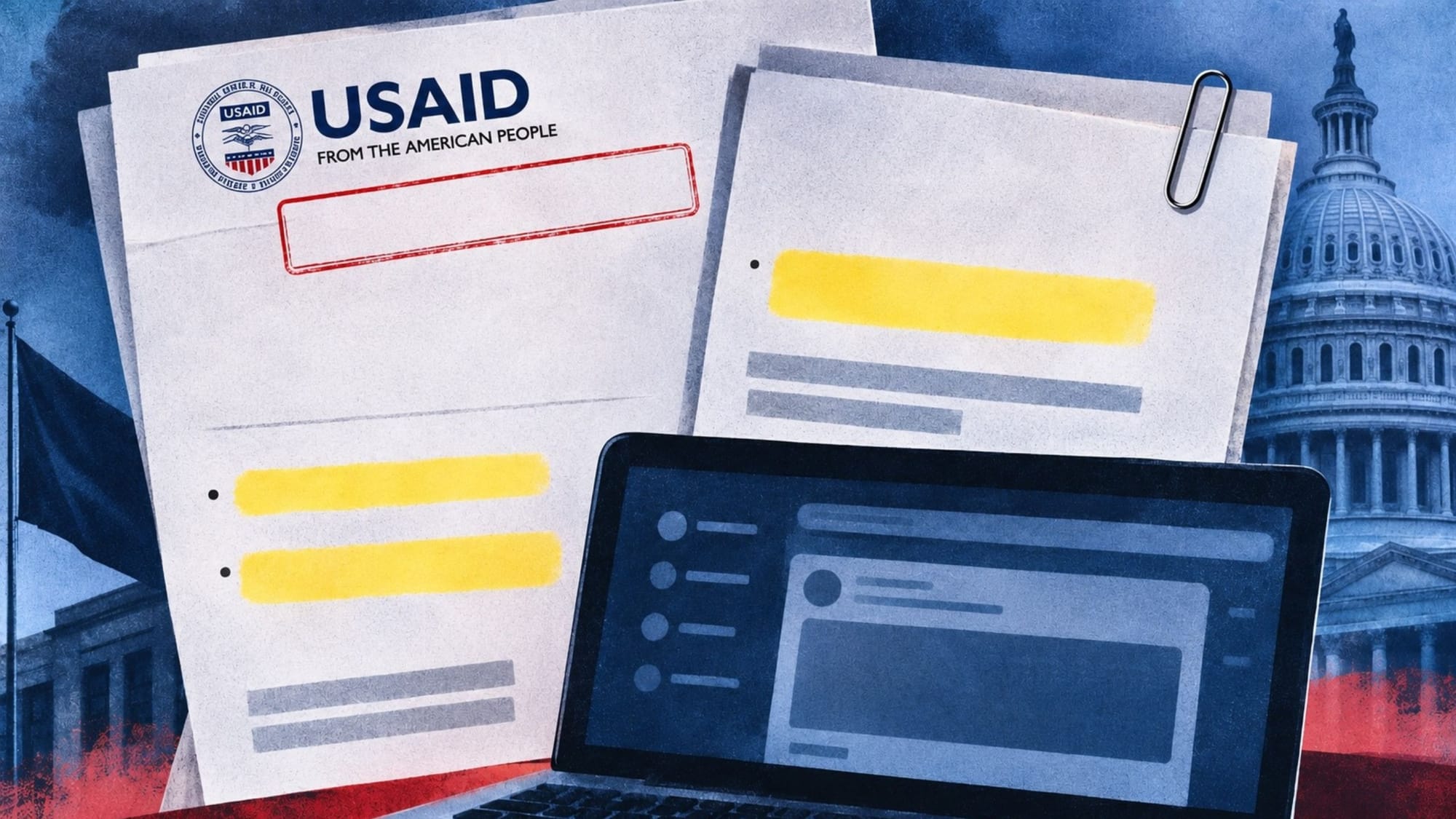
A trove of internal USAID documents reveals that while courts were considering whether government pressure on social platforms to censor content was lawful – and in the wake of a Supreme Court decision in June 2024 that went in favor of the Biden administration – the agency’s lawyers were advising staff on how to continue to work with those companies on content while managing the risk of disclosing these activities.
They were well aware that the way they were doing it might look like coercion.
The documents are part of the “USAID Files” release on the agency’s website. One is a staff presentation given by Chioma Ayogu, the acting Assistant General Counsel for Africa.
Ayogu’s presentation on July 8, 2024, advises staff to “keep it factual” and “keep it out of the Washington Post.”
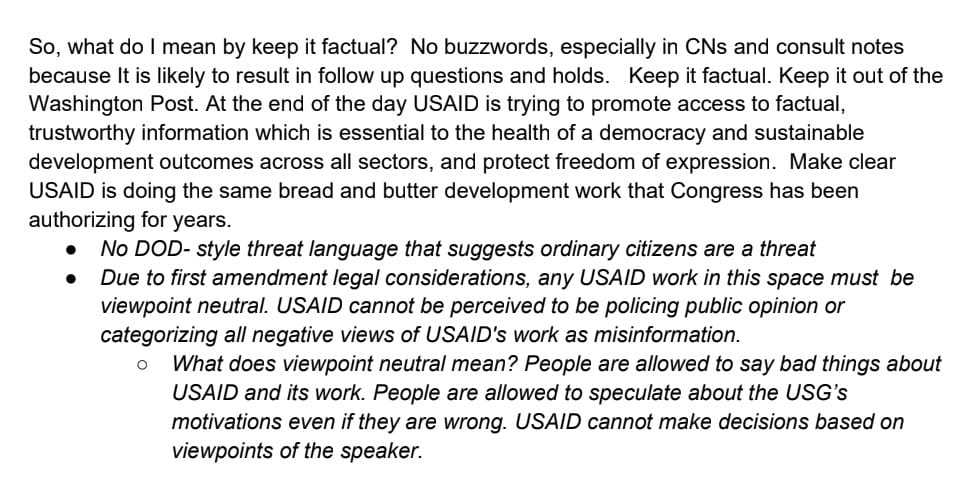
The context of this advice is the need to avoid any more congressional scrutiny of the agency’s activities than was already present at the time, as “information manipulation remains a hot topic with a lot of Hill scrutiny,” the presentation states.
Ayogu also refers to an injunction issued in Missouri v. Biden, which, while not naming USAID, was broad enough to include the agency as it worked with the State Department. The injunction barred federal agencies from pressuring social media companies to suppress what is described in the documents as “protected free speech.”
Ayogu instructed USAID staff that after the Supreme Court’s decision in Murthy v. Missouri, which was based on the plaintiffs’ lack of standing but did not address the merits of the case, the previous guidance “still applies as is for now.”
The Murthy v. Missouri ruling was on June 26, 2024, and we covered it at the time, noting that the Supreme Court had sided with the Biden administration in the case that was trying to establish that it was unconstitutional for the government to pressure social media to censor speech.
The ruling did not bring any clarity on the issue of the government’s involvement in censorship, as it was made on the basis of the plaintiffs in the case not having standing.
Staff were told to write emails and chats as if they expected them to be made public through a Freedom of Information Act (FOIA) request or a Hill inquiry, and that the default was disclosure. The goal was to avoid any “buzzwords” that could trigger follow-up questions and holds in congressional notifications.
Another talking point that staff were given was to make sure they were cleared by lawyers, as this “provides you all with some top cover if there are Hill inquiries or FOIA requests.”
Earlier talking points, after a letter from Congressman Jim Jordan was picked up by the Washington Post, were more direct: “Only write things that pass the Washington Post Test.”
Other instructions in the same vein were to avoid writing “this is too sensitive to discuss over email” and, “If in doubt, pick up the phone.”
As for working with Meta, USAID staff were warned that if several offices “called Meta to the carpet over the same trusted partners program over the past few months it helps fuel the narrative” – “USAID says it is not coercing tech companies, but do its actions say otherwise?”
The document then refers to the 2024 appropriations act, which requires that programs implemented by the agency abroad must counter “foreign state and non-state actors abroad” – and that simply countering “information manipulation in general” was not good enough.
An FAQ document, marked “FOR USAID INTERNAL USE ONLY” and not to be forwarded to implementing partners, and last updated on September 27, 2024, says White House guidance told agencies not to be “dissuaded by litigation like Murthy v. Missouri.”
Staff were told that they now had a greater ability to communicate with social media companies, and that they could make content moderation requests of these companies if they related to USAID staff, activities, or objectives.
The FAQ also says USAID may execute memoranda of understanding (MOUs) with social media companies “to amplify or promote USAID projects or activities.”
Two examples from 2024 show how these guidelines played out in real life.
In the spring of that year, USAID staff wanted to press Meta about under-resourcing and under-staffing of the Trusted Partners Program, and were also unhappy with the company’s response times.
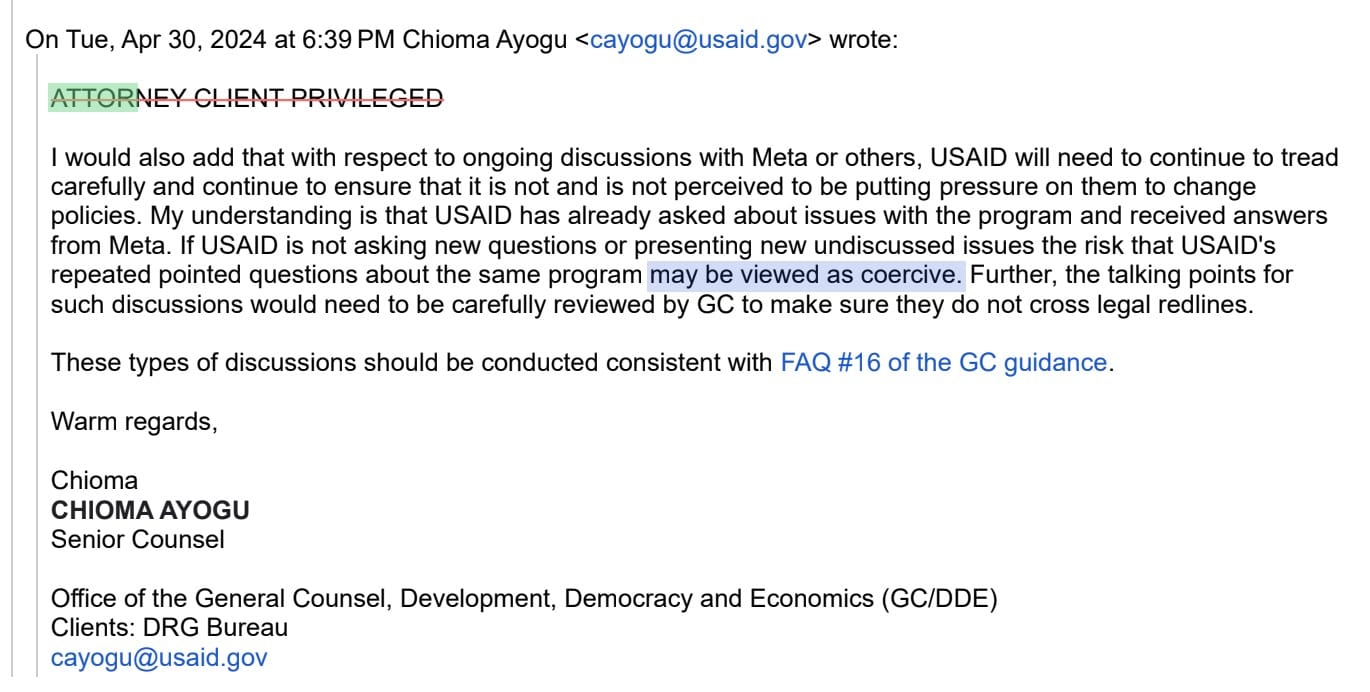
In an email marked “ATTORNEY CLIENT PRIVILEGED” and sent on April 30, 2024, Ayogu warned that repeated pointed questions about the same program “may be viewed as coercive.”
The agency’s Chief Digital Democracy and Rights Officer, Vera Zakem, replied that she was “not comfortable in pressing on this further at this time.”
By May 3, USAID had not followed up on the issue “largely because of GC guidance,” an email from the Latin America and Caribbean bureau shows.
Another example is from June 2024, when USAID’s press office asked for a readout of the Administrator’s meeting with “Meta’s President of Global Affairs.”
The Democracy, Human Rights, and Governance (DRG) bureau responded by saying there should be no public amplification of the meeting, while the press office noted that similar high-level meetings had been read out recently.
Ayogu then raised concerns about a readout, given “Hill sensitivities and the ongoing Supreme Court litigation” – and that it would invite inquiries and scrutiny. The outcome: “we are not doing a readout for this one.”
USAID’s lawyers treated the problem as one of disclosure and optics, rather than one of substance – and the work with social media companies continued.