It’s not just the US elections that the US government is interested in moderating through Big Tech – and it’s not just the way the social media giants’ tools are weaponized in the process that’s the problem – but also, who gets to decide what information is “authoritative,” what voice is “inauthentic,” and who qualifies as a “spoiler.”
All that is already bad enough when it happens in the US, but when the same practice is applied to other countries, it’s even more egregious.
Two draft documents have been published as part of the USAID Files on the agency’s website, showing that the US government was drafting a deal with Facebook (Meta) that would give it access to the giant’s moderation machinery in other countries.
Both documents are drafts. One is headed “DRAFT” and is undated; it says the partnership “would potentially include” the items listed. The other is marked “DRAFT PREDECISIONAL”. Nothing in the files shows a signed agreement. Both were released this month.
Even as drafts, they reveal the intent of the US government to make Facebook an even more effective tool of US foreign policy.
The first document spells out the goal of the partnership as giving “USAID local partners with streamlined access to Facebook tools, training and trusted partner networks that address information integrity and content that has potential to cause harm.”
What would these partners get? Access to “Facebook’s CrowdTangle platform”; “ad credits and toolkits”; referral into Facebook’s “International Fact-Checking Network (IFCN)” program (“receive IFCN certification”), “Trusted Partners”, “Info-Centers.”
The US would also share with Facebook “an annually updated list of countries of concern.”
There’s also a provision for a complaint channel – “Process and point of contact by which State/USAID and its partners can raise concerns and get feedback related to the violation of Facebook’s community values, policies, and terms of service, including inauthentic behavior on the platform.”
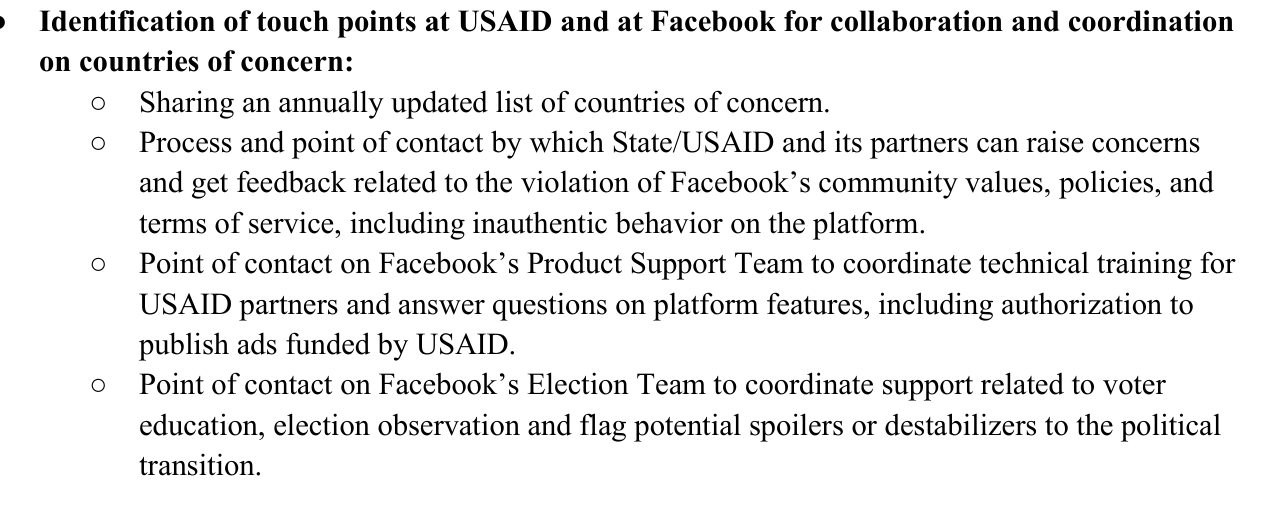
Then there’s the election team: “Point of contact on Facebook’s Election Team to coordinate support related to voter education, election observation and flag potential spoilers or destabilizers to the political transition.”
Note that flagging spoilers is listed in the same breath as “voter education” and “election observation” – all part of the same “coordination.”
The term "spoiler" is not defined in the document, but in peace and transition work, it refers to an individual or a group that seeks to wreck a settlement or transition. The draft agreement doesn't go into who would decide who qualifies for the label, and what Facebook would do with the referral.
It does mention “authoritative content” and “Joint alignment of resources to / investment in local organizations to engage with Facebook to promote authoritative messaging.”
The second document is a planning paper for a “reset” in the USAID-Meta relationship, and is marked as “DRAFT PREDECISIONAL.” The cover note, signed by “Vera,” announces a meeting planned for the last week of September.
Guatemala is mentioned in the context of "engagement around mitigating the use of Meta products in the formation of mass migrant movements (Caravans) and cross-national migrant movements."
This is listed alongside what is essentially law enforcement work: migrant smuggling ("coyotes"), human trafficking, and fraud about work visa programs.
Another request is to have a process to "streamline the referrals into Meta's Trusted Partner Network and Cross Check Program" - and to have a venue to discuss the responsiveness of this network.
There’s a mention of Belarus and Nicaragua, where USAID wanted to organize “Trainings on cross Check, Meta Pro, Fact-checking program.”
In the case of Nicaragua, the document mentions “Coordination tracking troll networks targeting our partners (and doxing removal).”
In a note that appears to come from the lawyers, USAID is advised to “exercise additional caution if talking to social companies about their content moderation” and to “encourage direct collaboration between platforms and partners, so we are not part of the conversation.”

The reason for this caution is that “content moderation referrals are different than content moderation direction” – and “we don’t want to cross the line into a directive.”
Referral to Cross Check is a significant ask: according to a 2021 report by the Wall Street Journal (cited by CNBC), the program "creates special rules for content moderation" for VIP accounts on Facebook and Instagram - 5.8 million in 2020 alone.
Meta's Oversight Board said in a December 2022 opinion that the program "appears more directly structured to satisfy business concerns" and that "because of cross-check, content identified as breaking Meta's rules is left up."
In the past, we have covered how USAID money has been used to fund censorship programs around the world.
Who gets to decide who a spoiler is in a foreign country’s elections or political process? The answer to that should be the citizens of that country, not Big Tech acting on behalf of a foreign government.