A set of documents published on usaid.gov contains a number of internal USAID emails and planning papers.
Some of the documents that have now been made public show that Meta was subjected to pressure by US officials, working in tandem, and that they used the EU’s Digital Services Act (DSA) – a law that has been criticized by free speech advocates as a tool to enable censorship across Europe – as leverage.
One email chain dates back to April 2022, the month the EU reached political agreement on the DSA, and involves then-USAID Administrator Samantha Power and Rob Berschinski, who was at the time a member of the White House National Security Council (NSC).
After reading a note about Power’s trip to Slovakia and Moldova, Berschinski wrote to her on April 16, 2022, to say that he would “double-track your outreach to Nick Clegg in the coming week.”
The topic of interest was “disinfo in Slovakia” – and Berschinski, who was in touch with Meta’s head of security policy, was ready to “push him on the lack of content moderators” – while he and his colleague Anne Neuberger had met the same official “on all things Russia-Ukraine.”

Power was scheduled to speak with Clegg, who was then Meta’s president of global affairs, on April 27, 2022, and she invited Berschinski to join the call; he had also asked for “a readout from your team” if anything came of it.
The day before the call, Power asked her staff to contact a Slovak think tank, Globsec, “tonight to get us their lay down on FB staff in region broadly.”
In the same email, she shared with Berschinski that she saw the EU’s new censorship law as a useful tool to put more pressure on Meta: “Isn’t the biggest game changer the new European law that just passed. Seems to create whole new level of liability for them?”
The DSA was mentioned again by Berschinski, who replied to Power’s email, but also corrected her: the act “hasn’t yet formally passed” – only a political agreement had been reached, while “the text is still being finalized.”
Nevertheless, the NSC official considered it “a huge deal that is going to have significant impact.”
Power’s interest was in knowing how many people Meta had in Slovakia to moderate content in the local language.
Berschinski then got in touch with “my usual contact on Meta’s security team” – and was told that the company had recently made two significant policy changes, but was not advertising them publicly “given that they’re worried about further punitive action from the Kremlin.”
According to the email, under the first policy change Meta “won’t allow governments that have instituted sustained blocks of social media to use their official departments, agencies, and embassies to deny the use of force or violent events in the context of an attack against the territorial integrity of another state.”
Berschinski was told that this type of content was now subject to takedowns – and that the second policy change was to downrank content generated by Russian embassies that fell outside the first rule.
Meta pushed back on the criticism of its staffing levels, with Berschinski’s contact saying that the company had “more bodies on the problem than what has been relayed to you.”
In 2023, USAID’s planning papers contained a draft of a “reset” meeting with Meta, scheduled for the last week of September of that year, just before the Slovak parliamentary election.
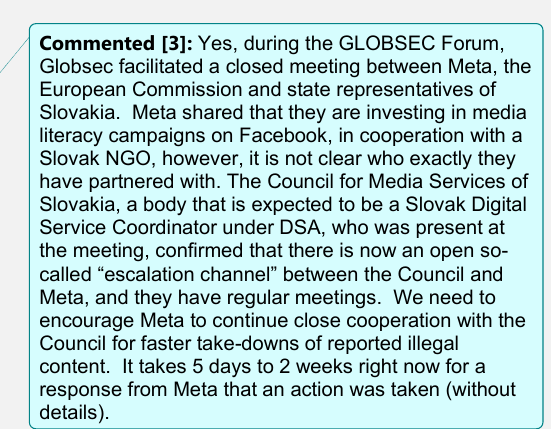
In the 2023 draft, marked “DRAFT PREDECISIONAL” and signed by “Vera,” reviewers noted in the margins that “Globsec facilitated a closed meeting between Meta, the European Commission and state representatives of Slovakia.”
The document also reveals that Slovakia’s Council for Media Services, “a body that is expected to be a Slovak Digital Service Coordinator under DSA,” said there was an “open so-called ‘escalation channel’ between the Council and Meta, and they have regular meetings.”
Another margin comment mentions that fact-checker Demagog Slovakia would be encouraged to join Meta’s third-party program “ASAP.”
A further comment suggests that USAID would encourage Meta to “continue close cooperation with the Council for faster take-downs of reported illegal content” – and notes that at the time, it took Meta five days to two weeks to respond to reports.
There is also a remark that there were “no immediate needs from civil society and media” – and the draft lists “Discussing measures of demonetization of disinformation and recommendation systems to stop recommending harmful content to users.”
The draft also lists the task of “Confirming points of contact for Slovakia, who will have a fast-track channel to large platforms.”
Later, in October 2023, USAID’s general counsel wrote an FAQ, updated in September 2024, that instructs staff on how to interact with social media companies.
The document, marked “FOR USAID INTERNAL USE ONLY,” advises against telling social media companies what to do, or how to deploy their resources – and specifically, “size, composition, or performance benchmarks for teams responsible for content moderation.”
This guidance came too late to affect the April 2022 conversation, and the events leading up to it, and described in the USAID documents. The same is true of the Missouri v. Biden injunction, which was issued in July 2023.
We covered the EU’s Digital Services Act and warnings that it would serve to enable censorship across Europe, as well as USAID’s disinformation primer for its partners, published in March 2024, and more about USAID’s censorship efforts in February 2025.
We also covered how in January 2025, EU officials were pressuring Meta to keep enforcing its censorship rules in the EU, in line with the DSA.
Slovakia faced a real Russian disinformation campaign around the war and the election – and the documents reveal pressure and planning, but not the outcome in terms of what content was actually removed in Slovakia.
The “illegal content” that is to be removed quickly is that which goes against Slovakia’s national law.
The point of the pressure was to make sure Meta removed content in Slovakia fast, which is the opposite of careful consideration of whether content is actually illegal, or simply unwanted.