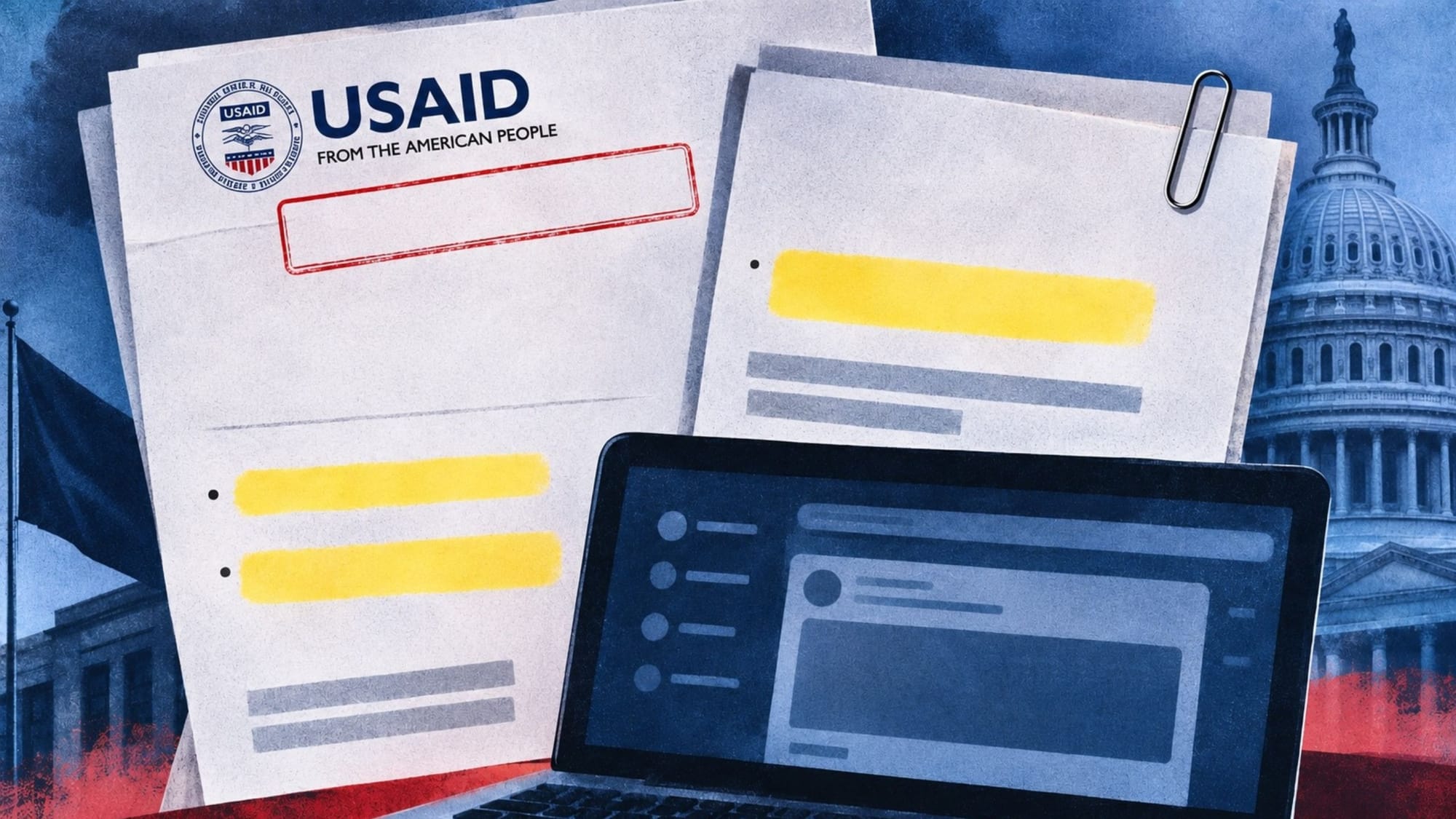
These are internal emails released in the "USAID Files" on usaid.gov, and they detail YouTube's (and Google's) collaboration with USAID.
The topics themselves are not sinister – lead poisoning, Ukraine, Belarus, Moldova, "trusted flaggers," and training of creators. What is problematic is the preferential access and treatment that a US government agency had and the secrecy around it.
In January 2024, a meeting took place between USAID's Garrett Lam and YouTube CEO Neal Mohan, who was briefed on the issue of lead poisoning and "was interested in supporting this by connecting USAID with creators who could help promote the issue (and other USAID priorities)."

Mohan "connected" USAID with two creators who happened to be present, but the agency decided it was not the right time to work with them, and a staffer was to plan a follow-up. Another action item was to work out "how to institutionalize the process" of "latching up local creators with upcoming principal trips."
Mohan also agreed to connect USAID with popular creators during the agency's trips abroad, and told USAID that his "partnerships team can identify the creators."
Mohan told USAID that more important to YouTube than content moderation was "raising/elevating content from legitimate and veritable sources."
Another action item was to connect USAID's Vera Zakem with YouTube's "threat analysis group/intelligence desk for potential partnership on disinfo."
Another email, sent on July 5, 2022, by Zakem, reveals that YouTube wanted "trusted flaggers," and that the agency was happy to oblige by identifying local partners in countries that were a priority for USAID.
Zakem wrote that Google's Josh Blumenfeld would be the contact person for "all things related to removing content to proactive engagement."
The same email produced several offers from YouTube: training for USAID communicators, and a co-branded program to bring together and support creators, journalists, and media outlets.
The latter, dubbed "Creator Cohorts," was to be a pilot program that would provide startup funds, equipment, and training on YouTube's backend analytics. USAID was asked to suggest where the pilot should take place, and the ideas included Ukraine, Moldova, Belarus, as well as Latin America and the Asia mission.
In August 2022, USAID sent a list of creators from Ukraine and Moldova to YouTube for training and support, while a month later, the video giant asked for the follow-up call to be postponed until it had had "a few more internal conversations."
The last email in this thread, sent on October 3, 2022, has a Google/YouTube staffer sending a link about how YouTube works for creators, and there is no further information on what happened next.
Another email, sent in July 2022, shows that USAID had a direct line to Google/YouTube for resolving issues that a partner was experiencing. The Belarusian workers' movement, Rabochy Ruh, based in Poland, had its YouTube Ads account blocked, and Zakem turned to Google's Josh Blumenfeld for help.
Zakem explained that the group had USAID's "advisory support" and that the blocked account had seven videos with 53,000 average views. The reason for the block was a message from YouTube about "suspicious payments." The group appealed but got no response. Blumenfeld replied, "I'm engaging with our colleagues in Europe and will circle back asap."
What Zakem asked for was not to file another appeal, but for Google to directly look into the matter.
The point of the story is not to dispute that the movement was a worthy cause - the email explains that independent trade unions in Belarus face real repression - but to show the direct line that USAID had to Google, and the special treatment that resulted from it. An ordinary channel with a blocked account would have filed an appeal and waited - but this one had USAID, and Zakem, to intercede on its behalf.
In March 2023, USAID sent an email to its partner organizations, asking them to help identify influencers who would take part in a social media campaign promoting the "Second Summit for Democracy."
The idea was to have these influencers, described as youth leaders, activists, journalists, musicians, actors, and poets, make short videos and post them on their own equipment, using the hashtag #SummitForDemocracy.
The email instructs missions and partners to inform influencers that their content "may be amplified on USAID official social media accounts," but does not suggest that the agency would pay them for their work. Nor does it tell influencers to reveal that they are working with USAID.
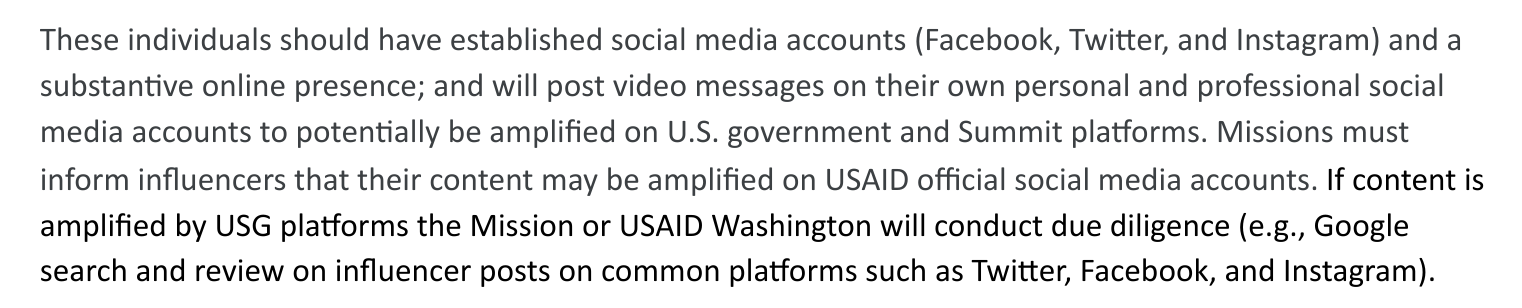
As for the message that should be sent to influencers, USAID suggested this: "By posting a video using the Summit for Democracy hashtag (#SummitForDemocracy) you agree to potentially have your post amplified by U.S. government social media platforms."
USAID wanted its missions to report back about any posts that "go viral or attract a significant amount of attention in the press."
It was actually YouTube who came to USAID, and the agency was happy to take it up.
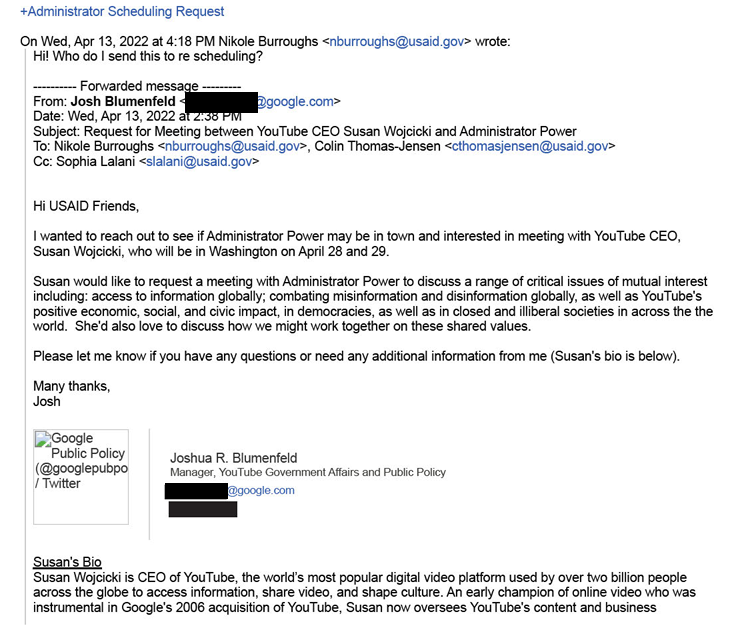
It was Blumenfeld, who on April 13, 2022, emailed USAID to ask whether Administrator Samantha Power would meet then-YouTube CEO Susan Wojcicki, who was going to be in Washington on April 28 and 29.
According to the email, Wojcicki wanted to meet Power to discuss “access to information globally” and “combating misinformation and disinformation globally” – but also YouTube’s role “in democracies, as well as in closed and illiberal societies,” and “how we might work together on these shared values.”
A USAID staffer who received the email forwarded it to another official, asking only who handles scheduling.
It turned out that the same week, Power was also scheduled to have a call with Meta’s Nick Clegg, on April 27, 2022.
The meeting with Wojcicki did take place: in July 2022, USAID’s Vera Zakem referred to a meeting with Blumenfeld as “a follow up meeting that the Administrator had with Susan Wojcicki.”
The same emails show that by July 2022, USAID officials who were planning a YouTube “Creator Cohorts” pilot wrote that “we talked about something like this in general terms when we met with the YT CEO.”
In these internal USAID emails, it is also revealed that YouTube wanted “trusted flaggers” and that the officials were in the process of picking which countries would be their priority for this purpose.
In February 2025, we covered USAID's network of media funding and what it meant for independent journalism. In 2020, we covered no less than 15 times YouTube turned its back on ordinary creators.
What these documents show is that YouTube was more than happy to work with a US government agency, offer it a fast lane to resolving issues, and even provide it with creators to promote its causes.
The topics may have been benign, but the issue here is the principle - a government agency getting a direct line to YouTube's CEO and other top officials, while creators, who are the backbone of the platform, are left to fend for themselves, with no such personal lines of communication.