An internal US government document released this month shows that a USAID-funded partner in Georgia would hand Facebook (Meta) lists of accounts to remove or de-promote, and holds this up as a model for other countries.
The document, an internal USAID guide, describes what is done in Georgia, and how this system can be replicated elsewhere, particularly in Latin America. The "AID/Georgia's Information Integrity Program" is a USAID-funded activity, and the guide goes into some detail about how it works, while admitting that the system can be abused.
Analyze online narratives and identify actors engaging in "coordinated inauthentic behavior" is the first step. Then "the partner" shares a list of accounts with Meta, which will "dig deeper and ultimately take them down or de-promote content."
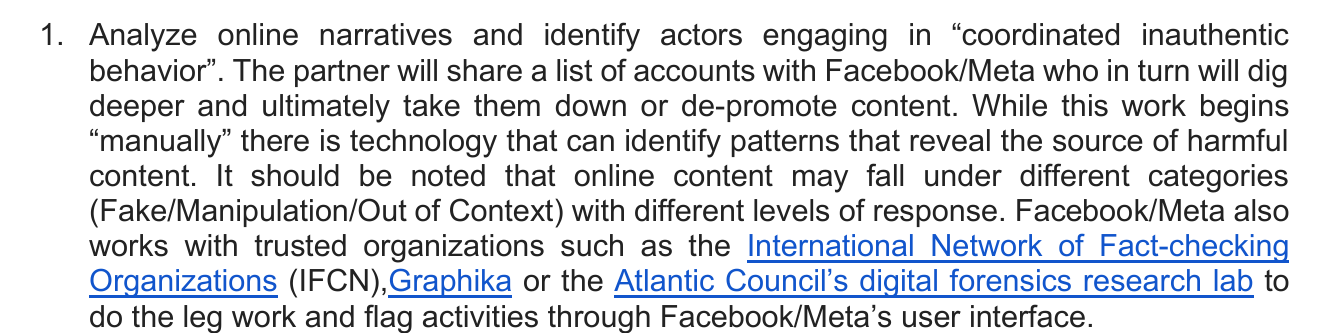
The work begins "manually" but "there is technology that can identify patterns that reveal the source of harmful content," the document, "Responses to Systematic Harmful Content on Social Media," says.
USAID's programs "track the online conversation and point out inappropriate use" - this is how the guide describes the process of having partners, "specifically investigative journalists or think tanks," "map out the bad actors" and then "petition the platforms to get 'inauthentic' accounts taken down."
This process does not involve making a public list of these accounts, nor is there a publicly available record of who decided what was "inauthentic" in another country's politics. And while the document was written as a plan rather than a report, it does not go into how many accounts were reported and removed.
Meta's one-pager that was sent to USAID in March 2022 explains that Trusted Partners get "an expedited way of reporting" that is "staffed 24/7" and that "we keep all Trusted Partners and their reporting practices confidential." At the time, Meta had "over 400 trusted partners in 113 countries."
This program is described as sitting "within Facebook's Content Policy team, the group that creates our Community Standards." Meta's email to USAID in March 2022 informed the agency that "many USAID civil society partners are likely already part of the program," and asked "how we might involve USAID in its expansion."
The guide does not name the partner in Georgia who is in charge of sharing the account lists with Meta, but according to the USAID activity data sheet, the Georgia Information Integrity Program (GIIP) has Zinc Network Limited (Zinc) as its implementing partner, managing "a consortium of domestic and international experts." The budget for this is listed as $7.5 million.
The program, which ran from September 2020 to September 2025, also included training local fact-checkers who would "eventually become part of IFCN and Facebook/Meta's fact checking program."
Though Meta's Trusted Partners program allows vetted partners to "weigh in on content takedown requests" and "make determinations on whether a takedown request is legitimate," the guide notes that Meta works with IFCN, Graphika and the Atlantic Council's digital forensics research lab "to do the leg work."
As for advertising, Meta raised its US standards after the recent US elections, and now "the program is lobbying with Facebook/Meta to introduce the same standards overseas, especially during elections," the guide reads.
Google, YouTube, TikTok, and Twitter, on the other hand, are "behind the curve on controlling harmful content," the document states.
However, the guide does offer some warnings about how the system works, and can be abused. "Reporting harmful content can be abused by malign entities seeking to discredit their adversaries," it reads. The document also notes that "public figures receive more leniency to remain online" and that the enforcement of rules is "extremely uneven."
Moreover, algorithms used by the platforms are "incredibly imperfect, to the point of oftentimes being harmful," and their work results in posts by journalists and human rights defenders getting "flagged by an algorithm."
The guide also mentions that Meta "changed its policy to allow users from certain Eastern European countries to call for violence against members of the Russian government and military. This is unprecedented and raises serious concerns."

The example given in the guide of what is considered to be "coordinated inauthentic behavior" is "troll farms or bots" - i.e., not opinions or political or ideological bias. And Meta's one-pager assures that "we will only remove the content and accounts that are in violation of our Community Standards."
The machinery used for censorship can be used fairly or unfairly, depending on who is operating it. For example, Meta's Q1 2023 threat report, published on May 3, 2023, revealed that 117 assets were removed that the company linked to the Strategic Communications Department of the Government of Georgia. Meta's report said the network "shared criticisms of the opposition, particularly during the most recent public protests."
This shows that the system is not only real, but also that who feeds it with reports can decide who gets taken down, and for what.
The guide frames the Georgia program as a model that can be used elsewhere, particularly in Latin America. The document maps countries in that region by internet censorship and government disinformation, noting that Venezuela and Cuba "lean heavily, while others (Brazil, Haiti, Nicaragua, and El Salvador) aren't far behind."
As for the Trusted Partner program, Internews, the media-development group, said in August 2022 that "I am pretty sure USAID is currently funding a lot of staff around the world to flag issues to the platforms through these trusted programs." It said it had "social media monitors already operating in about 20 countries" and said partners worked with "zero accountability or transparency."
We previously covered USAID's Disinformation Primer from March 2024, and the $1.5 billion federal "MDM" grants network from May 2025, as well as USAID's media funding in February 2025.
A government-funded group in someone else's country compiling lists of accounts to be removed or de-promoted on social media, with no public record or oversight of any kind, is essentially a censorship pipeline, regardless of the label attached to it. And the guide itself admits that it can be turned into a tool against adversaries.