NetChoice is going to court once again to stop New York state from enforcing another controversial law, this one requiring platforms to check everyone's age, in order to continue showing New Yorkers the feeds they already use.
"New York cannot tell social media companies how to organize the speech on their services any more than it can tell the New York Times how to order the articles displayed in its paper," says Paul Taske, NetChoice Litigation Center.
The organization's argument is that the law, known as the SAFE for Kids Act, affects not only children, but all users, including adults, who will be forced to have their age verified in order to see a "personalized organization of lawful speech."
As NetChoice sees it, New York cannot make every New Yorker prove their age just to see a personalized organization of lawful speech.
The law was challenged in a filing in the US District Court, Southern District of New York, on November 23, as NetChoice v. James. The filing is a complaint for declaratory and injunctive relief, against Attorney General Letitia James.
The law takes effect on January 25, 2027, while the attorney general's rules, to which the complaint refers, were finalized on July 28, 2026.
The law states that platforms must use "commercially reasonable and technically feasible methods to determine that the covered user is not a covered minor" before showing anyone a personalized feed.
This means that "covered websites" must "verify the ages of all users to display personalized feeds even to adults," the complaint says. The alternative is to obtain "verifiable parental consent" for minors, which means parents will have to verify their own age as well.
The upshot is that adults will be forced to undergo age verification or risk ceding anonymity, the filing continues. And that opens up a whole other can of worms, as "adults may wish to explore political, religious, medical, or other sensitive subjects without linking their identities to those interests."
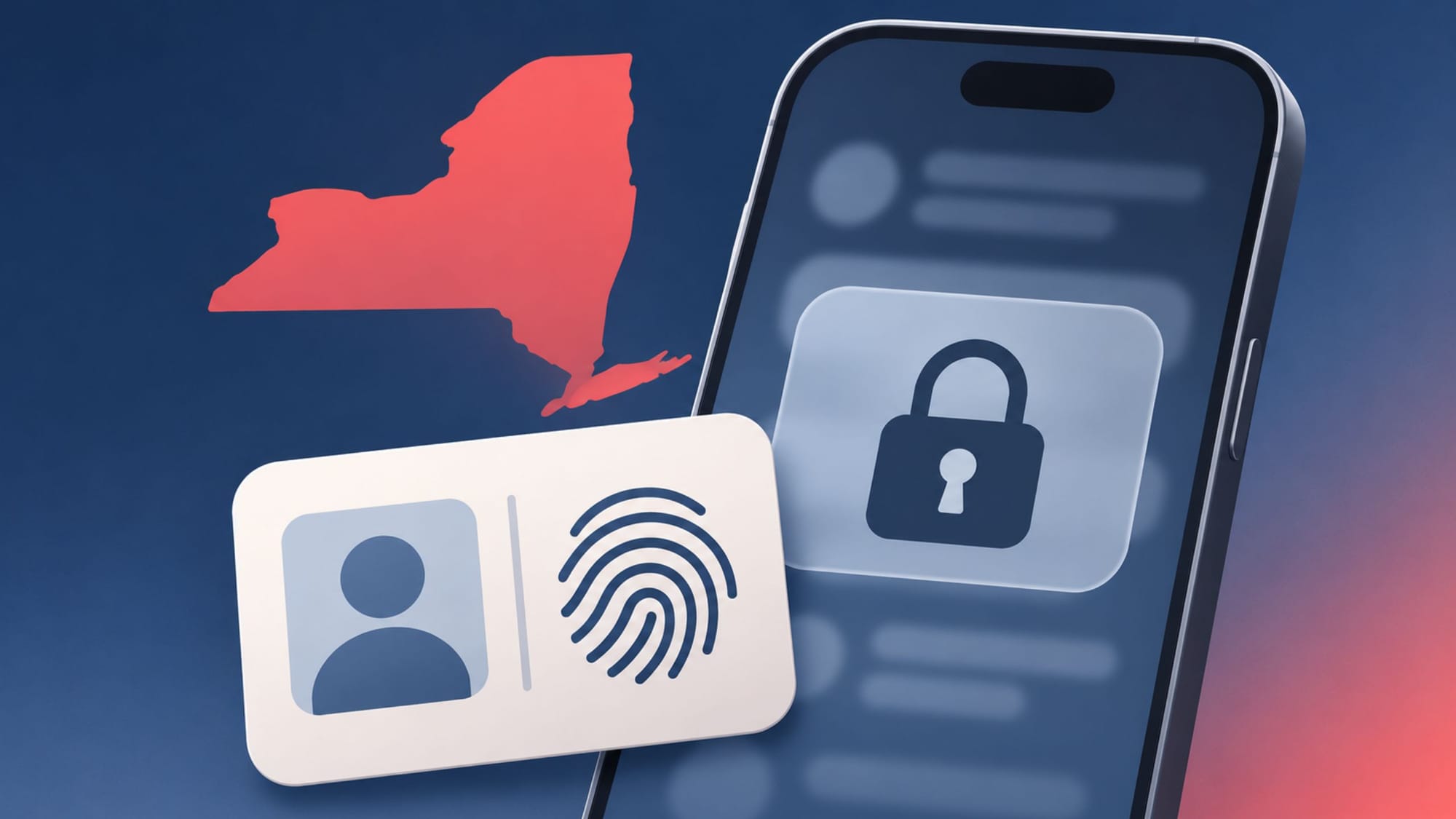
NetChoice is worried that checking every user's age "requires collecting sensitive data, such as government IDs, face scans, or behavioral data that third parties use to estimate age, and every database is a new target for breaches."
The rules proposed by the attorney general allow for "age estimation, age inference, or age verification," while verification can be done using "government-provided identification."
New York's own cost analysis, according to the complaint, shows that the rules "may deter 25% of users who reach the age-determination appeals process from completing that process."
While the rules are clear in many of their demands, they are also vague in some, such as whether the anti-circumvention duty "extends to preventing users from employing virtual private networks."
The SAFE for Kids Act bans personalized feeds for users under 18 without parental consent, and also bans notifications about feeds to minors "between the hours of 12 AM Eastern and 6 AM Eastern" without consent. The attorney general enforces the law, with "civil penalties up to $5,000 per violation."
The complaint names some of the NetChoice members affected by the law: Tumblr, YouTube, Facebook, Instagram, Threads, Pinterest, Reddit, X, and TikTok.
The legal arguments presented in the filing are that the law violates the First and Fourteenth Amendments, while also being preempted by Section 230.
As Taske put it, "Speech curation and presentation decisions are protected by the First Amendment, and the SAFE for Kids Act unconstitutionally interferes with them."
The complaint cites the 2024 case Moody v. NetChoice, which established that platforms decide what to "include and exclude, organize and prioritize."
The filing also refers to the Section 230 preemption, saying that the law is therefore preempted "because its requirements would force regulated websites to fundamentally change how they publish user-generated content or face punishing liability."
The complaint argues that "acts of arranging and sorting content are integral to the function of publishing."
NetChoice also notes that courts have already blocked similar laws in Arkansas, Utah, and Louisiana.
The organization adds that parents already have tools to control what their children can and cannot see online, and that the Act merely makes them make those decisions "through State-approved channels, when and how the State dictates."
This is the second lawsuit NetChoice has filed in New York this month, as on November 13 it challenged S.4505, which would make social media companies show state warning labels to users in New York under 17, repeatedly.
NetChoice views both laws as showing that "New York wants to control what speech websites present to New Yorkers, replacing the preferences of users and families with the state's."
As for the SAFE for Kids Act, the case is now in the hands of the US District Court, Southern District of New York, while NetChoice has asked for declarations and an injunction.
This is not the first time we have covered various attempts to impose age verification in the US - and specifically in New York.
We covered NetChoice's previous challenge to another New York law, S.4505, which would have social media companies show state warning labels to users in New York under 17, repeatedly.
We wrote about New York's law that requires adults to verify their age before using a chatbot, and a New York bill that would force age verification checks at the device level.
The SAFE for Kids Act is another example of how a law that starts with the goal of protecting children ends up affecting every adult in a given jurisdiction. In this case, it means that in order to be allowed to see a feed that an algorithm has picked for them, people will have to prove their age to the platform.
This can be done by handing over ID, undergoing a face scan, or allowing the platform to profile them based on their data. And that last option means giving up any possibility of reading the web anonymously.