Every day, millions of New Yorkers access social media to read the news, check in on friends, watch a lecture, attend a religious service, debate politics, learn something new, or share a photograph.
Starting January 1, 2027, they will all be interrupted by a message from the state of New York, lasting at least ten seconds, thanks to a law that is now being challenged in court by NetChoice, a trade group.
The law, Senate Bill 4505, amended by Senate Bill 8827, was signed by Governor Kathy Hochul in December 2025, and the attorney general, Letitia James, is now being sued in a federal court in Manhattan to stop it from taking effect.
The law says that social media companies must show a warning label, written by the state, that users cannot skip. The only way to avoid it is if the platform has "reasonably determined that the user is over seventeen years of age." But the law does not say how this is to be done, and the attorney general is yet to come up with rules on that.
The complaint mentions that the attorney general is authorized to come up with rules and regulations to enforce the law, but notes that the law itself does not provide any guidance on how to implement the age exemption.
This is a crucial point, because the warning is shown to all users by default - and the only way to avoid it is to prove to the platform that you are over 17. But how platforms are to determine this is left unexplained, and the attorney general is yet to come up with rules.
However, it is not hard to figure out what the "guidance" will be, given that the New York government already has a law in place, the SAFE for Kids Act, that is due to come into force on January 25, 2027. And that law defines "age assurance" as "any type of age estimation, age inference, or age verification."
In other words, the warning that the state is about to start forcing social media to show to their users will likely require those users to verify their age if they want to be able to use the platforms without interruptions. And the way to do that will be either to show government-issued ID, or use some other method, such as "zero-knowledge proof" - a cryptographic technique that proves something is true without revealing the information itself.
In July, when the SAFE for Kids rules were announced, the attorney general was asked if they raised privacy concerns, and replied, "not a question of privacy."
The SAFE for Kids Act is not the only one that contains a reference to age verification. S.9051-B, a law that regulates the use of chatbots, and was signed on October 28, says that platforms can offer full features of their chatbots only if they "used methods that are permissible under article forty-five" - that is, the same methods spelled out in the SAFE for Kids Act.
In other words, the chatbot law lets platforms offer full features only to users whose age has been checked.
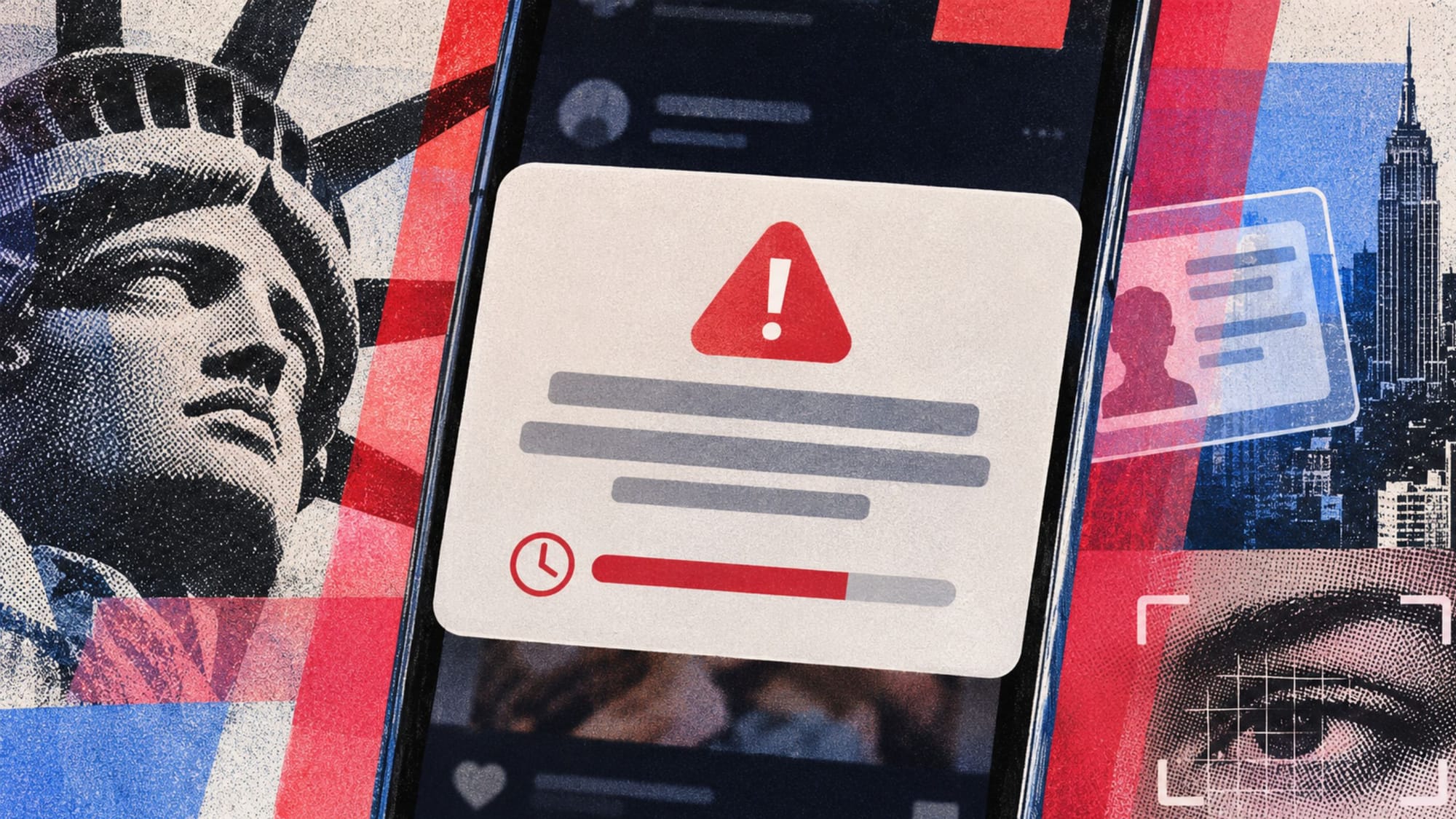
What the warning label, which will start appearing on New York-based social media users' screens on January 1, says is that "excessive use" of the platforms "may be associated with significant mental health harms."
The first time the message appears each day, it will be shown for at least ten seconds, without the possibility to "bypass or click through the warning," and will cover at least 25% of the screen or window. After three hours of "cumulative active use" and then every hour, the message will appear for at least 30 seconds, covering at least 75% of the screen. These are minimums, and the law does not specify the maximums.
The complaint, which asks for declaratory and injunctive relief, argues that the law is a clear violation of the First and Fourteenth Amendments, as it compels speech, forces users to see the message, and uses vague definitions of who is covered by the law.
The warning is not attributed to the state, and must be presented as if it were the website's own speech. Platforms are not allowed to hide the warning in their terms of service, and are not allowed to use any design that "intentionally serves to inhibit or subvert the purpose of this article." But the law does not define this phrase, and the complaint argues that if it means preventing platforms from responding to the warning, then it is a viewpoint-based restriction that the government is not allowed to impose.
The law also allows the attorney general to impose "civil penalties of up to five thousand dollars per violation" on platforms that do not comply, as well as restitution, disgorgement, and damages.
Furthermore, showing the label does not "waive, release, otherwise limit, or serve as a defense to, any claim, including claims premised on failure to warn."
The complaint lists several platforms that are covered by the law, including Facebook, Instagram, Threads, TikTok, YouTube, Reddit, Pinterest, Tumblr, and X.
The original bill, S.4505, was amended by S.8827, and the changes included limiting the scope of the law from "addictive feed, push notifications, autoplay, infinite scroll, and/or like counts" to "an addictive feed, autoplay, and/or infinite scroll."
The original bill had tasked the commissioner of mental health with writing the label, updating it every year, and deciding on the timing and duration of its appearance on users' screens. The amendment repealed that and instead wrote the text and timing of the warning into the bill.
Another difference between the two versions of the bill is that the original one did not contain the over-17 exemption, while the amendment introduced it.
The complaint argues that the law violates the First Amendment by compelling speech, and quotes the Supreme Court's 1977 ruling in Wooley v. Maynard, which said that free speech "include[s] both the right to speak freely and the right to refrain from speaking at all."
The complaint also argues that the science is not on the side of the New York legislature, as a National Academies review "did not support the conclusion that social media causes changes in adolescent health at the population level," while a 46-study meta-analysis found that "the current pool of research is unable to support claims of harmful effects for social media use on youth internalizing disorders."
The lawsuit also says that the wording of the warning is not supported by the surgeon general's advisory it references, which spoke of "excessive and problematic" use of social media, and that the state's law is using "contested policy and scientific judgments dressed up as factual warnings and forced into the mouths of private speakers."
NetChoice's Paul Taske said, "The First Amendment forbids New York from forcing private speakers to serve as government mouthpieces, and that includes compelled state-scripted warnings on speech" and "New York has every right to share its views on social media, but it has no right to make private websites say it for them."
In January, we wrote about the law, saying that "New York has turned the act of scrolling into a public health intervention."
In July, we reported that Attorney General James was pushing TikTok toward "more age-gating, which means checking everyone's age."
A similar warning label law in Colorado was blocked in November 2025 in the NetChoice v. Weiser case, and is now on appeal before the Tenth Circuit, with no argument date set.
New York's law is what the state itself calls a "warning" - but the state writes the words, hides its own name, blocks the screen, and offers the only exit from this "warning" to people who prove their age.
In reality, the label is the compelled speech, and the age check is the exemption.