New York state is not wasting any time putting into practice the new rules that are to govern the development and deployment of AI there.
A portal, where the biggest AI companies must register, was opened on November 10 by the Office of Digital Innovation, Governance, Integrity, and Trust (DIGIT).
DIGIT is a unit of the Department of Financial Services (DFS) that was given the task of overseeing the implementation of the RAISE Act, and this is the first step in putting that law into effect.
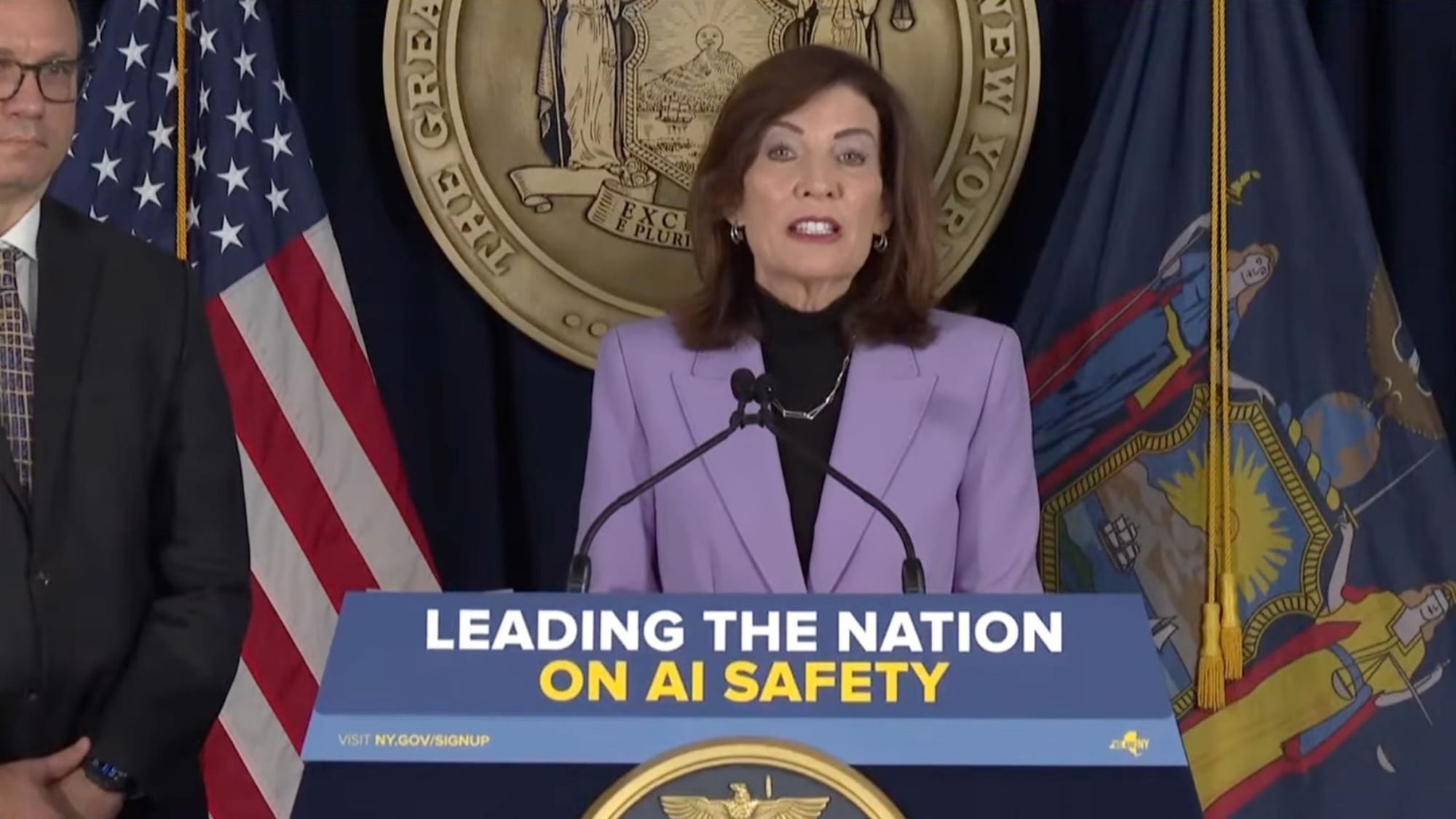
The RAISE Act was signed by Governor Kathy Hochul in December 2025, and amended in March 2026, to require that "large frontier developers" submit to the state a disclosure statement and pay a fee.
These companies must have had revenue of $500 million or more in the previous year, and the law gives them until January 1, 2027 to register. That is also the day the law takes effect.
The same day the portal was launched, Hochul also announced the opening of the New York Center for AI Responsibility and Research (NYCAIRR), located at the State University of New York (SUNY) in Binghamton. The center is supposed to be independent, but it was launched by the governor and will work with the state to "inform policy decisions about AI safety and accountability."
No large frontier developer may "develop, deploy, or operate a frontier model, in whole or in part in New York state, without having a current disclosure statement filed with the office and paying the required share," the law says.
This means that the state is establishing a permanent reporting and control relationship with these companies, which will have to renew the disclosure statement every two years, and pay a pro-rata share of the costs of running the office.
The statement must contain the names of the company's offices in the state, three contacts, and owners of five percent or more of the company.
The companies must also publish a safety framework, and every three months send the office a confidential summary of risks arising from their internal use of their models. If the statement is missing or false, the office can fine them $1,000 a day.
The state is also requiring that all frontier developers - not only the large ones - report a "critical safety incident" within 72 hours.
The office can then pass these reports to "other governmental entities at their discretion" - and these reports are exempt from New York's public records law. The office is also empowered to adopt "additional reporting or publication requirements."
The Attorney General can seek civil penalties of $1 million for a first violation and $3 million for each subsequent one.
As for the NYCAIRR, the November 10 release announcing its launch said that "At the State's request, NYCAIRR will be able to provide expertise, assessments and evidence that can assist in informing state policy making and oversight of frontier AI Developers."
The center will also "coordinate with DIGIT to begin reviewing AI Developers' published safety frameworks and providing recommendations on ways to strengthen requirements."
The center has received $25 million in capital from the state and $30 million from donors, led by Tom Secunda, co-founder of Bloomberg LP, and who also chairs the board of the state's own AI network, Empire AI.
That project, which the center is part of, got $275 million in the 2024-25 state budget, and is described as "Governor Hochul's $500 million public-private initiative."
The RAISE Act specifically states that its provisions do not apply to "the Empire AI consortium or the institute." This means that the state's own AI project is exempt from the rules that the NYCAIRR will help shape.
In January, when the center was first announced, Hochul said it "will be an independent arm of research that gives New Yorkers transparency and confidence."
Its interim co-directors are Cornell Tech Dean Greg Morrisett and Columbia Executive Vice President for Research Jeannette Wing.
“One of the Center’s first objectives is a national recruiting effort for experts who focus on foundational limits and mathematical theory, formal methods and verification, agentic and complex systems, hardware security and privacy, interpretability and alignment, and scientific AI and biosecurity,” the release said.
DFS Acting Superintendent Kaitlin Asrow said that her office looks forward to "working closely with the Center under Governor Hochul's leadership."
The November 10 release said that the governor would in the coming months "continue exploring ways to build on the RAISE Act as part of ongoing efforts to further strengthen New York's nation-leading AI safety laws and regulations."
At the same time, Hochul said that "Tech moguls tell us that their vision for AI is inevitable" - and added, "We're building a national model for smart, sensible AI regulation, a model that puts communities above corporations and people above powerful technology."
In September, Hochul had a message for developers: "Bring it on. We will fight you in court, and we will hold you accountable," and mentioned that the state might "explore safeguards like AI kill switches if they're deemed feasible and in the best interest of our state."
At the time, the sponsor of the RAISE Act, Alex Bores, said that the office was empowered to "demand more data from AI companies, issue new rules, and recommend new legislation as the technology evolves."
As Reclaim The Net reported at the time, the law was all about creating "a permanent reporting and control relationship between the state and AI developers."
In October, Hochul signed a separate bill that will require age checks for chatbot users from January 1, 2027.
As the state is working to cement its position as a leader in regulating AI, the way it’s going about it is by keeping a file on every company that runs the systems millions of people use for writing, searching, and talking. The state will get reports from them that it can share with other governmental entities and keep secret, and it has the power to add to its demands by rule. And it has a center, funded by the state, that will help it come up with more rules, but is itself exempt from those rules. Registration is where control starts, not where it ends.