New York Governor Kathy Hochul is not only not worried that companies will sue the state over its new AI law – she is almost goading them to do it.
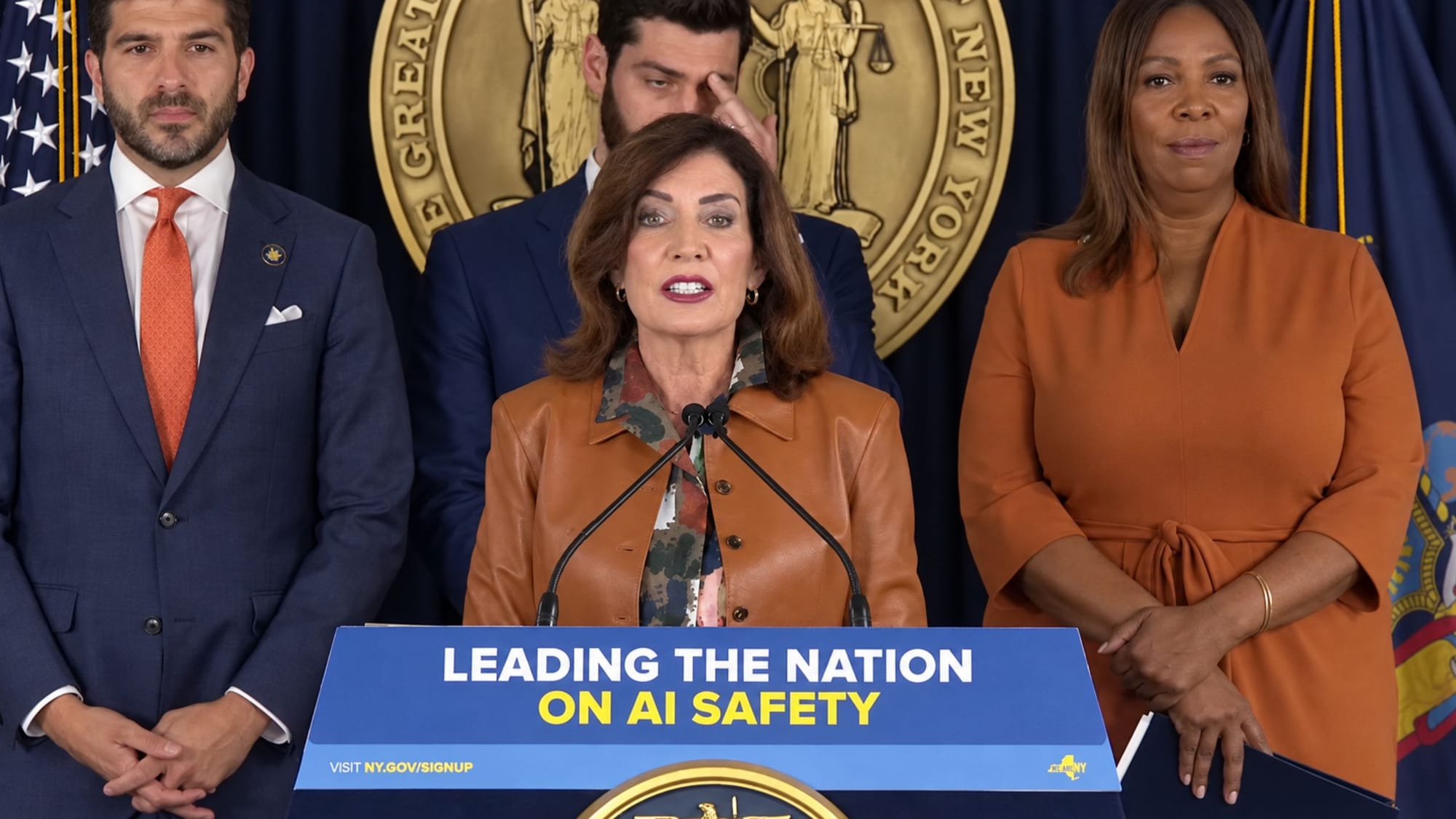
“I also know there’s other AI developers already on the phone with their legal teams planning their lawsuits against us. Here’s my message to them: Bring it on. We will fight you in court, and we will hold you accountable,” Hochul said at a press conference in New York City on Monday.
Hochul, who in December 2025 signed the RAISE Act (Responsible AI Safety and Education Act), was joined by Attorney General Letitia James, Senator Andrew Gounardes, and Assemblymember Alex Bores, to announce the “next steps to advance New York’s nation-leading AI safety law.”
Many politicians are grasping for more control over AI and its capabilities, all in the name of safety.
More: How the AI “Safety” Push Creates New Gatekeepers
As of November, large frontier AI developers will have to register with the state, and starting January 2027, they will have to comply with a number of demands, including publishing safety protocols, and reporting critical safety incidents within 72 hours. Those who don’t comply will face civil penalties.
In addition to this, the state may “explore safeguards like AI kill switches if they’re deemed feasible and in the best interest of our state,” Hochul said.
A day before Trump’s UN General Assembly speech, the governor took a jab at him, saying he would “play the hits” and “insult our allies” – but would not offer “a serious, thoughtful plan to regulate artificial intelligence.” The same criticism was directed at Congress for not doing its job and passing AI regulation – possibly, Hochul suggested, because of lawmakers’ personal investments in AI companies.
But in New York, the state is taking it upon itself to regulate the industry. The law’s sponsors, Senator Gounardes and Assemblymember Bores, spoke at the press conference, with the senator warning that “AI companies are playing Russian Roulette with humanity’s future.”
Bores, meanwhile, said that the newly established Office of Digital Innovation, Governance, Integrity and Trust (DIGIT) “was empowered in the law to demand more data from AI companies, issue new rules, and recommend new legislation as the technology evolves.”
New York Attorney General Letitia James, who will be enforcing the law, said, “My office will always enforce the law and do everything in our power to keep New Yorkers safe.”
But what the rules will be, and how they will be implemented, is a work in progress. And while the kill switch gets the headlines, the rest of the law is more about creating a permanent reporting and control relationship between the state and AI developers.
The kill switch, on the other hand, is not yet a part of the law, but something the state may “explore.”
The registry, however, is here to stay, and will be implemented in a series of steps. In November, large frontier AI developers will be directed to register with the state via a portal. Then, in January, the law becomes enforceable.
In addition to publishing safety and transparency frameworks on their own websites, companies will have to file a disclosure statement every other year, starting with January 1, 2027. They will also have to pay assessments, the amount of which is not specified, and file quarterly reports on catastrophic risk.
Hochul also had some choice words for the tech industry, saying that “if carpenters and cooks have to follow safety standards, then why would the creators of AI think that they should operate unchecked? Why should tech billionaires and purveyors of this most powerful world-changing technology play by a different set of rules?”
The law covers companies with annual revenues of more than $500 million, and that they will have to publish their safety and transparency frameworks on their own websites.
The public will also be able to report suspected critical safety incidents to the state, which will publish an annual report on the number of such incidents, and any proposed changes to the law.
The Office of Digital Innovation, Governance, Integrity and Trust (DIGIT) will be the one to collect this data, and is located inside the Department of Financial Services. In the coming weeks and months, more staff will be hired, and its first full-time hire is Marc Gilman, who will serve as the Deputy Director for the RAISE Act.