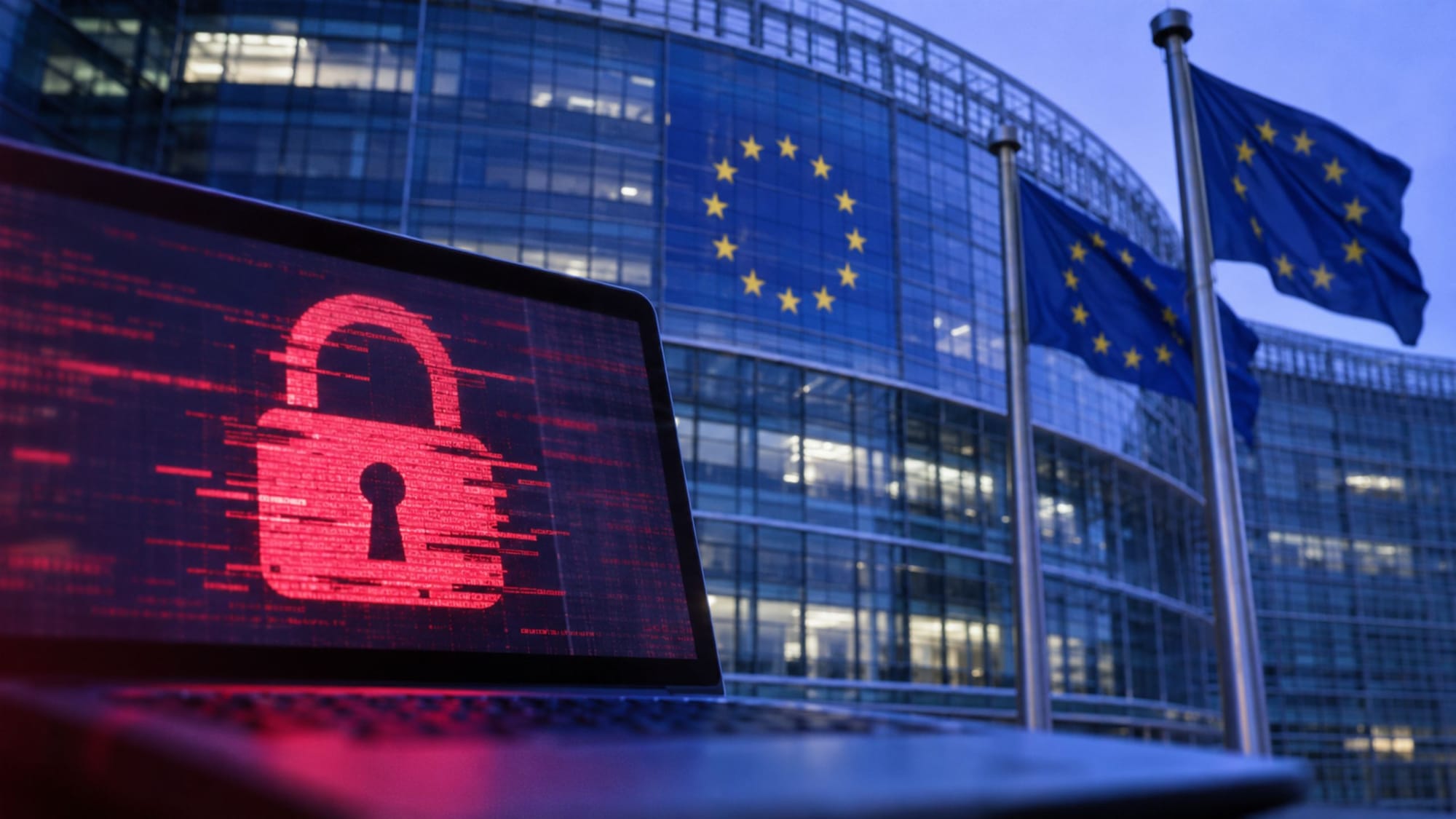
The European Commission (EC) - the very entity that wants every new social media account to be age-verified, and is also pushing hard for a digital ID wallet to be in every European's phone - has just had its own systems breached.
The attack was AI-assisted, and the EC confirmed it, but not before Politico reported about it.
At the same time, the EC is trying to push through a number of legislative efforts that would result in every internet user in Europe proving their age and identity online.
But the organization does not seem to be doing a great job with its own security. EC staff tools, such as those for payslips, working hours, leave, and medical reimbursements, were taken offline for around ten days, and that's according to Politico.
The privacy and security implications of this are evident, but the EC – which wants to usher in a new era of online age verification and digital ID, that would cover 450 million people – can't even tell you how much data of its own staff may have been exposed in this latest incident.
"We have not detected any evidence of a data breach affecting Commission staff as a whole," spokesperson Thomas Regnier told a midday briefing on November 19.
While the attack was detected on October 22 and confirmed four days later, the public was not informed until the Politico report came out.
Regnier said that "as a protective and preventive measure, we temporarily took down several applications, and most of them have since then been restored."
The spokesperson confirmed that the attack was carried out with "an AI tool that is publicly available," and that "this was an AI generated cyber campaign."
But he also said, "I'm not going to qualify the scale and extent of this cyber attack."
When asked about the identity of the attackers, Regnier said, "So on the attribution, I will not go there."
When questioned why the public was not informed about the attack earlier, Regnier said, "there was no hiding whatsoever."
As for the July AI cybersecurity plan presented by the EC, Regnier said that the latest incident "shows that we are very well aware of what's going on around us."
And then there was this: "of course no one is immune to this."
Minutes later, during the same briefing, the same spokesperson was asked to comment on Italy restricting social media usage for minors, and used the opportunity to promote the EC's own legislative efforts, namely the KIDS Act.
"We need a European response. This is precisely why we have presented the Kids Act," Regnier said, and added, "No national law will allow us to effectively protect all our kids across the European Union."
But it's not only children that the EC wants to "protect" in this way – its plans are much more far-reaching. The KIDS Act, proposed on September 17, would mean that no one can open a new social media account without proving their age.
This would apply to every new account, whether the user is a minor or an adult.
The proposal states that "online services and app stores must use age assurance tools" - and that social media and video platforms must "perform age verification when a user opens a new account."
For existing accounts, the proposal wants platforms to "estimate the user's age based on reasonable proxies (e.g. account creation date, credit card details)."
The EC would have you believe this is all safe and sound, as it promotes its own age verification app, claiming that it "does not retain identity documents or biometric data, thereby meeting the highest privacy-preserving safeguards."
Meanwhile, the Digital Fairness Act proposal, presented on November 11, is another EC legislative effort that would introduce age verification, this time for any "trader."
Then there's the digital ID wallet, eIDAS 2, which is a part of the EU's digital ID framework. It mandates that member countries provide this service to every citizen by the end of 2026.
The law says the use of the digital ID wallet "shall be voluntary." But Germany has already decided to make it the country's digital ID, which will be introduced on January 2, 2027.
Even though the EC says it will be voluntary, 16 cryptographers warned in 2024 that the wallet's design could let one party "trace this user's activities throughout the system and observe everywhere the user has been, like a virtual stalker."
The EC is also not above mistakes. In April this year, it launched an age verification app, which von der Leyen said was "fully open source. Everyone can check the code."
But consultant Paul Moore cracked it in under two minutes, finding that the PIN was not tied to the identity data, rate limiting was in an editable file, and ID images were stored unencrypted.
Moore at the time said, "Seriously, Von der Leyen – this product will be the catalyst for an enormous breach at some point. It's just a matter of time."
The spokesperson at the time, also Regnier, said that the app was "still a demo version."
But the Commission still went on to tell all 27 EU member states to make sure the app is rolled out by the end of 2026. EC's Henna Virkkunen said at the time that she wants "one solution for the EU, not 27 different ones."
In March, the EC was hit by another attack, when hackers used a stolen cloud key to raid the Europa.eu hosting platform, with CERT-EU revealing that the data of "42 internal clients of the European Commission, and at least 29 other Union entities" was affected, including "lists of names, last names, usernames, and email addresses."
So, to recap, this is an institution that has had multiple major incidents this year, and is now trying to convince everybody that it has everything under control, and that the way to control the vast, vast majority of law-abiding Europeans is to treat them all as potential suspects and make them prove their age and identity online, in a multitude of ways.
An institution that cannot keep its own systems running, now wants to create a massive system that will contain the most sensitive information about every EU citizen. What could possibly go wrong with that?