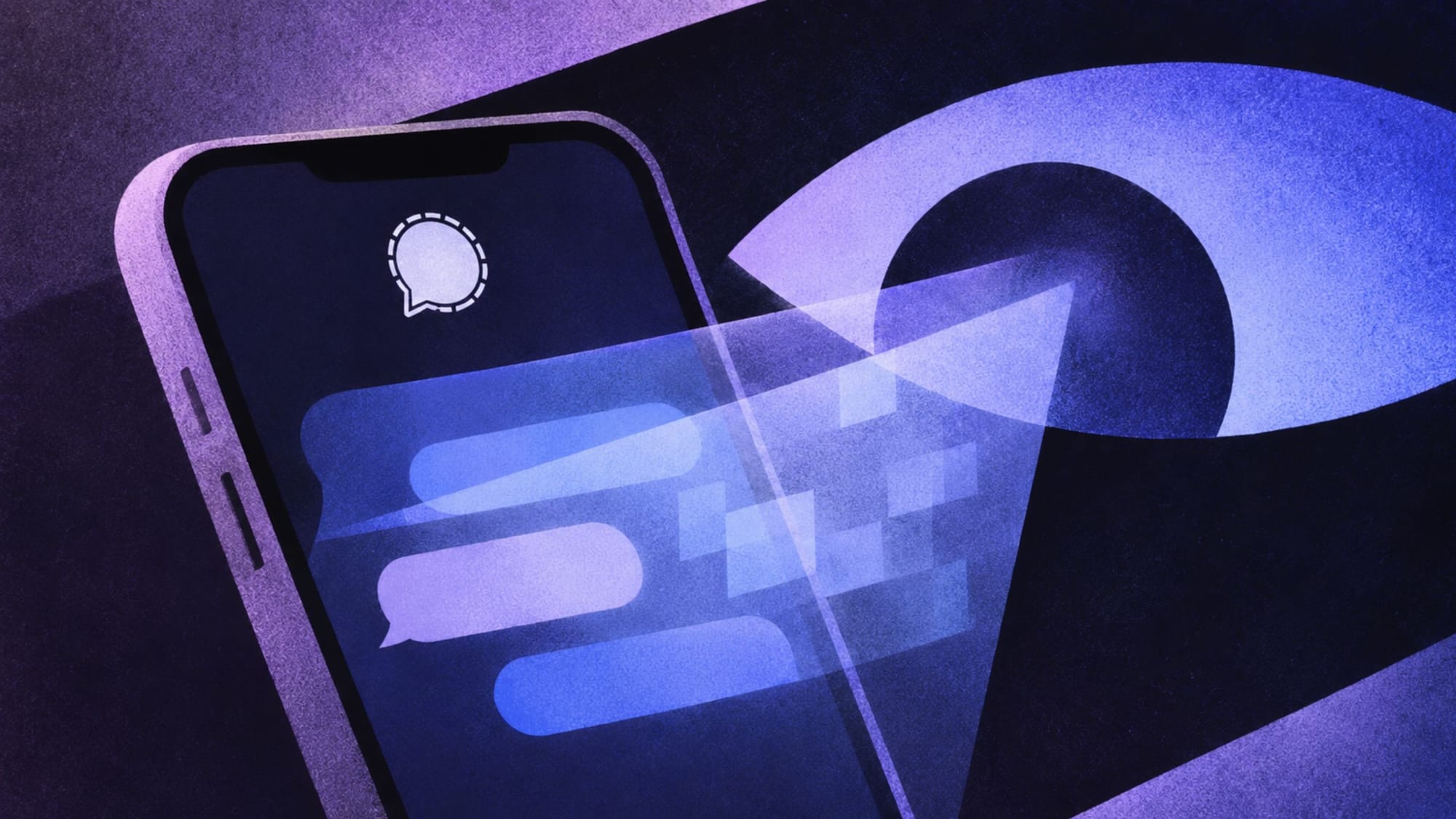
The latest update of the Signal app on iOS 27 and on Android is designed to block the operating systems' AI agents from reading the content of the app's screens.
This is because these agents, integrated into the operating systems, read what is on the screen, and since Signal decrypts messages in the app, the OS then has access to that content.
The fact that agents scan the screen means that "your Signal data is captured, then made available to these agentic systems in order to allow them to answer your questions and do your bidding," Signal explained. Once the data is captured, it is out of Signal's hands, and it exposes everyone in the conversation, not only the user: "imperils the privacy of all the participants in a conversation."
Signal calls this “an existential threat to Signal, and our ability to responsibly uphold our mission.”
Signal president Meredith Whittaker announced the changes in a blog post explaining that the three major OS makers, Apple, Google, and Microsoft, set the rules that all apps must follow.
Signal said that “these three operating systems are the oceans in which Signal, and other applications, must swim,” and that while Signal's own encryption is not broken, the message is protected only in transit, and once displayed on the screen, the OS can read it.
“This means that we are restricting the latest AI agents built into mobile operating systems from potentially capturing and storing your Signal data,” the company said.
On iOS 27, the update blocks screenshots in the app by default. On Android, the update detects when an AI assistant is trying to read the screen and automatically turns on the Screen security setting in Signal. However, this does not apply to all Android devices, as many vendors do not provide a reliable way to detect this.
Users can turn this setting off in Signal's settings, but the app warns that this will potentially expose Signal content to AI agents.
On macOS, Signal says it cannot block screenshots in a reliable way for lack of documented tools provided by Apple. As a workaround, macOS 27 users are advised to add Signal to Excluded Apps under System Settings > Siri.
The company admits that the measure it has taken is only a partial fix, as “restricting screenshots does not address other more sneaky ways AI agents could potentially access application data, such as retrieving content already present on a user’s device via the filesystem.”
The agents in question are the likes of Apple's Siri AI, that has "onscreen awareness" and can "answer questions or take actions related to the content on a user’s screen," and Google's Gemini that can automate multi-step tasks across apps, and is "even more powerful when you add screen or image context."
There is also Meta's Muse, that has more than 10 million downloads since its launch in September, and that can, according to a report by Reuters, pull Signal messages from push notifications on Android, use accessibility and screenshot tools on a Mac, but is blocked on an iPhone.
Meta spokesperson Daniel Roberts said the examples were “isolated incidents” and that the agent can access other apps only through permissions explicitly granted by users. Google said that people “must deliberately grant permissions” for apps to read Android notifications.
Signal president Meredith Whittaker told Reuters that Meta launched Muse "without showing any respect for basic privacy or cybersecurity," and that its deployment was "technologically reckless."
Meanwhile, Signal's Whittaker has asked Apple, Google and Microsoft to provide developers with tools to stop their apps' data from being accessed by AI agents, and documentation on how this data is used.
Signal says it is "cautiously optimistic" about the result of its request, as Google and Apple are already in talks with the company. What Signal wants is a way for developers to opt out of AI data access, and for this to apply to screen reading, file access, notifications, and APIs.
The company also wants the three OS makers to make sure that accessibility settings are not used as a backdoor by AI agents, and to provide proper documentation of how these agents access and process data.
This is not the first time Signal has had to take steps to protect its users from OS-level AI agents. In May 2025, it turned on "Screen security" by default on Windows 11 to keep Microsoft's Recall from taking screenshots of chats every few seconds.
"Microsoft has simply given us no other option," Signal said at the time, and warned that agents could "break the blood-brain barrier between applications and operating systems."