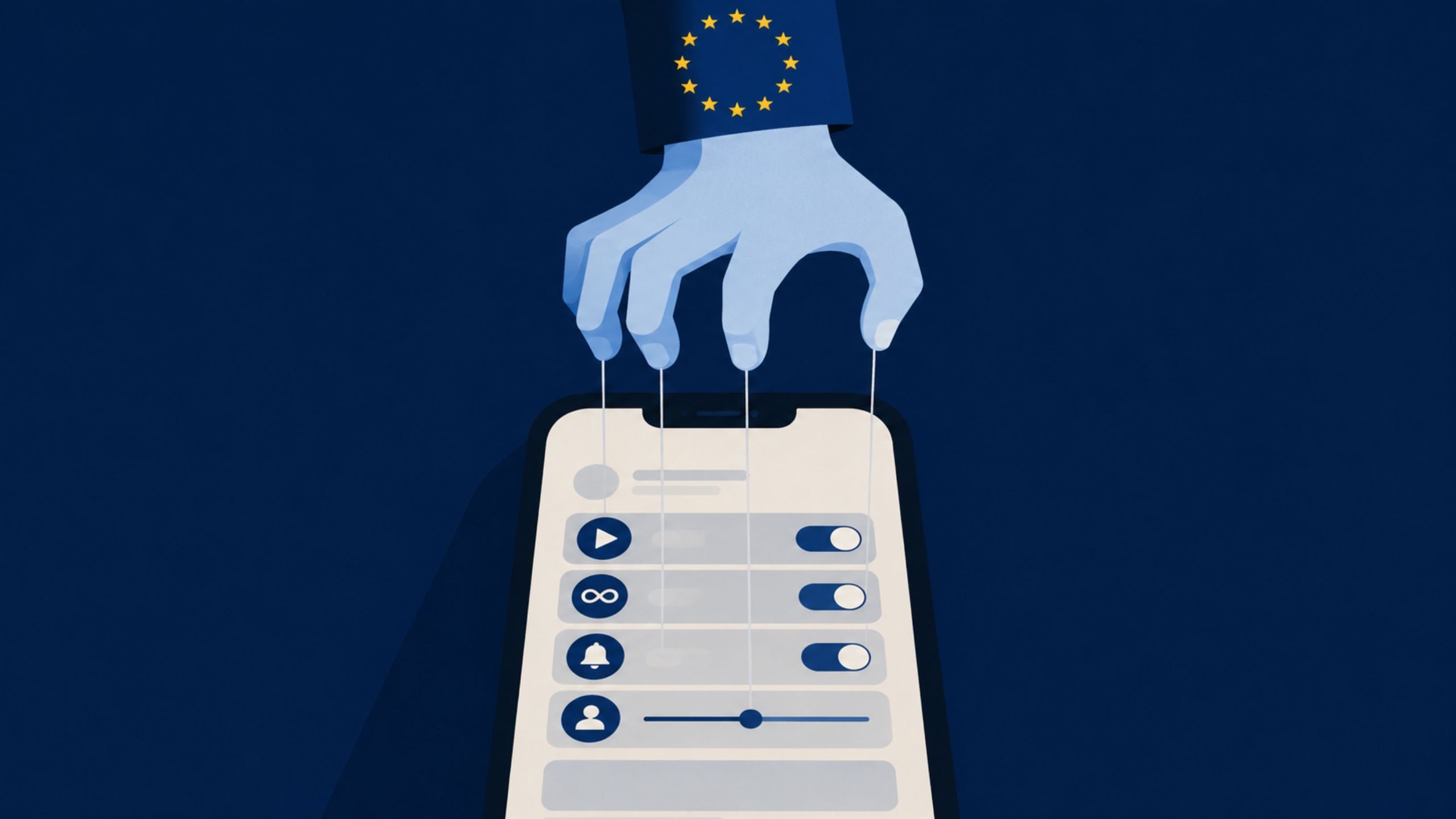
The European Commission wants the power to force a redesign of the apps on your phone. Regulators in Brussels said Friday that Instagram and Facebook break European law because the products are built to hold your attention. They are ready to fine Meta as much as 6 percent of its global revenue, more than $12 billion, until the company rebuilds the apps to Brussels’ liking.
The preliminary findings target the ordinary machinery of a modern feed, from infinite scroll and autoplay to push notifications and the recommendation systems that decide what you see next. The Commission’s proposed remedy seems like a product spec written by a government. It wants autoplay and infinite scroll switched off by default, real screen time breaks built in, and the algorithm retuned so it stops working so hard to keep you around.
The finding falls under the Digital Services Act, the law Brussels uses to police what Europeans can post and see online.
The machinery now aimed at button placement and video autoplay is the same machinery built to decide which content stays up and which comes down. Once a regulator can order how an app is designed, the distance between design and speech runs short.
Someone has to define “addictive,” and under this law that someone is the government. The Commission says Meta pushes users into “autopilot mode” and failed to weigh the risks its design poses to minors and what it calls vulnerable adults.
The behavior it describes, opening an app and scrolling longer than you meant to, is familiar to anyone with a phone. The question is who gets to name it a harm and prescribe the cure.
“Protecting the physical and mental health of Europeans must be a priority for social media platforms. The Digital Services Act provides a clear framework to hold platforms accountable for the addictive design and effects of their services. We are fully committed to enforcing our legislation in Europe,” said Henna Virkkunen, the Commission’s executive vice-president for tech sovereignty, security and democracy.
The title alone shows how wide the mandate has grown. One official holds a brief that spans “tech sovereignty, security and democracy,” and from that chair rules that a scrolling feed threatens public health.
Meta rejects the finding. “We disagree with these preliminary findings, which don’t accurately take into account the significant steps we’ve taken to protect teens.
We share the European Commission’s commitment to providing teens with safe, positive online experiences and will continue to engage constructively with them,” the company said. It points to Teen Accounts, rolled out over the two years the investigation has run, which switch on by default for minors and let parents block nighttime use and cap daily screen time.
The Commission was unmoved. It said Meta’s existing guards fall short. Time limits for teens can be dismissed with a tap, parental controls only help parents with the time and technical skill to set them up, and mental health tips sit on a separate “safety center” page where few will find them.
None of this ends with a fine yet. The findings are preliminary, and Meta can read the Commission’s files and reply in writing before any decision. The European Board for Digital Services gets consulted along the way. What arrives ahead of any penalty is the precedent.
A government body has claimed the authority to set the default settings of a service used by hundreds of millions of people, backed by a threat large enough to make compliance the only rational choice.
This is not the Commission’s first move against Meta under the same investigation, which opened in May 2024. Brussels already issued findings over how the company checks the ages of children under 13, and it is still probing what it calls the “rabbit hole” effect of the recommendation engine on young users.
The features under review are small, like autoplay and a feed that never ends. The authority being claimed to reach them stretches a great deal further. Brussels writes the definition of “harm,” and the design of the products follows.