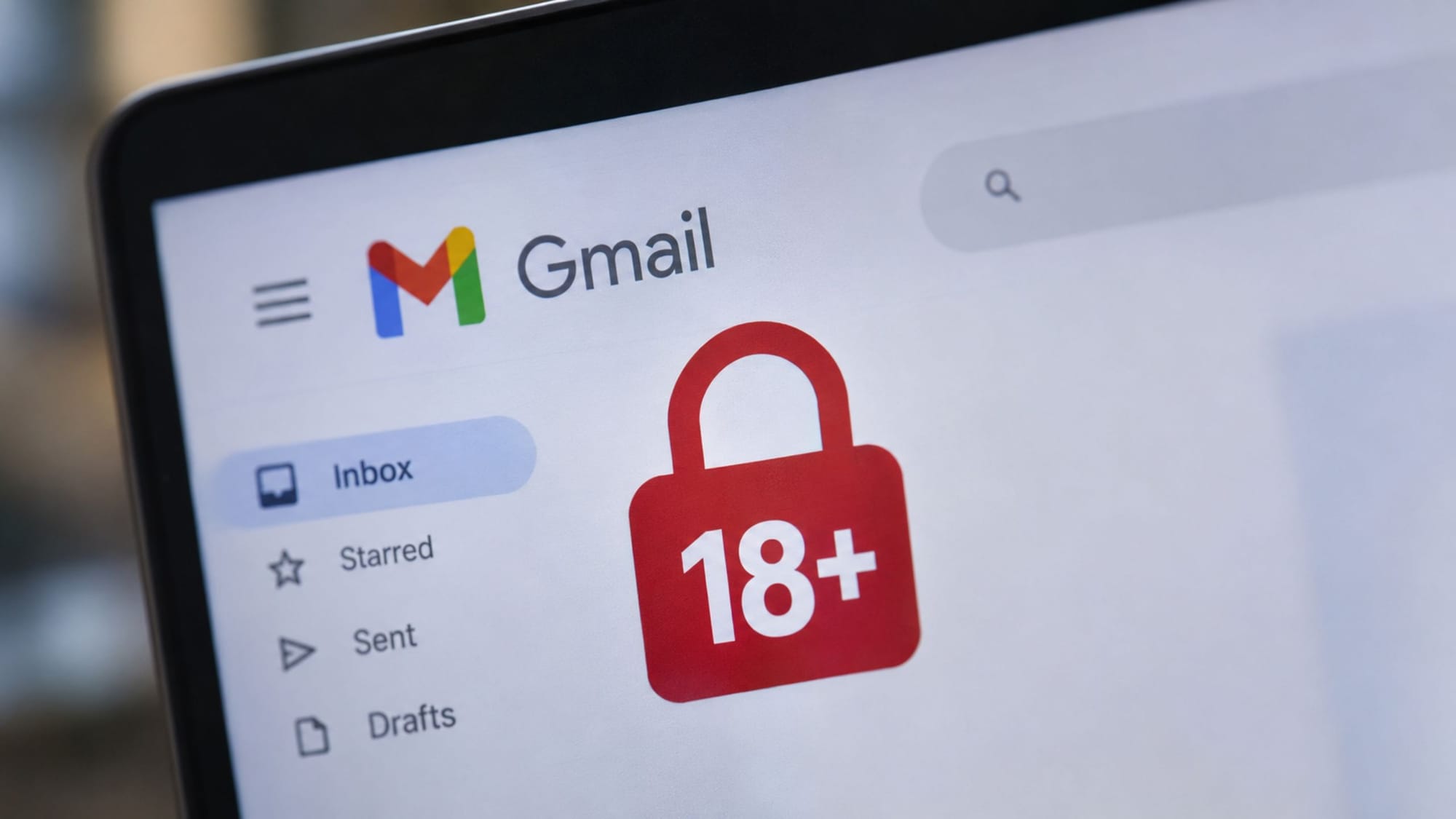
Google has told an Australian Senate inquiry that a controversial bill could force the tech giant to check users' ages and lock those under 18 out of email, messaging, and file storage.
Liberal senator Sarah Henderson has called the proposal "mass surveillance of people's emails."
This is one of the ways in which the Digital Duty of Care bill, which has already passed the House of Representatives, is under fire during the Senate's review.
YouTube's senior manager of government affairs and public policy, Rachel Lord, told the committee on Monday that one section of the bill could have this effect on Google's services.
The provision that Google is concerned about is the one covering any online service where there is a “reasonably foreseeable risk” that a child could come across “pornography or fetish material.”
It says that where it is “technically feasible and reasonably practicable” companies must use at least two ways to check a user’s age, and prevent those not verified as adults from accessing the material.
It has no exemption for email or messaging, and Lord said that Google thinks the provision "should be limited to those services with a sole or predominant purpose of disseminating pornography, to make that a more targeted and proportionate measure."
Senator Sarah Henderson, of the Liberal Party, asked if Google had previously warned that Gmail and Google Drive would be forced to introduce age checks and scan private emails, messages, and files, and lock out children. “Correct,” Lord replied, adding that the company is concerned about the requirement to verify age and block under-18s.
A spokesperson for the communications minister, Anika Wells, responded to the comments made at the hearing by saying that "it is not the government's intention to cut children off from email or the internet. The Duty of Care seeks to prevent children from accessing or being exposed to pornography."
The bill, that has already passed the House of Representatives 96 votes to 38, is now being considered by the Senate Environment and Communications Legislation Committee, which will hear submissions on November 9 and 10 and report by November 20. The penalties for breaching the law can reach $109.2 million.
Lord appeared before the Senate Environment and Communications Legislation Committee to speak about the Digital Duty of Care bill, and said that privacy had been one of the factors that companies had to consider when complying with the law in a draft of the bill released in September, but that it has been removed now.
"We're a bit confused about why it's been removed," Lord said, adding that the latest version of the bill means that "there are no protections for Australian privacy when we're talking about what are effectively private communications and private file storage."
Lord also said that Google thinks "it's important that people have an express and recognised right to privacy, particularly when we are talking about potentially intrusive monitoring within private communications or file storage."
The bill instructs companies to have regard for factors such as security and whether their actions are proportionate to the risk – but does not mention privacy. The cost of implementing the measures is not to be considered at all.
Lord said that the bill was "missing the nuance and the detail" needed for private communications and file storage.
Senator Sarah Henderson is no friend of Sam Bamford and Big Chocky, but even she had to ask if the government could use the Digital Duty of Care bill to silence them.
Bamford is the host of the 2 Worlds Collide podcast, while Big Chocky is an Instagram creator. Henderson read their names into the Senate record during the first day of the inquiry into the bill, and asked if the government could shut them down.
Henderson said that voices like theirs are “very vocal, online, basically in people’s hands, on their phone, very accessible, really getting cut through.”
“They’re not dependent on mainstream media to get their message, come straight to the individual,” Henderson continued, and added that this is “clearly driving a lot of the unpopularity of the current government.”
Henderson then asked if podcasters like Bamford and Big Chocky are “in the sights of the government” – and if the government has the power to silence them using the bill.
Some of the points made during the first day of the Senate inquiry indicate that the bill is so poorly written that even the tech companies it is supposed to regulate do not understand what it is that they must regulate.
Henderson said that the categories of material the bill seeks to ban or restrict are too broad and could be used to limit debate that is legitimate. She said that Wells told her the bill was not about stopping the manosphere, but a departmental briefing suggested otherwise.
"It seems this is more about shutting down free speech than tackling harm," Henderson said.
While Wells previously told the National Press Club that Australians could still listen to manosphere podcasts, Henderson said, "Now the mandatory codes and standards are being removed and replaced with guidelines [made by the eSafety commissioner] that are not enforceable."
Henderson is not the only one to have noted that the categories of material the bill seeks to ban or restrict are too broad and open to interpretation. These include content "harmful to children", that "encourages or promotes hostile attitudes towards women or gender equality" and that "encourages dangerous stunts."
TikTok's Jessika Lofstedt told the inquiry that the bill replaced "certainty with ambiguity and with subjectivity" and warned that this could lead to platforms over-moderating content that is contentious in order to avoid penalties.
Google and Meta made similar observations, saying that the bill lacked clarity, including around which recommender systems are being regulated, and what new powers the eSafety commissioner may create.
Senator Sarah Henderson put a question to the Australian Computer Society: why should a café or a plumber be subject to new obligations under the duty of care to conduct risk assessments of their online activity.
Henderson said, “This level of bureaucracy for small businesses is completely unjustified.”
She also called the bill “deeply flawed.”
While the law is presented as a way to regulate the biggest and most powerful tech companies, the way it is written means that it will apply to every small business that has a website.
The Free Speech Union of Australia’s Reuben Kirkham, who is a computer scientist, questioned whether social media platforms would even be able to monitor the billions of posts that are published each day.
Kirkham warned that the resources required for such an operation may even exceed the available computing capacity.
He estimated that the cost to run an AI-powered detection tool across all content published by Australians would consume two percent of the country’s total energy.
“The resource load to police the three billion pieces of social media content made every day … there may not actually be data centres and services sufficient to implement this,” he said.
Even those who want children kept off phones and social media for as long as possible are coming out against Australia’s Digital Duty of Care bill.
One of them is Dany Elachi, founder of the Heads Up Alliance, who has no problem admitting that the group’s goal is to have children’s access to smartphones and social media delayed for as long as possible.
When he appeared before the Australian Senate on Monday, he warned that the bill was “ideologically driven” and could be “weaponised”.
In fact, Elachi said, the bill contains “manufactured input from left-leaning organisations funded by the government to lobby the government back on issues the government wants to be lobbied on.”
We have previously reported about one such group, Teach Us Consent, that is “nearly 90 percent funded by the Australian government.”
In Australia, the Institute of Public Affairs (IPA) has been analyzing the Digital Duty of Care bill that recently passed in the House of Representatives with 96 votes to 38, and is now being considered in the Senate.
Daniel Wild of the IPA believes that the reason Australians turn to podcasters and other online creators is “because the government and the mainstream media have failed Australians.”
“They give the mainstream media money, and in response they expect positive coverage,” Wild said. “But a lot of these online podcasters aren’t bought in the same way, and the government doesn’t seem to like that.”
The IPA says podcasters are “likely to be caught up” in what the think tank calls a “censorship machine.”
“It’s really hard to say who will be captured and who will not,” said the IPA’s Dr Andrew Bushnell.
Section 25F of the bill excludes “professional news material” from the harms covered by the duty. This is defined as material that is subject to a code of practice that is registered with the Press Council, or is a broadcasting code, or is produced by the ABC or SBS, or adheres to standards “analogous” to those codes.
Bushnell said that this provision rests on the false premise that “there’s a meaningful distinction between professional journalists and everyone else who likes to have an opinion.”
He was asked about the powers available to be used against podcasters who are critical of government policy, and replied that the language used in the bill creates “so much government discretion and so much surveillance required” that it is unpredictable how things will play out.
However, Bushnell also noted that with the large penalties attached, online services “will simply do whatever they are told by eSafety they have to do to comply, or at least they’ll have a very risk averse position to going against any guidance.”
Another criticism of the bill is that it does not distinguish between giant tech companies and small commercial websites, such as those selling roast chickens. Bushnell said this lack of distinction is deliberate.
“Ultimately it will be in the remit of eSafety to determine how those distinctions are made,” he said.
Bushnell said that “freedom of speech is not a privilege”, but “a right that Australians have enjoyed since the foundation of our country.”
Even the supporters of the Digital Duty of Care bill that is currently being considered by Australia’s Senate have a hard time coming up with anything but one of its most controversial provisions – the introduction of digital ID via age verification – as the solution to the problems the proposed law is supposed to solve.
This came out clearly on the first day of the Senate’s inquiry into the legislation, when Greens senator Sarah Hanson-Young asked representatives of Google, Meta, TikTok, and Snap if those harmed on their platforms should be able to “seek recourse” – and if the bill should be amended to allow individuals to seek compensation.
Meta said it would be challenging to change the bill in this way, while TikTok said there was no need since the Online Safety Act already provides “a strong and robust framework.”
Snapchat said users should have a choice of remedies when they experience harm – but that those processes are best administered through the eSafety Commissioner’s existing framework.
Meta’s regional director Mia Garlick was asked about a US ruling that found the giant liable in a social media addiction lawsuit, and why the teen protections from that settlement are not in place in Australia.
When asked why the protections for teens that are part of the US settlement are not in force in Australia, Garlick said that the company sees the settlement as a model that could be used elsewhere, and that it has suggested this in its submission to the Senate.
“So in Australia, our compliance has been focused on the codes and standards, which include age assurance, requirements and then also teen accounts, which are global and also include Australia,” Garlick said.
“There have been additional measures that have been agreed as part of the settlement. Those are still being worked on, so that’s why we’ve suggested it as a model in our submission for the Parliament and the government to consider,” she added.
Meanwhile, a bereaved parent who lost his 17-year-old son to a sextortion scam spoke in favor of the bill.
“We need to act now,” said Wayne Holdsworth.
While the first day of hearings may not have produced any major surprises, it did show that even the bill’s supporters are having a hard time explaining how it would work, and how it wouldn’t, in fact, represent a dangerous overreach.
One thing is clear: age verification is the solution that its supporters keep coming back to.