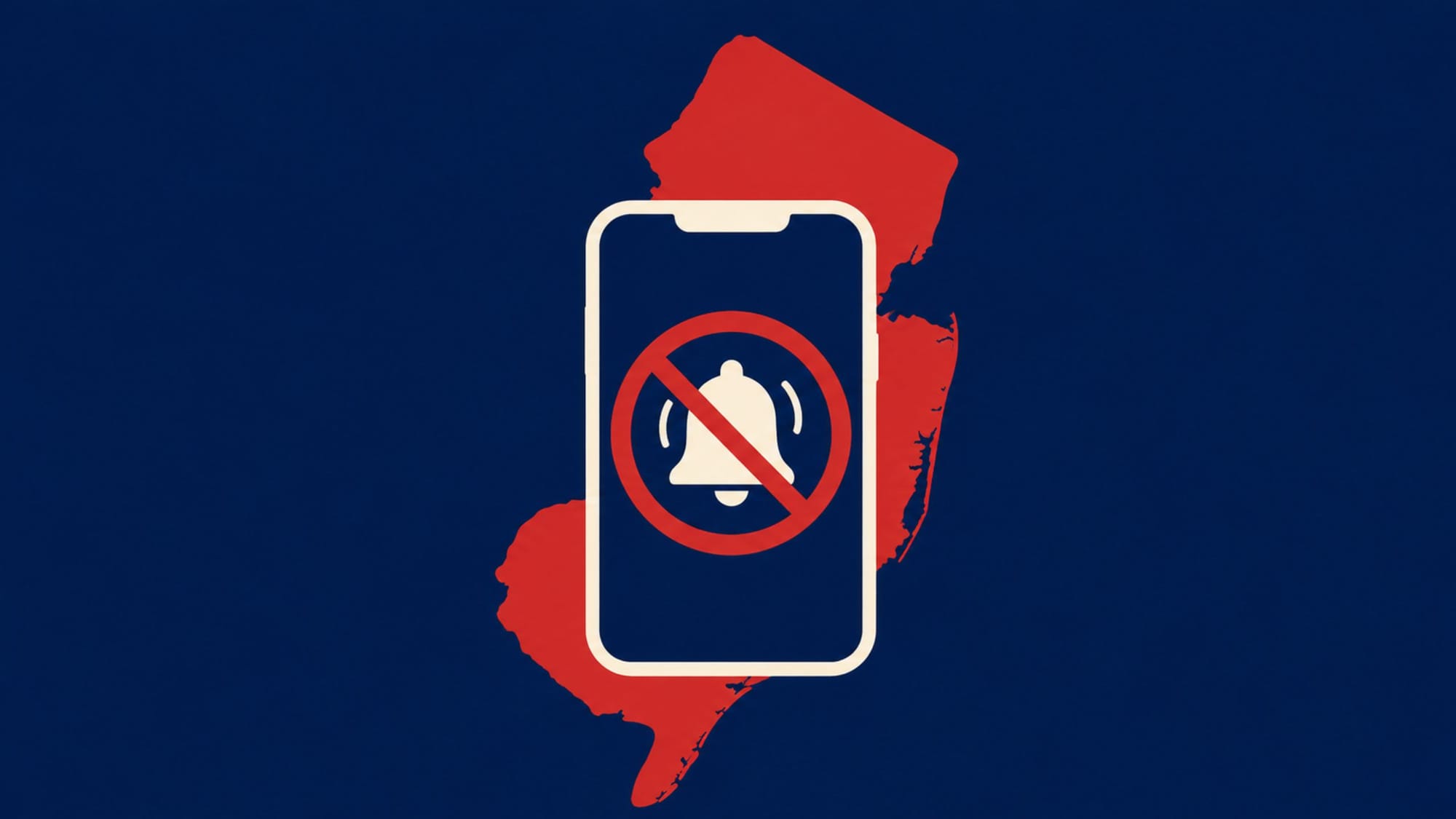
"Big Tech might have stopped politicians in Washington from holding them accountable, but they won't stop us here in New Jersey," Governor Mikie Sherrill said last week, signing three child online “safety” bills. The main part gives the state authority over when a platform may send a child a notification.
A4015, the New Jersey Kids Code Act, requires a covered platform with "actual knowledge" that a user is a minor to keep notifications off that account between 10 p.m. and 6 a.m. daily, and between 8 a.m. and 4 p.m. on school days. "With these new laws, we are putting real protections in place for children online," Sherrill said, "and making clear that technology companies have a responsibility to put kids' safety ahead of profits."
Whether an app may buzz a teenager on a Saturday night used to be settled in the household, differently in each one, and will now be settled in Trenton, by the state, on one schedule for every child a platform knows about.
The duties attach only where a platform has "actual knowledge" of a minor, and a standard like that would normally reward not asking. NetChoice, which opposed the bill before the Assembly Budget Committee, says this one does the reverse: it "functions more like a 'reason-to-know' standard."
A4015 "doubles down on the same First Amendment defects that have already sunk similar 'kids code' laws in Arkansas, California, and Ohio," the group told legislators — "effectively forcing platforms into age verification, relying on vague 'heightened risk' standards that will push companies to over-censor lawful speech, and stripping users, including minors, of their right to speak and browse anonymously online."
It reads the design as deliberate. A4015 "attempts to steer private platforms towards an age-verification regime without formally mandating one, hoping that this will save the legislation from any challenge."
Enforcement runs through the Consumer Fraud Act at up to $20,000 per violation, and NetChoice says the bill likely engages that Act's private right of action, carrying treble damages. Facing that, companies "will have no choice but to collect, and for a period of time store, sensitive user data in order to formally determine the age of every user to avoid liability."
That is digital ID age verification, arrived at without the statute ever using the words, and it lands on the adults too. Courts have struck such schemes down before for forcing people to "forgo the anonymity otherwise available on the internet," and the Supreme Court has said government has no "free-floating power to restrict the ideas to which children may be exposed."
Sherrill's other two signatures set up the studying. A4014 establishes a Social Media Research Center at one of the state's four-year public colleges, backed by $500,000. It "will play a vital role in better understanding the evolving impacts of social media on our young people," Acting Secretary of Higher Education Margo Chaly said.
S3412 writes its brief: addictive social media behaviors among children, and warning labels shown to minors at account creation and each day they open or leave a platform. A report is due within 18 months, feeding rulemaking by the Department of Health.
"Children should be able to learn, connect, and explore online without having their privacy violated, their mental and physical health jeopardized, or their attention manipulated for profit," Attorney General Jennifer Davenport said.
The labels remain a study assignment, not a requirement. What the center is asked to produce is the wording a private company would have to show a child, and the moments it would have to interrupt the child to show it. How often does a research body wired into a rulemaking process report back that no rule is needed?