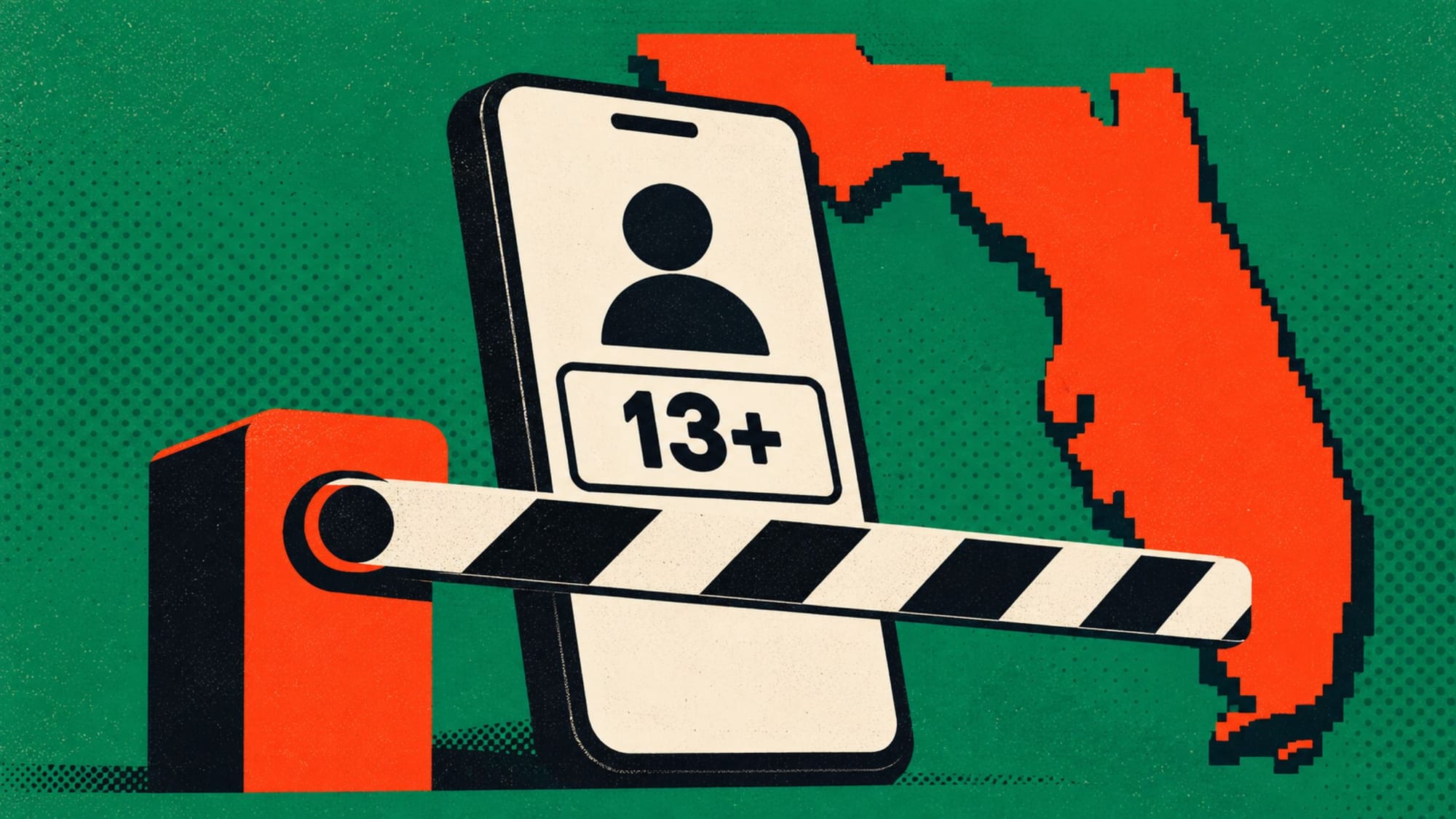
The Eleventh Circuit Court of Appeals has thrown out an injunction against Florida’s social media age verification law, ruling that the law is "likely" constitutional and allowing it to remain in force while a First Amendment lawsuit against it continues.
We obtained a copy of the ruling for you here.
The law, HB 3, bans under-14s from using covered social media platforms, while those between 14 and 15 must have parental consent. The three-judge panel found that it was content neutral, and that Florida has an important interest in protecting minors.
In his opinion, Judge Kevin Newsom wrote, "Yes, it implicates the First Amendment and thus triggers constitutional scrutiny. But it likely does so in a content-neutral manner, and it likely survives intermediate scrutiny because it doesn’t burden substantially more speech than necessary to advance the important interest in protecting minors from social-media addiction."
Newsom also wrote, "HB3 is facially content neutral: It regulates social-media platforms based on their functional capabilities and features, not the content they communicate."
The law covers platforms that use algorithms to recommend content, have features like infinite scroll, push notifications, like counts, autoplay, or live-streaming, and where at least 10 percent of users under 16 spend more than two hours a day.
According to the ruling, the law only restricts creating an account, not using the platforms. Even a minor can continue to use the platforms provided they use their parents' (or someone else's) account, or gain access without an account, the ruling reads.
The court cited the Supreme Court’s 2025 Free Speech Coalition ruling upholding Texas’s age checks for porn sites: "requiring age verification is common when a law draws lines based on age." And, "unlike a store clerk, a website operator cannot look at its visitors and estimate their ages."
The court did not rule on the rights of the users. It said that "CCIA seems (at least for now) to have walked away from it," and rejected their facial challenge for lack of data.
A district judge blocked the law in June 2025; the Eleventh Circuit then paused that injunction on November 25, 2025, allowing Florida to enforce the law, which it has been doing since.
The statute requires platforms to terminate accounts they treat "as belonging to an account holder who is likely younger than 14 years of age for purposes of targeting content or advertising." Violations are punished with fines of up to $50,000 each.
In November 2025, Judge Robin Rosenbaum dissented from the pause, noting that the law "effectively requires linking users’ identities (not to mention their parents’ identities) with users’ social media accounts."
She also noted that this means users "lose the ability to hold accounts anonymously and engage freely in these sensitive discussions."
Rosenbaum also warned that the state may share information from its investigations with another "governmental entity," and asked, "If Florida’s compliance investigation uncovers, say, that a particular social media account belongs to an international student, who has used that account to make posts critical of the Trump Administration, what’s to stop Florida from sharing that information with Immigration and Customs Enforcement?"
In the past, Attorney General James Uthmeier gave social media companies until April 8 to comply with the law, saying, "It is the law of the land."
Meta said it would comply and in May started removing accounts of under-14s in Florida. Florida then sued TikTok for not complying - the first enforcement action under HB 3.
In addition, Florida has asked courts to order Meta to implement age checks for all users, and force OpenAI to implement "a robust and effective age verification system" for ChatGPT.
CCIA President Matt Schruers reacted to the latest ruling by saying, "This ruling is deeply concerning and risks altering First Amendment protections against government interference in online speech for users young and old alike." And, "It grants the government considerable power to manage how its citizens access information, based on Florida’s unsubstantiated claims about addiction." Schruers also said the decision "risks imposing identity authentication on Floridian internet users of all ages."
Paul Taske of NetChoice Litigation Center said, "We are disappointed in the Eleventh Circuit’s ruling, which allows Florida to enforce its law imposing digital ID requirements as a condition for accessing lawful speech." The group said that websites must now verify ages "forcing Floridians of every age to hand over sensitive personal information just to access lawful speech online." NetChoice also said it would explore all options.
The way the law is written, you cannot keep a 13-year-old off a platform without checking the age of every single other user, including adults. And the court's own statement that an underage user can continue to use a platform if they use someone else's account shows that the law achieves nothing but introducing an ID checkpoint for honest users, law-abiding citizens who are not the target of the law, at the door to lawful speech.