
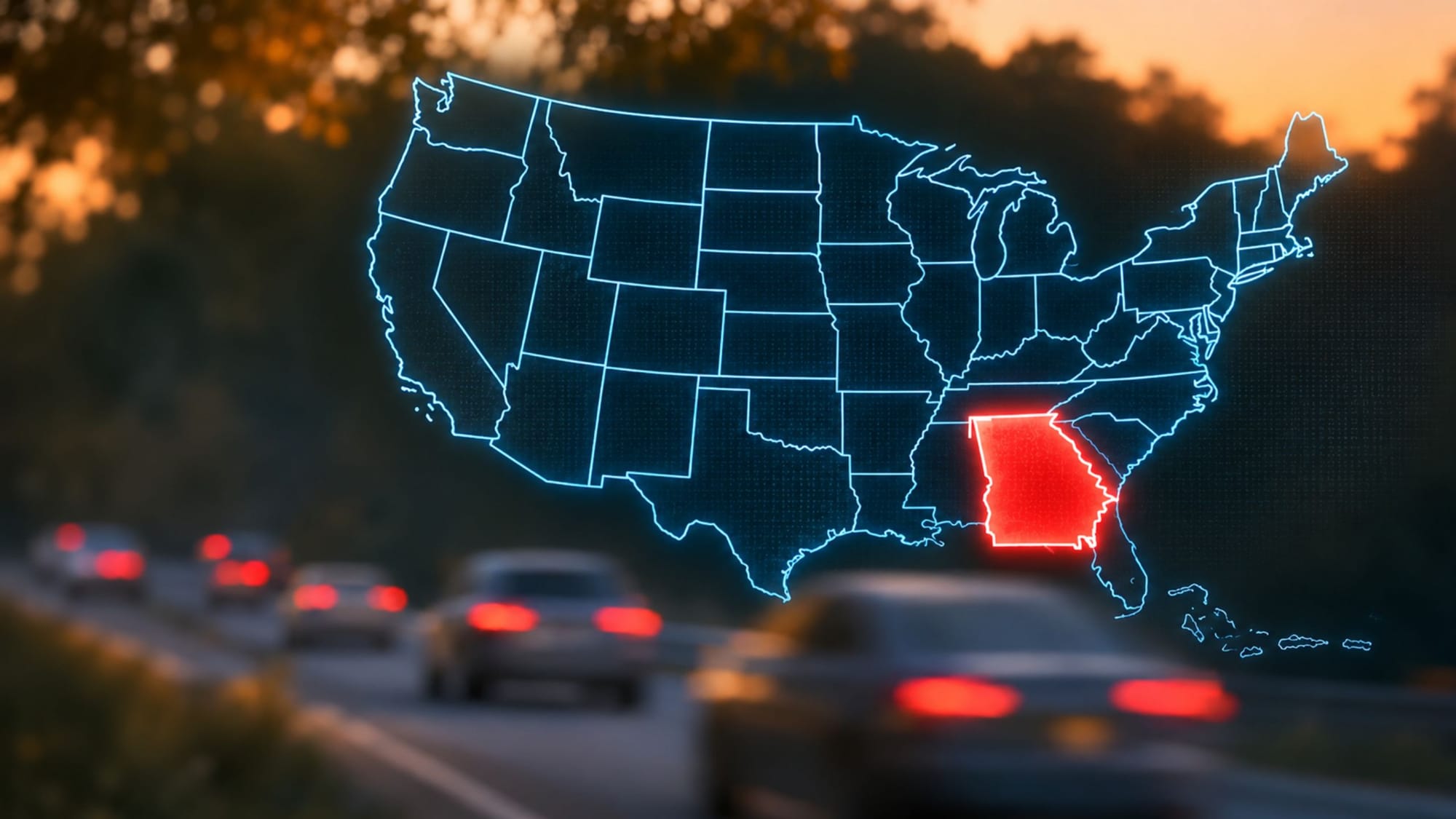
A Reclaim The Net analysis of the locations of Flock Safety license plate readers, mapped by volunteers, shows that there is one of these devices for every 1,200 people in Georgia.
This is the highest density in the US, more than double the national rate, and higher than any other state.
The numbers are based on 116,548 Flock cameras mapped across the country, and the US Census Bureau’s July 2025 estimates of the population. At the other end of the scale, New Hampshire has 19 mapped cameras, or 1.3 per 100,000 people.
Mapped Flock license plate cameras per 100,000 residents, by state/territory
| Rank | State/Territory | Mapped Flock cameras | Population (July 2025) | Per 100,000 |
|---|---|---|---|---|
| 1 | Georgia | 9,407 | 11,302,748 | 83.2 |
| 2 | Ohio | 6,304 | 11,900,510 | 53.0 |
| 3 | Texas | 15,987 | 31,709,821 | 50.4 |
| 4 | Alabama | 2,570 | 5,193,088 | 49.5 |
| 5 | Indiana | 3,433 | 6,973,333 | 49.2 |
| 6 | Illinois | 5,886 | 12,719,141 | 46.3 |
| 7 | Kansas | 1,322 | 2,977,220 | 44.4 |
| 8 | Tennessee | 3,213 | 7,315,076 | 43.9 |
| 9 | California | 17,178 | 39,355,309 | 43.6 |
| 10 | Missouri | 2,567 | 6,270,541 | 40.9 |
| 11 | Kentucky | 1,831 | 4,606,864 | 39.7 |
| 12 | Colorado | 2,336 | 6,012,561 | 38.9 |
| 13 | Delaware | 408 | 1,059,952 | 38.5 |
| 14 | Louisiana | 1,747 | 4,618,189 | 37.8 |
| 15 | Virginia | 3,196 | 8,880,107 | 36.0 |
| 16 | South Carolina | 1,971 | 5,570,274 | 35.4 |
| 17 | Mississippi | 997 | 2,954,160 | 33.7 |
| 18 | New Mexico | 714 | 2,125,498 | 33.6 |
| 19 | Arkansas | 987 | 3,114,791 | 31.7 |
| 20 | North Carolina | 3,421 | 11,197,968 | 30.6 |
| 21 | Wisconsin | 1,822 | 5,972,787 | 30.5 |
| 22 | Florida | 7,153 | 23,462,518 | 30.5 |
| 23 | Oklahoma | 1,247 | 4,123,288 | 30.2 |
| 24 | Michigan | 3,007 | 10,127,884 | 29.7 |
| 25 | Arizona | 2,183 | 7,623,818 | 28.6 |
| 26 | Rhode Island | 296 | 1,114,521 | 26.6 |
| 27 | Washington | 2,111 | 8,001,020 | 26.4 |
| 28 | Minnesota | 1,483 | 5,830,405 | 25.4 |
| 29 | Iowa | 818 | 3,238,387 | 25.3 |
| 30 | Nevada | 758 | 3,282,188 | 23.1 |
| 31 | Utah | 814 | 3,538,904 | 23.0 |
| 32 | South Dakota | 211 | 935,094 | 22.6 |
| 33 | Nebraska | 418 | 2,018,006 | 20.7 |
| 34 | Connecticut | 651 | 3,688,496 | 17.6 |
| 35 | Idaho | 349 | 2,029,733 | 17.2 |
| 36 | North Dakota | 128 | 799,358 | 16.0 |
| 37 | Massachusetts | 958 | 7,154,084 | 13.4 |
| 38 | District of Columbia | 91 | 693,645 | 13.1 |
| 39 | New Jersey | 1,223 | 9,548,215 | 12.8 |
| 40 | Maryland | 741 | 6,265,347 | 11.8 |
| 41 | Wyoming | 67 | 588,753 | 11.4 |
| 42 | West Virginia | 195 | 1,766,147 | 11.0 |
| 43 | Pennsylvania | 1,410 | 13,059,432 | 10.8 |
| 44 | New York | 2,141 | 20,002,427 | 10.7 |
| 45 | Oregon | 358 | 4,273,586 | 8.4 |
| 46 | Montana | 71 | 1,144,694 | 6.2 |
| 47 | Puerto Rico | 145 | 3,184,835 | 4.6 |
| 48 | Hawaii | 61 | 1,432,820 | 4.3 |
| 49 | Alaska | 25 | 737,270 | 3.4 |
| 50 | Maine | 44 | 1,414,874 | 3.1 |
| 51 | Vermont | 18 | 644,663 | 2.8 |
| 52 | New Hampshire | 19 | 1,415,342 | 1.3 |
| United States (50 states, DC and Puerto Rico) | 116,491 | 344,969,692 | 33.8 |
Source: Reclaim The Net analysis of Flock Safety cameras mapped in OpenStreetMap (© OpenStreetMap contributors, ODbL), many added by DeFlock volunteers, as of November 2, 2026; US Census Bureau Vintage 2025 population estimates. Crowdsourced data: counts reflect where volunteers have mapped, and some states are undercounted. Excludes the US Virgin Islands (57 mapped cameras), which are not in the Census state estimates.
The Flock cameras are part of a system that photographs every passing car, reads and stores the license plate number along with the time and place of the sighting. But this is not just a local issue – because agencies that have signed up to the Flock network can search each other’s cameras, effectively making every town that buys the system part of a national surveillance network.
When Senator Josh Hawley wrote to Flock Safety in August, he put the number of these cameras at more than 120,000, in 49 states, producing more than 20 billion vehicle scans per month.
Hawley, a Republican, reacted to this by saying, “But Americans do not surrender their privacy rights when they drive to work, drop their kids off at school, or go to church” and “Congress never authorized the network your industry has built.”
In October, the Justice Department tried to downplay the issue by telling the Fifth Circuit that being watched on the road is “a reality of modern life.”
However, Chief Judge Jennifer Walker Elrod asked, “What if it becomes not spread out and it’s on every corner, which it’s soon to be?” and “Is it really episodic when it so permeates everything?”
The answer to the judge’s question is the density of the network. The higher a state ranks in terms of the number of cameras per head, the closer every trip its residents make is to being logged, and the more likely it is that a few photos become a detailed travel history.
The ranking shows Ohio second with 53.0 Flock cameras per 100,000 people, followed by Texas with 50.4, Alabama with 49.5, Indiana with 49.2, and Illinois with 46.3.
Flock Safety is headquartered in Atlanta, Georgia. In August, the Georgia Bureau of Investigation arrested four former Savannah Police Department employees accused of using the system for non-law-enforcement purposes.
California has the most Flock cameras, with 17,178, and Texas is second with 15,987. However, their large populations put them in 9th and 3rd place, respectively, in terms of the number of devices per 100,000 residents.
In Texas, the cameras were paid for with a $1 fee on every auto insurance policy that was introduced to fight the theft of catalytic converters. The state spent at least $30 million on at least 3,200 Flock cameras. On August 27, outgoing Governor Greg Abbott paused state agency funding of the system. Flock Safety says that “new city partnerships have outpaced nonrenewals by approximately 10 to one.”
At the other end of the scale, New Hampshire has the fewest Flock cameras per head, followed by Vermont with 2.8, Maine with 3.1, Alaska with 3.4, and Hawaii with 4.3.
New Hampshire state law says that “neither the state of New Hampshire nor its political subdivisions shall engage in surveillance on any public ways” – with exceptions. Police are allowed to use license plate readers, but the data must be “purged from the system within 3 minutes of their capture” unless it is tied to an arrest, a citation, or a wanted vehicle.
So the state with almost no Flock cameras is the one that has forbidden keeping the data produced by these devices.
The Northeast is broadly lagging behind in terms of the number of Flock cameras per head. New York has 10.7, Pennsylvania 10.8, New Jersey 12.8, and Massachusetts 13.4.
In Massachusetts, a Suffolk Superior Court judge ruled in September that State Police must disclose where their Flock cameras are located and when troopers search the database. This was the result of a records fight by the ACLU of Massachusetts, as reported by the Boston Globe.
Flock Safety makes about 80 percent of all mapped plate readers, with the rest mostly being Motorola Solutions, Genetec, and Axis. When all makers are counted, the top three states are Georgia with 91 per 100,000 people, Kansas with 69.5, and Illinois with 59.9.
In Kansas, Wichita machinist Mason Grimmett is suing the city, saying that the police can “reconstruct where you sleep, work, worship, seek medical treatment, protest, who you associate with – currently without a warrant.”
As for other types of surveillance devices, Flock Safety also makes gunshot detectors, which are always-on microphones. These are most densely placed in Virginia, with 478, or 5.4 per 100,000, followed by Georgia and Louisiana. About two-thirds of these devices are Flock’s Raven.
It’s not just law enforcement that operates these cameras – retailers are among the biggest operators, with Lowe’s having 1,690 and The Home Depot 1,133 mapped devices, more than any police department. And private customers like these can choose to share their cameras with the police. This means that efforts to introduce oversight of the system that is focused only on police usage miss a part of the network.
There are several federal bills, including the Ban Flock Act (H.R. 10691), the Flock-Off Act (H.R. 10221), and the Protection Against Mass Surveillance Act (H.R. 9800). The latter has been promised a House vote in the lame-duck session by Speaker Mike Johnson.
According to our bill tracker, H.R. 9800 “does not restrict surveillance purchased entirely with state or local funds, leaving a substantial part of the national camera network outside its reach” – and our count shows that it is the local networks that achieve the highest density of cameras in some states.
The OpenStreetMap data of Flock cameras used in this article was last updated on November 2, and the population figures are the US Census Bureau’s July 2025 estimates. The numbers are subject to some uncertainty since the map is a crowd-sourced effort and some states are likely undercounted because fewer volunteers are mapping cameras there. The total number of Flock cameras is close to the 120,000+ figure cited in Senator Hawley’s letter.
Outgoing Florida Governor Ron DeSantis has ordered the cameras to be removed from state highways, while Texas has paused funding. At this point, where you live in the US determines how much of your driving can be reconstructed and replayed by the police later – in New Hampshire, that record is gone in three minutes, while in Georgia it can become a detailed diary of your movements.