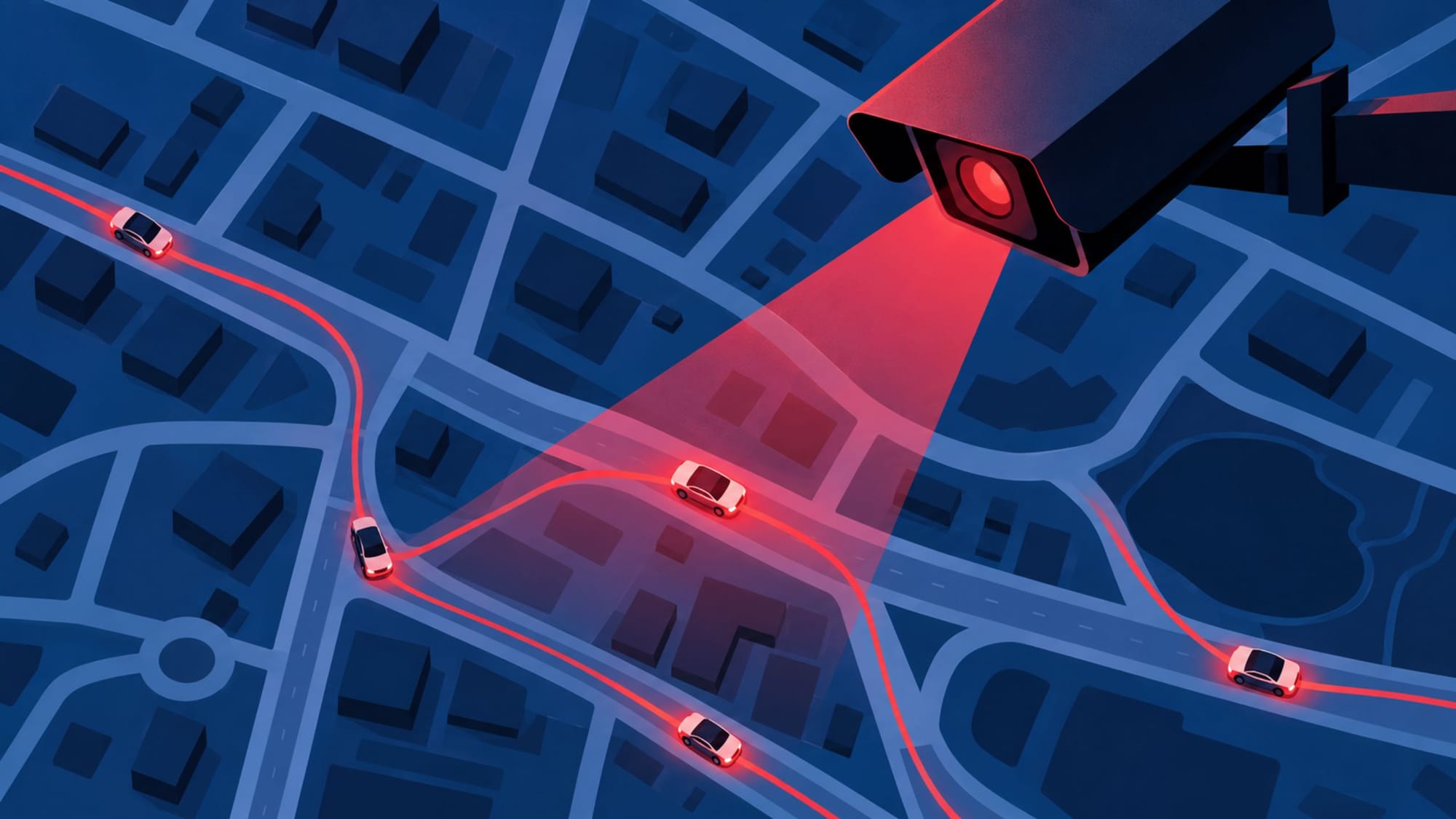
The federal government already uses Flock data and is trying to get the courts to agree that the surveillance data collected by these devices is not protected by the Fourth Amendment.
A bill that would prevent the feds from accessing this data, by cutting off every federal agency from automated mass surveillance systems, including Flock, has been promised a vote in the House of Representatives in the lame-duck session.
The promise was made by House Speaker Mike Johnson at a campaign stop in Michigan, where he was supporting one of the bill's cosponsors, Rep. Tom Barrett, who is in a tight race.
The vote is set to take place after the elections, and the paper quoted a GOP source as saying that any Flock legislation "could face headwinds in a post-election House, particularly if Republicans lose the majority and face attendance issues."
The Protection Against Mass Surveillance Act was introduced in July by Rep. Tim Burchett, and has eight cosponsors, including Barrett. It is short, consisting of only three sections, and is broad, targeting not only Flock cameras but also facial recognition tech, and biometric ID.
However, the proposed legislation does not cover cameras paid for with local money, so if it becomes law, it would not affect a significant portion of the automated surveillance network across the country.
The bill provides that "no federal agency may purchase, deploy, operate, access, or contract for any automated surveillance system that identifies, tracks, or records individuals."
In addition to Flock, this would include facial recognition technology, biometric ID, and "any technology that captures, analyzes, or retains a person's image, likeness, or other personally identifiable information for the purpose of conducting persistent or mass surveillance."
The federal government would also not be able to fund state, local, and Tribal governments for the purpose of buying or using these systems. If data is obtained in violation of this proposed law, federal agencies would have to delete it within 30 days, and it could not be used as evidence in court.
At a Senate Judiciary hearing on September 15, FBI Director Kash Patel said of license plate data: "They collect information, not the FBI." Instead, the agency is "utilizing the fact that this great information has been collected and sitting on the shelf."
The bill introduced by Burchett, and now supported by the Speaker, would close off this route for every federal agency, by preventing them from accessing data collected by automated mass surveillance systems.
This is the data that the Justice Department is now trying to convince the courts is not protected by the Fourth Amendment. On October 5, a DoJ lawyer told the Fifth Circuit in US v. Brownlee that citizens have no reasonable expectation of privacy when driving on public roads because they expect to be "subject to intermittent surveillance."
In Oklahoma, federal judge Sara E. Hill ruled in United States v. Kyle that a sheriff's deputy who searched plate-reader databases without a warrant violated the Fourth Amendment, calling the technology "a type of indiscriminate mass surveillance."
Even if the House passes the Protection Against Mass Surveillance Act, it is uncertain what the fate of the bill would be in the Senate.
Sen. Josh Hawley, who held a hearing on Flock in late September, said the company "maintains a network of 120,000 individual cameras in 49 states all across this country."
Flock told the New York Post it favors "strong policy, accountability and oversight mechanisms."
Another bill, the Flock-Off Act, was introduced by Rep. Thomas Massie and would cut off federal funding for license plate readers and biometric cameras. The Ban Flock Act, introduced by Rep. Alexandria Ocasio-Cortez, would ban the use of license plate readers by federal agencies, as well as prohibit federal funding for their purchase by local police.
The Institute for Justice (IJ) has been testifying in Congress about the issue of mass surveillance, and in one instance, its written testimony to the Senate showed that in San Jose, 474 cameras captured over 360 million photos in 2024, but only about one-quarter of one percent triggered a "hotlist" alert.
Our H.R. 9800 bill tracker notes that the bill "does not restrict surveillance purchased entirely with state or local funds, leaving a substantial part of the national camera network outside its reach."
Johnson's promise covered two Barrett bills, this one and his Iran war authorization. Asked about both while campaigning for Barrett, Johnson said they "will be processed in the lame duck right after the election."
However, a promise made on the campaign trail, even by the Speaker, is not the same as a vote, and it remains to be seen if the Republican majority will be able to push this legislation through, and if the Senate will accept it.
For now, all we can do is hold him to it, and also remind him that even if this bill passes, the mass surveillance carried out by Flock and others will continue unabated wherever local money is used to fund it.