A federal district court in the Central District of California has ruled that police queries of automated license plate reader (ALPR) databases are not Fourth Amendment searches.
The case is United States v. Riley, 2:25-cr-00380, and the decision came in the form of a September 10, 2026, order denying a motion to suppress evidence.
The court’s reasoning, as outlined in the ruling, is that the detectives only came away with eight photographs from the database – four of a white Dodge Charger and four of a gold Chevrolet Malibu.
This, the court said, is “clearly distinguishable from and less extensive than the ‘near perfect surveillance’ achievable through the historical CSLI at issue in Carpenter and the Google Location History data at issue in Chatrie.”
Stanford law professor Orin Kerr, who wrote about the ruling on September 16, said “This is just a trial court decision, of course, and I assume it will be appealed to the court of appeals.” He added that it is the first court decision he is aware of that considers the question of ALPR data in the wake of the Supreme Court’s Chatrie v. United States decision in June, and noted that the 11th Circuit Court of Appeals heard oral arguments on the same issue on July 29 and has not yet ruled.
That ruling established that acquiring Google Location History is a search, because it records the location of a user’s cell phone every two minutes or so and gives a “sweeping, granular, and comprehensive tool” to track people’s movements.
Two defendants, Melvin Riley and Kenneth Holley Jr., are charged with Hobbs Act robbery, conspiracy to commit robbery, conspiracy to commit kidnapping, and kidnapping.
The charges stem from two investigations, in Culver City and Carson, that both used ALPR data.
The number of photographs is the key to the court’s decision, and it quoted the relevant case law to say that the data obtained by the police here could not create “an all-encompassing record” of a defendant’s whereabouts, nor could it “recreate the complete paths that Defendant traveled in those cars, even in combination with information from other sources.”
The police had no “intimate window” into the defendant’s personal life, the ruling continued, and the data did not reveal “familial, political, professional, religious, and sexual associations.”
And, the court said, this was not “dragnet type law enforcement practices.”
The conclusion is that the ALPR queries “do not constitute searches for purposes of the Fourth Amendment.”
The court also rejected the argument that the ALPR systems in question are “extensive, retroactive,” and allow for “deductions about individual’s daily movements over an extended period of time that ‘go to the privacies of life, the epitome of information expected to be beyond the warrantless reach of the government.'”
The court noted that a previous ruling in the Northern District of Ohio in 2025 found that a defendant has no reasonable expectation of privacy “in the appearance of his vehicle or in his license plate number.”
The court also found that the systems used by Culver City and Carson are not as comprehensive as the one in the Baltimore aerial surveillance case that the Fourth Circuit found unconstitutional.
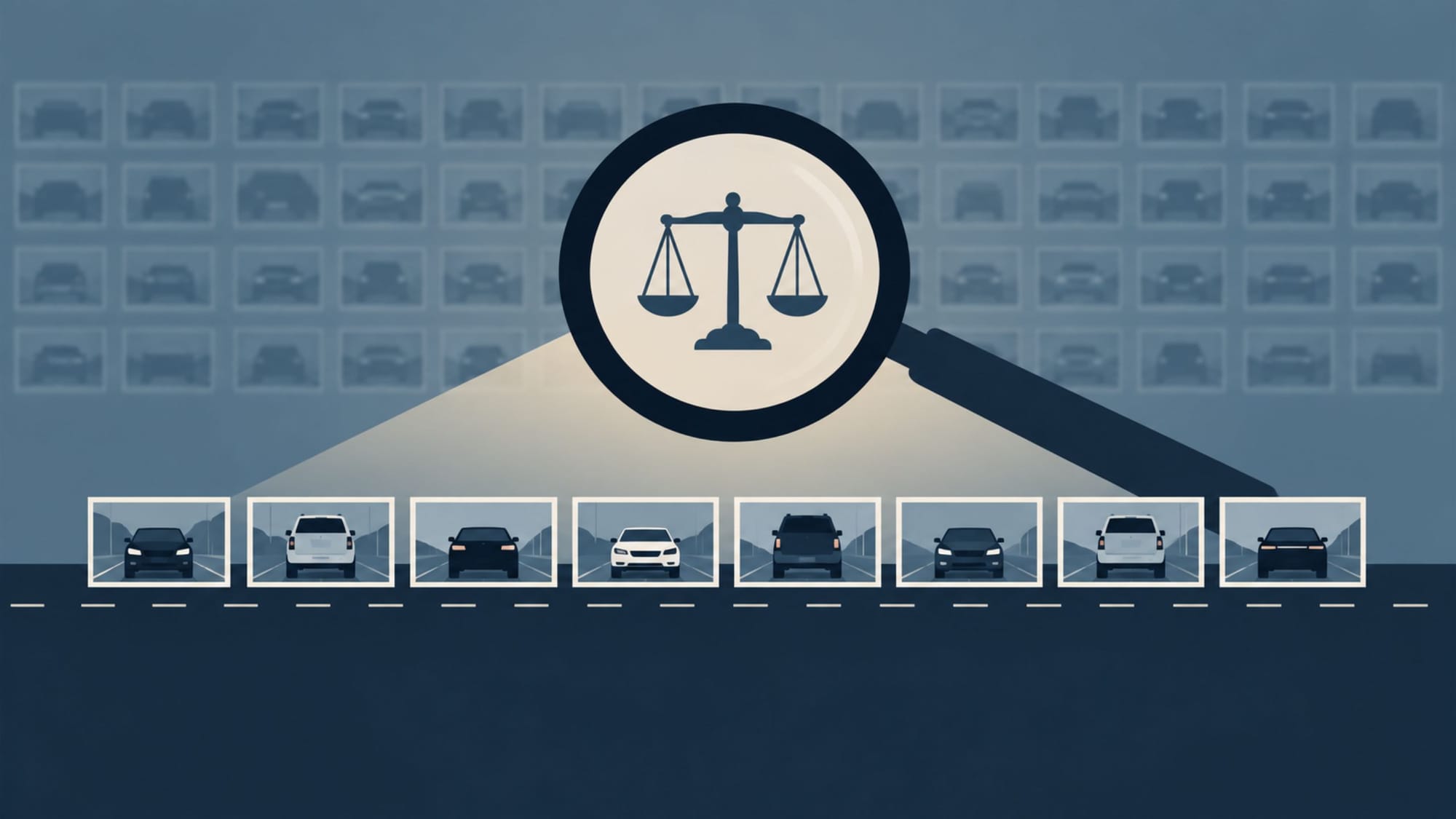
The eight photographs at the heart of this ruling were discovered in the following way: Culver City Detective Preston looked at “less than 100 photographs” in the Flock database, and found four that matched the white Dodge Charger. A subsequent search by plate number yielded one more. In Carson, Detective Maciel found four photographs of the gold Chevrolet Malibu. And a Home Depot in the same shopping center as the McDonald’s had its own Flock system, which captured a photograph of the gold sedan’s license plate and gave it to the police.
Culver City uses Flock, which has 52 cameras at 28 intersections – “four percent of the city’s intersections” – and takes “18 million photographs a month,” storing them for 30 days. Only the Culver City police can search the database, and they can do it by plate number, location, roof rack, back rack, decals, bumper stickers, make, model, or color.
In Carson, the Motorola system has 85 cameras at 31 locations, covering 75 percent of the city’s entry points. In April 2025, the data was stored for five years, and the police could access it with a case number.
The court noted that there is no way for citizens in either city to opt out of the systems.