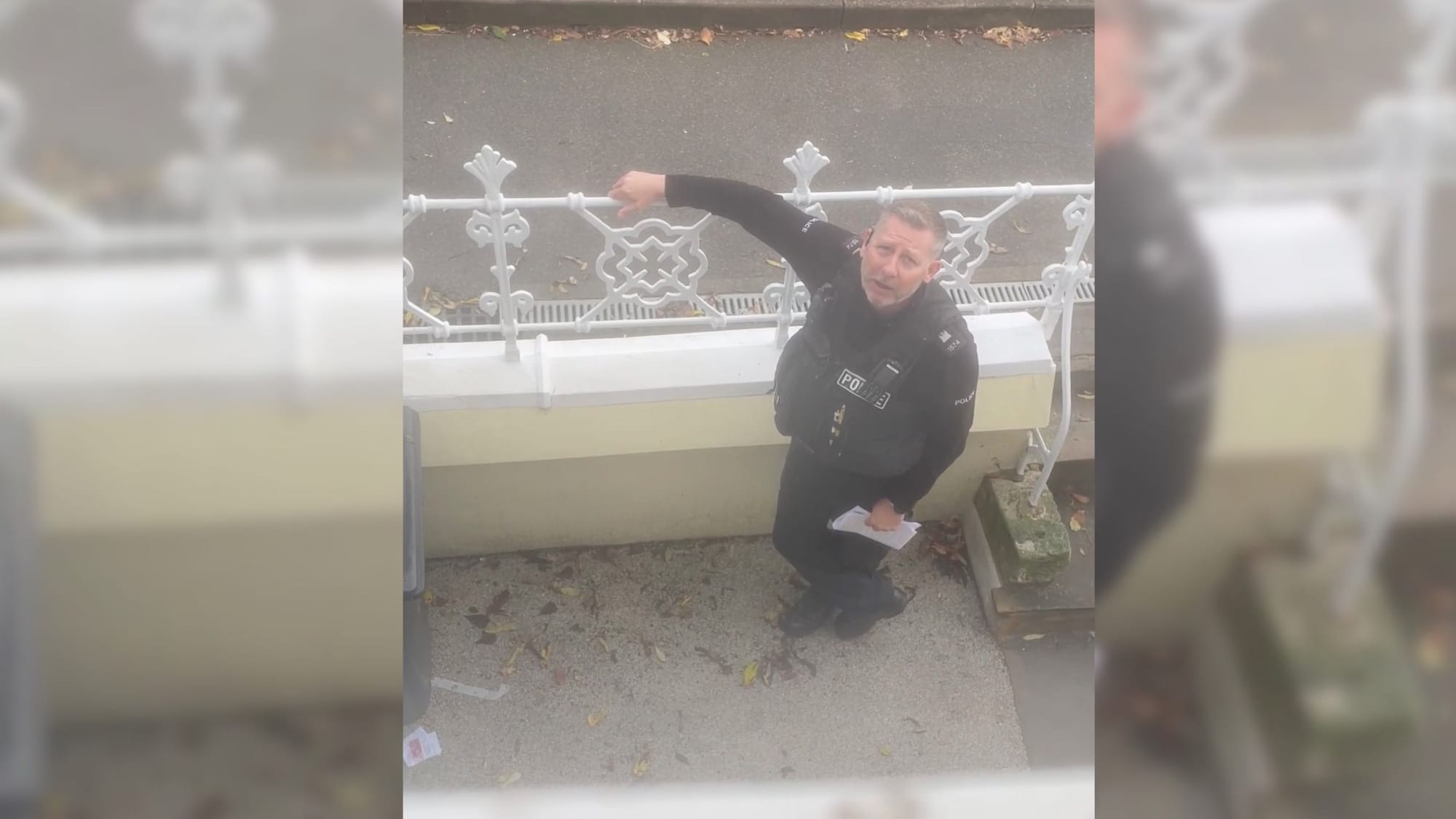
In a country where people are repeatedly visited by the police over social media posts, a woman has been given a warning by an officer who admitted that he didn’t even know if she was the one who actually made the post in question.
A video of the exchange was published on X by Joanne May, who runs Oldspeak Bookshop, which says it is “Britain’s only dissident bookshop.”
In the footage, the police officer can be heard saying that the complaint was about “the two gentlemen that you’ve pictured and then ridiculed” – and that “you’ve basically put a picture of them on your webpage and then literally the comments that you’ve created.”
May is heard explaining that she took the picture but did not add speech bubbles to it. The policeman, however, insisted that “it’s linked to your website.”
When May again denied that she was the one who put up the post, the officer asked her: “Well who put the post up then.” She replied: “I don’t know, have a look, you’re the one looking.”
But the officer later admitted: “I don’t know who’s done that.” May responded: “Nor do I, so why are you coming to me?”
The policeman’s explanation was that he was giving her “words of advice.”
It’s unclear what the offense could be, since the officer admitted that he didn’t even know if May was the one who made the post. The “advice” he gave was that “you need to be aware of what you’re putting on your page” – because “if it starts creating comments it can incite hatred.”
At one point, the officer told May: “You are quite able to put on your private page, whatever you want.” But then he added: “To a point.” When May asked what that point was, he replied: “I suggest you look it up.”
In the end, the officer told May: “I’m advising you to be aware of what you’re putting on your page because if it continues and we can prove that there are offenses there, then next time we come back we will have a conversation at the police station.”
May responded: “So you come round here for something that I haven’t done.”
Oldspeak Bookshop opened in June 2025 in a converted chapel in Long Melford, Suffolk, with a logo featuring the singing thrush from George Orwell’s 1984. In August, the physical location was closed and the business went online-only, with May explaining at the time that it became “increasingly difficult to maintain a welcoming environment due to the constant hostility I experienced.”
In September, the Big Brother Watch campaign group said that at least 62,199 people had been arrested over the previous five years for online or phone speech, while 12,292 were convicted.
In 2025, a woman was visited by police over Facebook posts about a local councillor – and was told that “there’s not a lot we can do, we are just giving you advice.”
And in July, two officers warned a man in a Chiswick pub over tweets about a councillor – and were recorded on camera admitting that the man had broken no law.
This is only the latest in a long series of incidents in the UK where police pay visits to citizens over their online speech – and sometimes, as in this case, it’s not even clear if the person they are visiting is the one who actually made the post in question.