Apple has announced changes to its App Store rules in Europe, to take effect on October 1, in an attempt to end a long-standing competition dispute with the EU.
On August 18, Apple announced that it was making the changes to its online marketplace – a move that the EC has welcomed.
The European Commission (EC) said that the changes follow "a close dialogue" with Apple, and that it will monitor how the company implements the new terms.
But not everyone is convinced that the changes are as significant as Apple and the EC are trying to make them seem.
For one thing, Apple is dropping the per-install fees it charged developers who distributed their apps outside of the App Store. Apple is also doing away with several fees and replacing them with a single, unified one, and lowering its cut of App Store sales.
Some new features will also be added, such as "child-safety" tools, Apple said.
However, the giant is not giving up on taking its cut from app developers. It's simply changing the way it goes about it. Instead of the previous 30% cut from in-app purchases, Apple will now take 26%, with a discounted rate of 15% for those in its various programs.
Apple's new fees are as follows:
• 26% (or 15% discounted) for apps using Apple's own In-App Purchase
• 20% (or 10% discounted) for apps using alternative payment processing
• 15% (or 10% discounted) for apps that link out to complete a purchase
• 5% Core Technology Commission on digital transactions for apps distributed through alternative marketplaces or the web
This is a simplification of the previous system, which included a Standard and an Alternative Terms Addendum, with a Core Technology Fee of €0.50 per install per year on every install above one million, a 2% Initial Acquisition Fee, and a tiered Store Services Fee.
Epic Games CEO Tim Sweeney, who has been challenging Apple's anti-competitive behavior, is not buying it though. In a post, he said that Apple was introducing a "new junk fee structure in EU, mirroring the terms in Brazil and Japan."
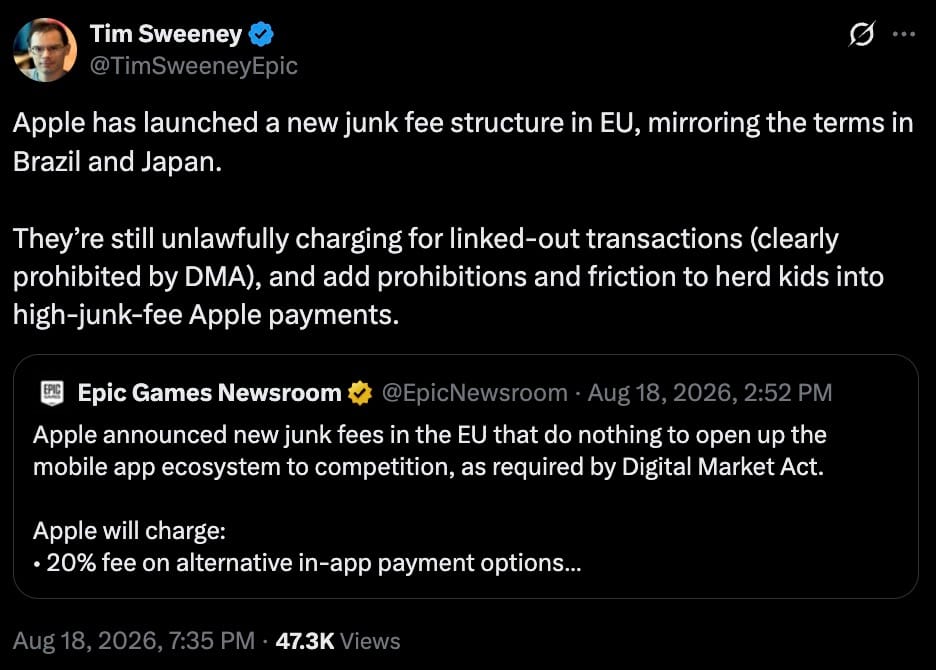
"They're still unlawfully charging for linked-out transactions (clearly prohibited by DMA), and add prohibitions and friction to herd kids into high-junk-fee Apple payments," Sweeney continued.
Apple and other Big Tech have for years been under fire for gatekeeping and extracting exorbitant fees from developers and users alike, and for using their power to stifle competition.
The DMA was meant to change that but, so far, the biggest example of it being "enforced" has been this move from Apple, which the company frames as compliance.
Detractors see it as Apple trying to "repackage" its existing practices and continue to extract fees from developers and push them and users toward its own payment processing.
While the DMA was meant to open up the App Store and other Big Tech's platforms, the fine print of this particular proposal seems to be doing the opposite. This new fee structure still allows Apple to collect substantial commissions on alternative payment options and especially on link-outs to external purchases, practices that do undercut the DMA’s requirement for developers to steer users to competing options free of charge.
By retaining these charges alongside residual restrictions and the same old friction that encourages reliance on Apple’s own higher-fee payment system, this is still all about Apple's ability to extract revenue and limit competition rather than just opening the platform as the law called for.