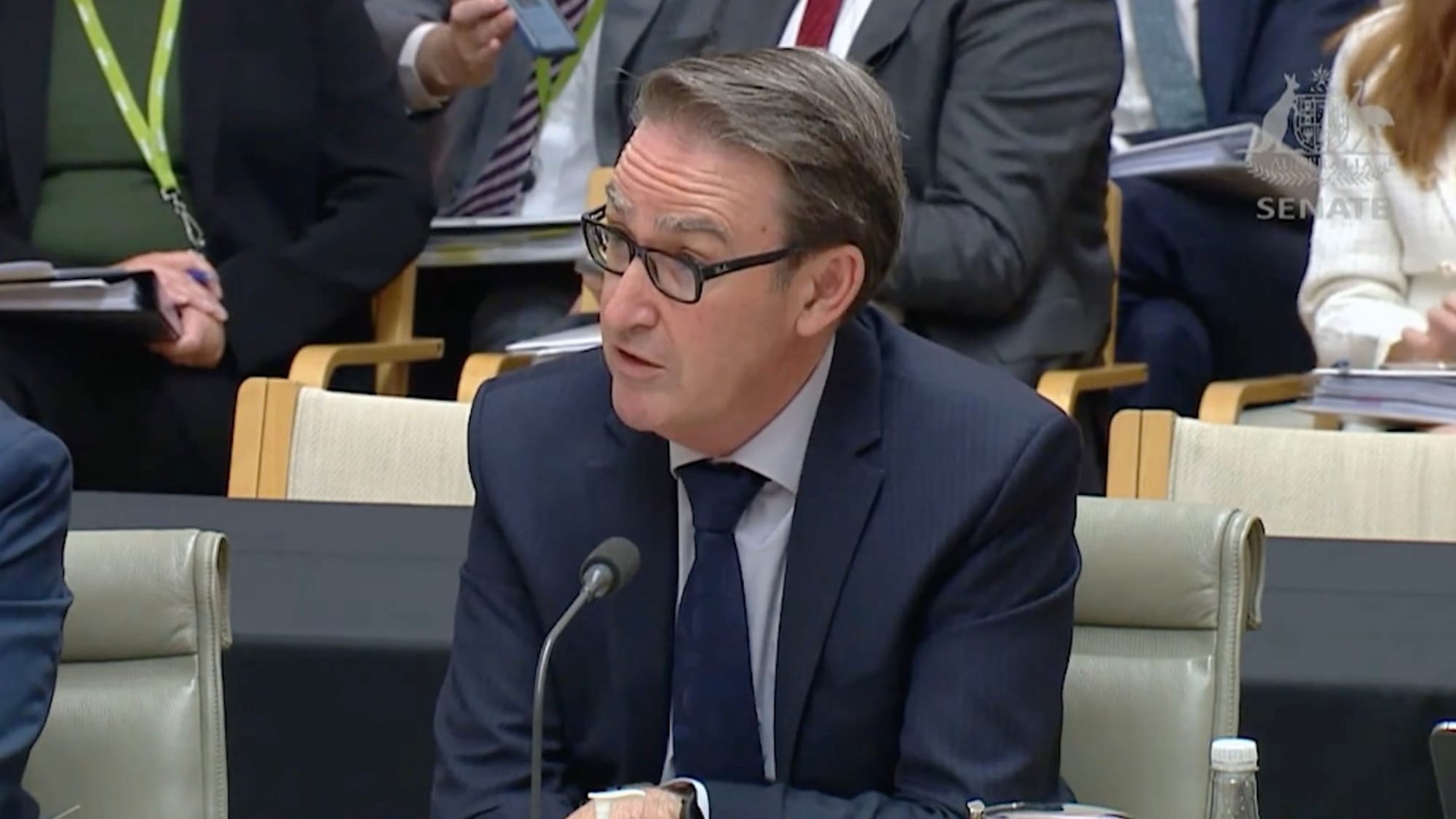
Just when you thought Australia’s steamrolling toward censorship couldn’t get any worse, the heads of Australian government departments want new limits on how members of parliament share recordings of officials testifying at public parliamentary hearings.
A new attempt to this end was made last week by the Secretaries Board, made up of the heads of Australia’s government departments. The board is currently chaired by Steven Kennedy, secretary of the Department of the Prime Minister and Cabinet, which advises the prime minister and coordinates policy across the government.
The proposal was contained in a submission to the Parliamentary Joint Committee on Parliamentary Standards.
The board is unhappy that politicians are using excerpts of the footage from these hearings, often to criticize the officials, and sometimes to ridicule them, by editing the clips and adding captions to highlight certain parts of the testimony.
Comments left on social media under these posts are also a major concern for the board, as they can be “highly offensive” – and sometimes even defamatory.
As examples, the board cites personal attacks on officials’ physical appearance (especially if they are women), their integrity, as well as comparisons to “Nazis, pedophiles, and other criminal offenders.”
Some of the “highlights” of the comments mentioned in the submission include “despicable,” “filth,” “political puppet,” “bigot,” “pig,” “KKK member,” “parasite,” “shill,” “criminal,” “fraud,” “clown,” and “lying corrupt grub.”
The board wants parliament to come up with “guidance” on how to use these recordings on social media, and lists several ways to do it, such as preventing “potentially harmful” use of committee evidence, and requiring that a link to the full hearing or transcript is provided whenever an extract of an official’s testimony is posted.
Another idea is to have MPs disable comments on social media when they post these clips, and make sure that the full, unedited version of the hearing, or the transcript, is made available instead of extracts.
Reporting on the submission described full hearings and transcripts as the preferred approach, with fallback restrictions on editing, captions and posts targeting individual officials.
The submission said that officials appearing at these public hearings “have not consented to a subsequent use of their image, or its use by parliamentarians and their political parties for party-political purposes.”
And the board also complained of “the increasing use of excerpts from committee proceedings on social media, particularly where material is presented without context and exposes officials to ridicule, hostility or abuse.”
The proposal was rejected by Greens Senator Steph Hodgins-May, who said that bureaucrats should not be allowed to decide how parliamentarians do their job, and that the proposed restrictions would be an attempt to “take the teeth out of parliamentary scrutiny.”
“Bureaucrats shouldn’t get to decide where to draw the line on parliamentary scrutiny, particularly when they’re the ones being scrutinised,” Hodgins-May said. “Restricting what parliamentarians can post from public proceedings is not the answer. This looks like an attempt to take the teeth out of parliamentary scrutiny. Frankly, if this scrutiny wasn’t having an impact, they wouldn’t be so worried about it.”
But the board’s proposal is not the first of its kind. In fact, the previous week, Celia Perkins, deputy secretary of Australia’s Department of Defence, made a similar request to a parliamentary hearing, asking that the committee prevent MPs from sharing video and audio of officials appearing at public hearings on social media.
Perkins said that public servants giving evidence “do not consent to the reposting of our evidence to social media sites or the reproduction of our likenesses for the purposes outside the framework of the parliament and the transparent public proceedings of this committee.”
However, the Senate committee rejected the request on the advice of the Senate clerk.
Professor Luke Beck from the Monash University Law School, who specializes in constitutional law, believes that the latest proposal may be unconstitutional because it would likely violate the implied freedom of political communication in the Australian Constitution by “directly and expressly” burdening political communication.
However, the fact remains that the people who are asking for protection from ridicule and criticism here are senior officials appearing before the very institution that is tasked with scrutinizing their work – the parliament.
In other words, the conflict here is not between social media users and the government, but between the government and the institution that is supposed to keep it in check, and ultimately, between the government and the people who elect it, and whom the parliament represents.