The Democrats have come out on top in the November 3 US midterm elections, and some of them wasted little time in declaring what they would like to do first: take on the tech industry and put the government in charge of AI development.
The comments started appearing on X within a day of the election, with Rep. Yassamin Ansari posting, “Top of the Democratic agenda on day 1 needs to be a pause on advanced AI development, regulation of this out of control industry, and a ban on artificial superintelligence.”
A member of the House Democratic leadership, Rep. Ted Lieu, also quickly got down to business, announcing that the new Congress would be holding hearings on AI, and that “reasonable guardrails” would be introduced around the tech.
Lieu criticized Republicans for allegedly deciding “to let the AI industry run wild.”
It’s the type of regulation that is the problem, not its quantity. The “guardrails” Lieu and others want to put in place are those that would give the authorities the power to decide who can build and use software, and under what conditions.
That is the same type of “regulation” that is present in the Ban Artificial Superintelligence Act, introduced in the House by Rep. Greg Casar, and in the Senate by Bernie Sanders. The bill is essentially a licensing scheme that would give a newly created cabinet Department of Artificial Intelligence the power to decide which companies can build “advanced” AI.
“Advanced” is defined as AI trained on at least 10^25 operations. Those allowed to build such AI would have to obtain a charter from the department, and then give its secretary access to “systems, staff, and physical premises.”
Flagged systems would be cut off from the internet. Executives who recklessly violate the terms of the bill could end up in prison for up to 20 years, and if a company’s charter is revoked, its assets can be seized.
Reclaim The Net has been tracking this bill and we noted that, “Publishing code and model weights is a form of expression, and this bill puts prior government approval in front of it.”
In the wake of the election, Casar described the results as “the early tremor of a much bigger AI earthquake upending American politics.”
Some of the newly elected officials also ran on an AI platform. In Michigan, Sen.-elect Abdul El-Sayed wants to build on the Ban Artificial Superintelligence Act, and has proposed “at an absolute minimum” a pause in “AI frontier development” and a Cabinet-level AI watchdog agency.
El-Sayed also wants “public ownership of frontier AI labs” and a ban on warrantless AI-powered surveillance. The latter is a good idea, but it’s unclear if the plan is to give the government more power over the industry, while taking away the ability of citizens to use the same tech.
California’s Rep.-elect Scott Wiener has also announced his intention to push for a federal regulatory body to “oversee AI safety and security.” Wiener also wants a federal framework that would impose “real civil and criminal penalties for weaponized deepfakes” and “platform accountability for the amplification of synthetic disinformation.”
In Colorado, Rep.-elect Manny Rutinel has said he will back “age checks and parental controls on AI chatbots for minors” and “independent safety reviews before major model releases.” That means digital ID checks.
In Iowa, Rep.-elect Christina Bohannan’s message was brief: “We have to legislate for the perils and the promises of artificial intelligence.”
As for those already in office, Sen. Mark Warner said, “this is too important to be left to Donald Trump and a few of these tech bros making all the rules.”
Warner has his own bill that would create a federal AI Safety Board whose standards would be mandatory for developers of “frontier” models. The board would have access to a model at least 45 days before it is released.
Illinois Gov. JB Pritzker is boasting about having “enacted the toughest AI regulations in the country.”
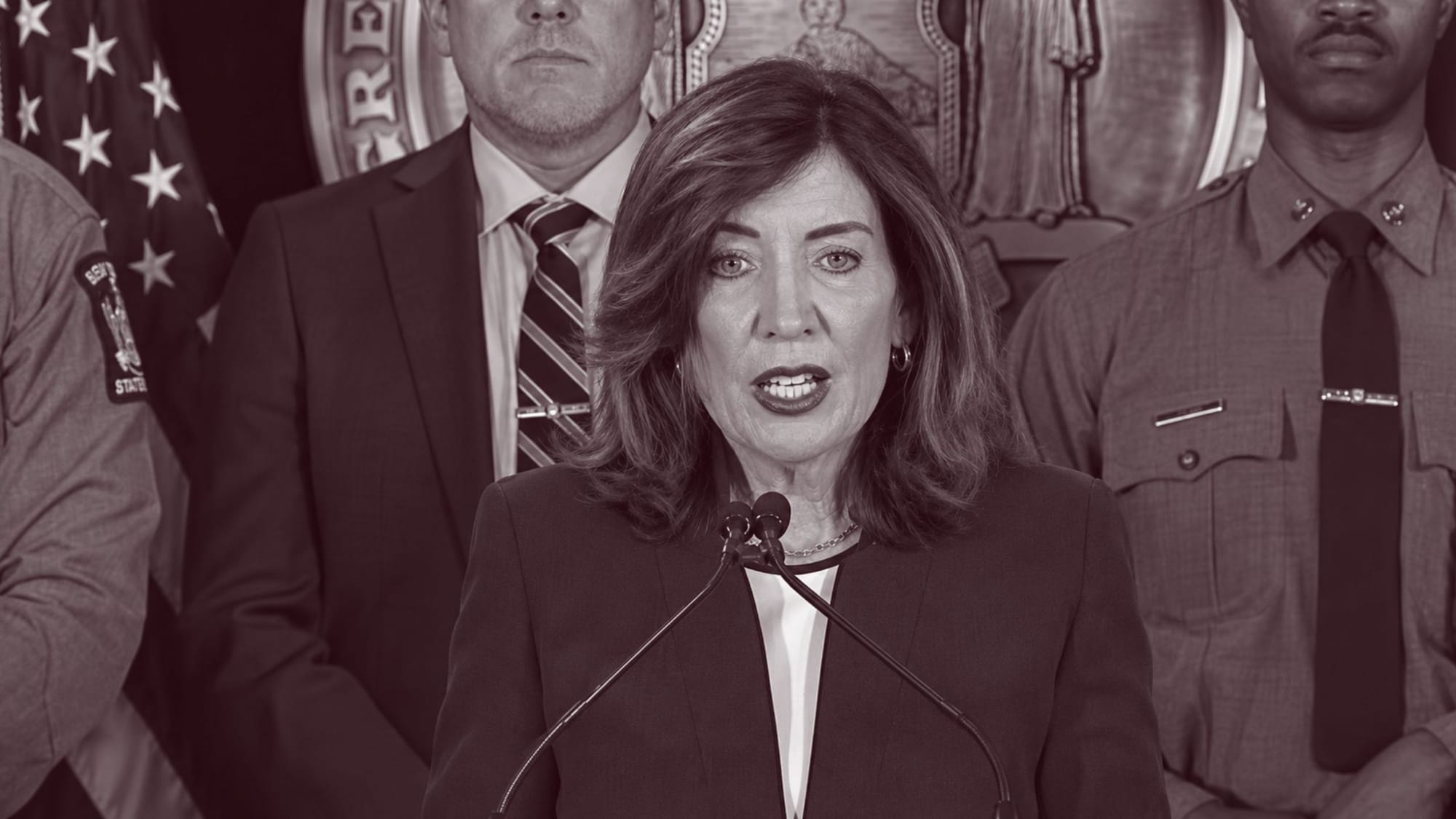
New York Gov. Kathy Hochul, meanwhile, said in her victory speech that “we’re holding the world’s largest, most powerful AI companies accountable.”
A few days earlier, she signed a bill that, according to her office, means companies may not offer certain chatbot features “to any user unless the company has first confirmed the user is not a minor” – which means adults will also have to prove their age.
In September, discussing the RAISE Act, Hochul said that New York may “explore safeguards like AI kill switches if they’re deemed feasible and in the best interest of our state.”
The same bill makes it mandatory for large AI developers to register with the state.
Massachusetts Gov. Maura Healey’s message was simple: “We need to protect our kids in a world of social media and our jobs in the face of AI.”
There are real harms that can come from AI, and there is a need to pay attention to how the government uses this technology – but the flurry of bills and statements we are seeing from Democrats, who will soon be in control of Congress, is not about that.
It is about introducing licenses to develop and use AI, “kill switches,” age checks, criminal penalties for deepfakes, and liability for amplifying what is deemed to be “disinformation.” All these measures answer the same question in the same way: the state decides who can build software, who can use it, and what that software can “say.”
The choice is whether AI remains something that people can own and adapt, or if it becomes a service that can only be accessed through institutions that have been approved by the state. It’s clear now which way the party that will soon be running Congress leans.