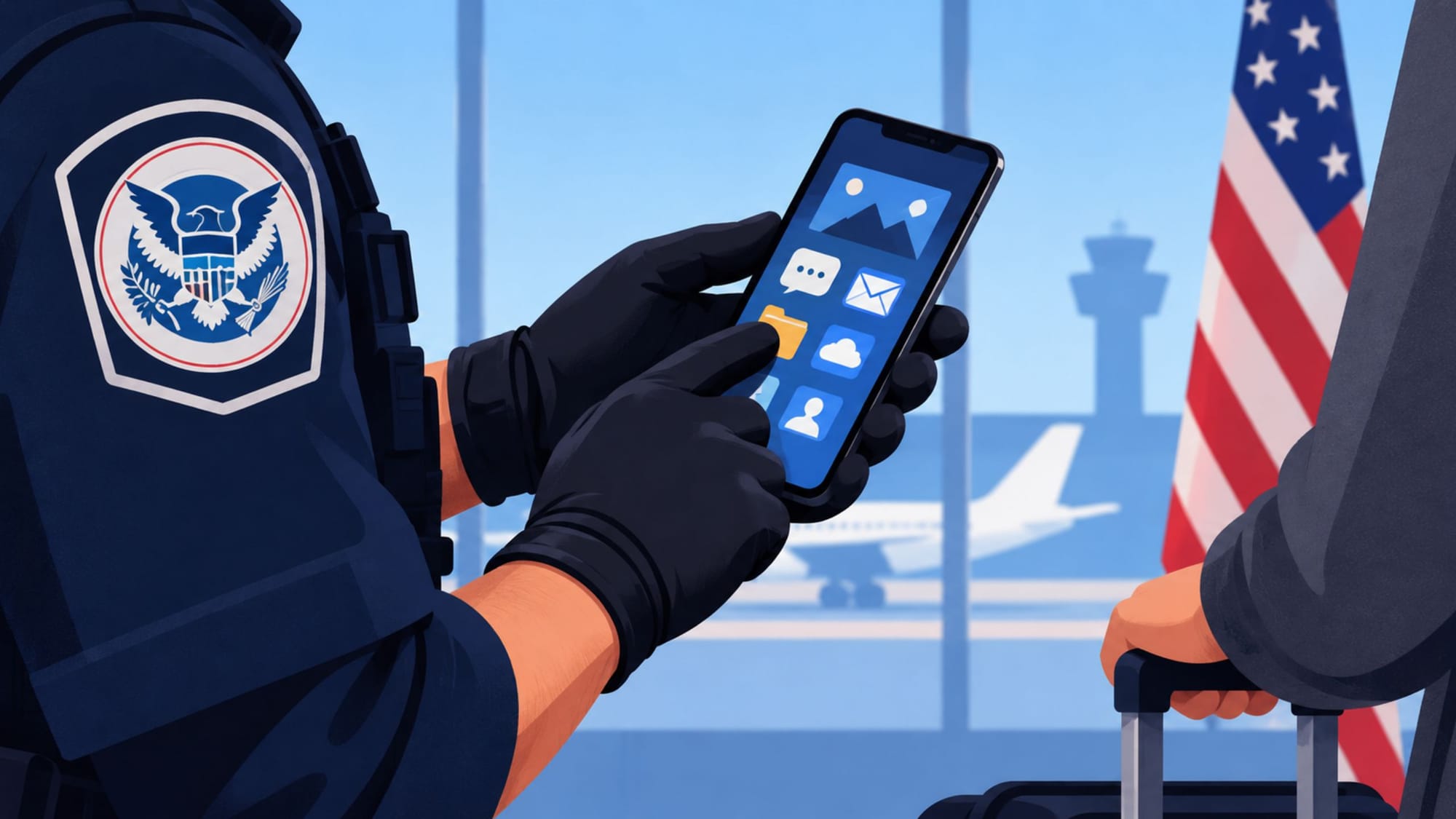
If you’re a US citizen, when you travel abroad, the US Constitution's Fourth Amendment, which protects you from unreasonable searches and seizures, is not there to shield you from having your phone searched and its contents copied. That means you can be searched coming back into the US.
At least, that is the effect of a ruling by the US Court of Appeals for the Second Circuit, that said Customs and Border Protection (CBP) has the right to do that at an international border, and that the search does not require a warrant, probable cause, reasonable suspicion, or individualized suspicion of any kind.
The court refused to extend the 2014 Supreme Court ruling in Riley v. California, which says police need a warrant to search a phone seized during an arrest. The appeals court said this ruling “did not disturb our precedent holding that a search of a traveler’s property at the border is a routine search that requires no suspicion.”
Instead, the court said that "the government has as strong an interest in digital contraband as in other property" and that the border search exception "serves the purpose of preventing the entry of unwanted persons or things into the country - not only specific types of contraband."
And so, the court concluded, "it is not limited to cases in which the government is investigating border crimes."
The case is United States v. Alisigwe, and was decided on September 17, 2026.
The case involved a lawful permanent resident, Chinwendu Alisigwe, whose phones were searched in 2019 and 2021 at JFK International Airport. The evidence obtained from the phones was used against him, and he was convicted of conspiracy to commit bank fraud, bank fraud and conspiracy to commit money laundering.
He argued that the searches violated the Fourth Amendment and wanted the evidence to be suppressed. But the appeals court disagreed, going even further than it had to by declaring that no suspicion of any kind is needed to carry out such searches.
Judge Eunice C. Lee concurred in the judgment only, and in her opinion, she wrote that the majority went too far by declaring that the searches are "routine."
"A standard that permits a search of every international traveler's cellphone without suspicion means that any person who goes on vacation or a business trip anywhere outside the country can be subject, upon their return home, to review of their medical records, financial information, personal messages, internet search and viewing habits, location tracking, and any other private information that may be contained on their cellphone through stored data, apps, or cloud connection," she wrote.
"This unrestricted authority to search is not a carefully-crafted exception to the Fourth Amendment to address an immigration or contraband-related interest in controlling who or what comes into the country; it eliminates Fourth Amendment protections in this context," Judge Lee continued.
And, "An unrestricted and suspicionless search of a cellphone is intrusive enough to warrant greater protection than the majority gives it today - which is none."
Judge Lee also noted that under the majority’s view, officers at an international airport may search a traveler’s phone data “with no suspicion and for any reason (including political or discriminatory ones).”
But Orin Kerr, a Stanford law professor and Fourth Amendment scholar, hopes the highest US court will take it, and says, “If the Court could take on geofencing in Chatrie, it could take on the border search exception for cell phones. And it should.”
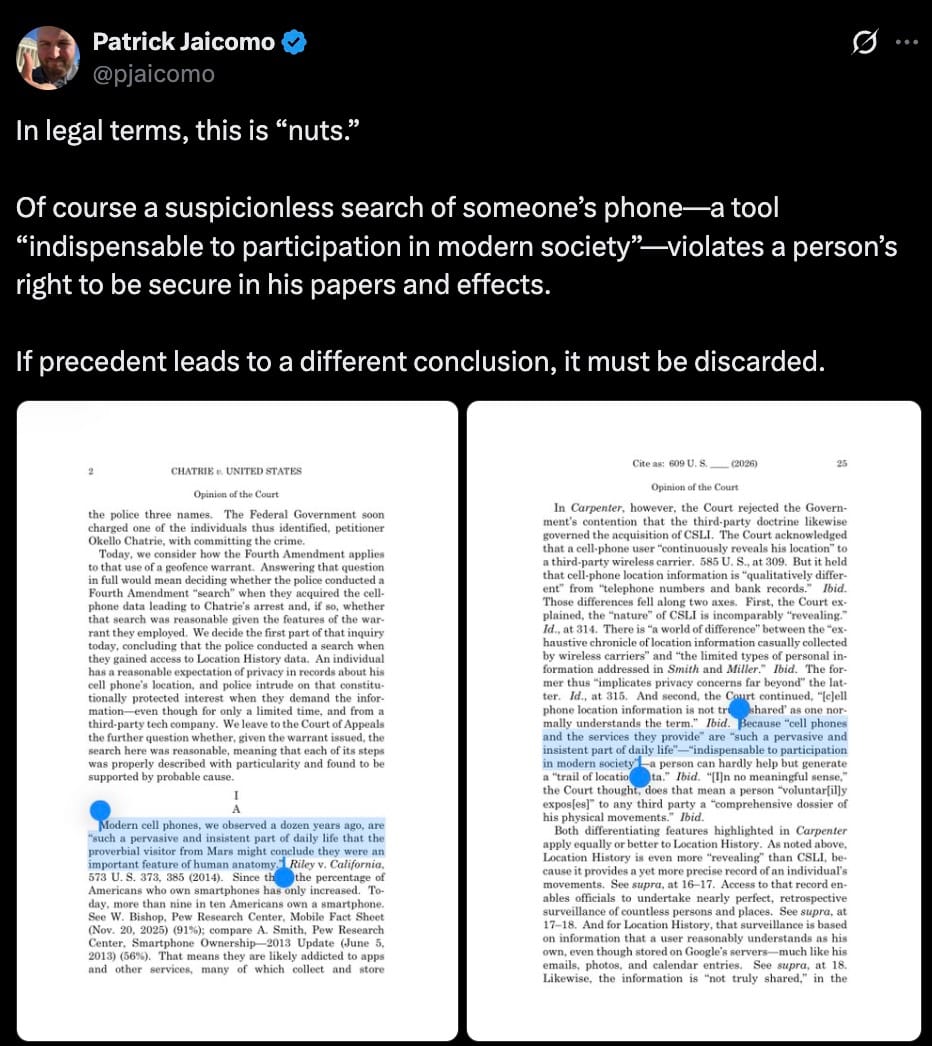
Meanwhile, Patrick Jaicomo, a senior attorney at the Institute for Justice, was scathing in his criticism of the ruling: "In legal terms, this is 'nuts.' Of course a suspicionless search of someone's phone - a tool 'indispensable to participation in modern society' - violates a person's right to be secure in his papers and effects. If precedent leads to a different conclusion, it must be discarded."
Just a week before the appeals court ruling, a federal district court in California decided in United States v. Riley that police queries of Flock automated license plate reader databases are not Fourth Amendment searches at all, and therefore do not require a warrant or probable cause.
The two rulings came after the Supreme Court held in June that getting phone location data through a geofence IS a Fourth Amendment search.