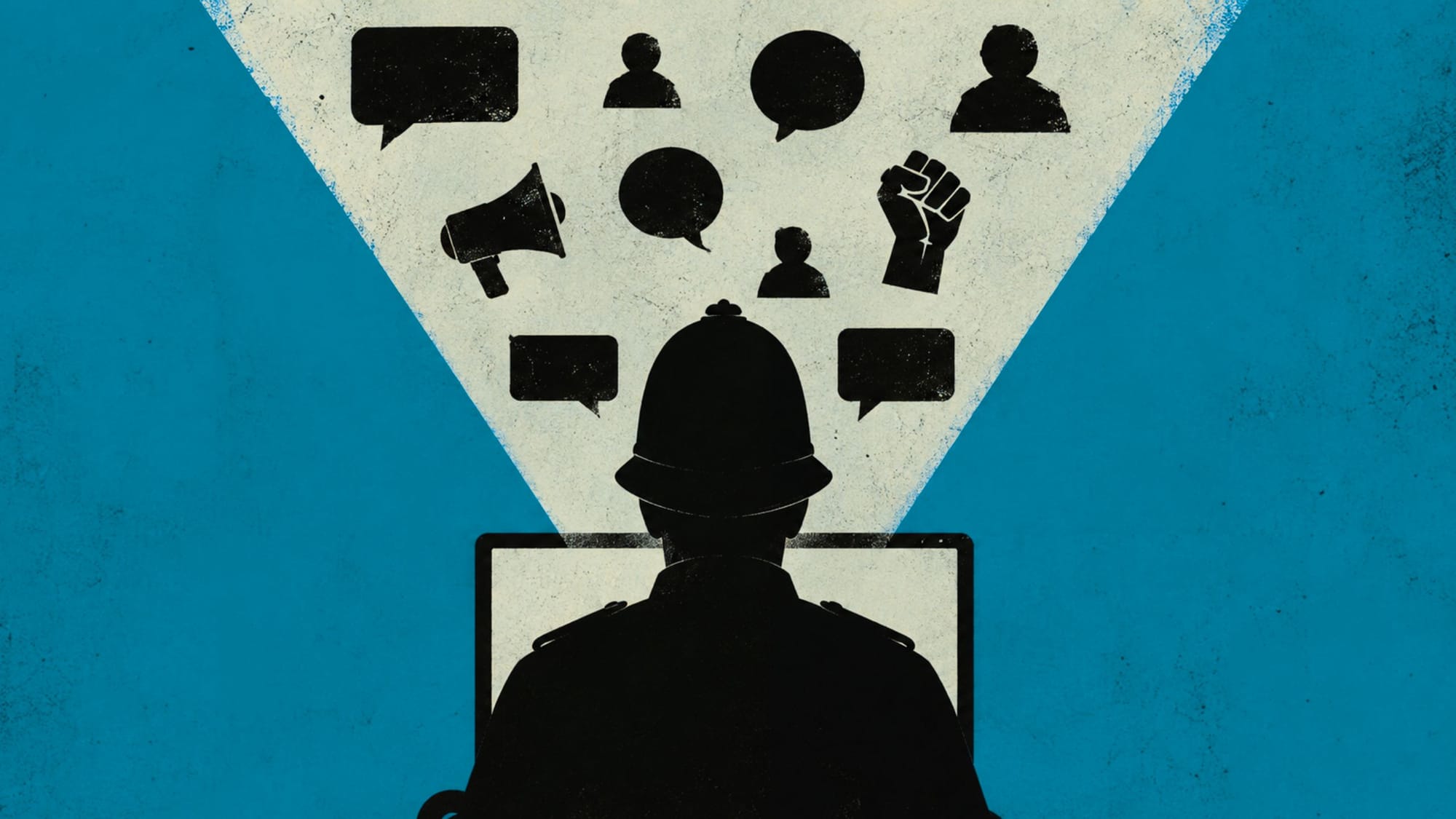
They called it elite. An elite squad of detectives, drawn from forces across England and Wales and convened at the National Police Coordination Centre for a mission of national weight, spying on people's social media posts.
The National Internet Intelligence Investigations team - four capital letters before you reach a noun that does any work - was stood up after the Southport riots to watch social media for "protest-related activity." Protest being, last anyone checked, completely lawful.
It was born of catastrophe. In 2024 three girls were murdered at a Taylor Swift dance class in Southport, and online the lie went round that the killer was an asylum seeker. He was not. He was Axel Rudakubana, born in Britain, his parents from Rwanda. The riots came, and from the wreckage the state produced its answer: a desk to watch for anti-migrant posts and the first signs of the next riot, the internet being the thing the rioters had reached for.
Dame Diana Johnson, then the policing minister, announced it last summer in the register such things are always announced in, promising "a national capability to monitor social media intelligence" and "a dedicated function at a national level for exploiting internet intelligence." Exploiting. Her word, not mine.
Then nothing, for a while. The squad began operating in February, and by the time a newspaper thought to ask, under freedom of information law, it had flagged 106 posts to local forces. Referred them onward, to be exact. The unit watches and points; it does not itself knock on any door. What the forces did after that is not in the record, or not held by anyone willing to say.
Fifty of the 106 landed in June. Nearly half the total, in a single month.
And what a month June was. It was when Hampshire Police released the bodycam footage of Henry Nowak, eighteen, stabbed by Vickrum Digwa, who told the arriving officers that Nowak had racially abused him and was believed, while the boy was handcuffed on the ground saying he could not breathe. Digwa was jailed for life on the first of June, the footage came out the next day, and Southampton went up.
So the referrals spiked in the very month the public's anger at the police ran hottest. Whether the fifty flagged posts were criminal, or merely furious at the police, is exactly the question. And the answer is one nobody will give you.
Here is where the eliteness earns its keep. Asked which posts, the police chiefs declined to say, citing an exemption that covers the prevention of crime and the prosecution of offenders. It is a real exemption and a lawful thing to reach for. It is also, entirely, a choice.
The person whose post was flagged, meanwhile, is not told. They go on with their week, referred and filed and none the wiser, one of a hundred and six on a list they will never see. They cannot even be angry about it, not knowing it is there.
Invited to explain the whole enterprise, the National Police Coordination Centre offered that the squad "supports policing's understanding of protest-related activity in the online environment by developing a broader picture of emerging, potential risks." That is a real sentence, composed by a real person, supposedly. Its remit, it went on, is "strategic insight" into "protest-related developments that may have relevance to policing."
Relevance being carried, as ever, by whoever is doing the deciding.