France’s Interior Minister Laurent Nuñez may not have been trying to advertise the messenger app bitchat when he said that “social networks are becoming a real problem” and that the government had the option of “suspending the use of the networks,” but that’s exactly what seems to have happened.
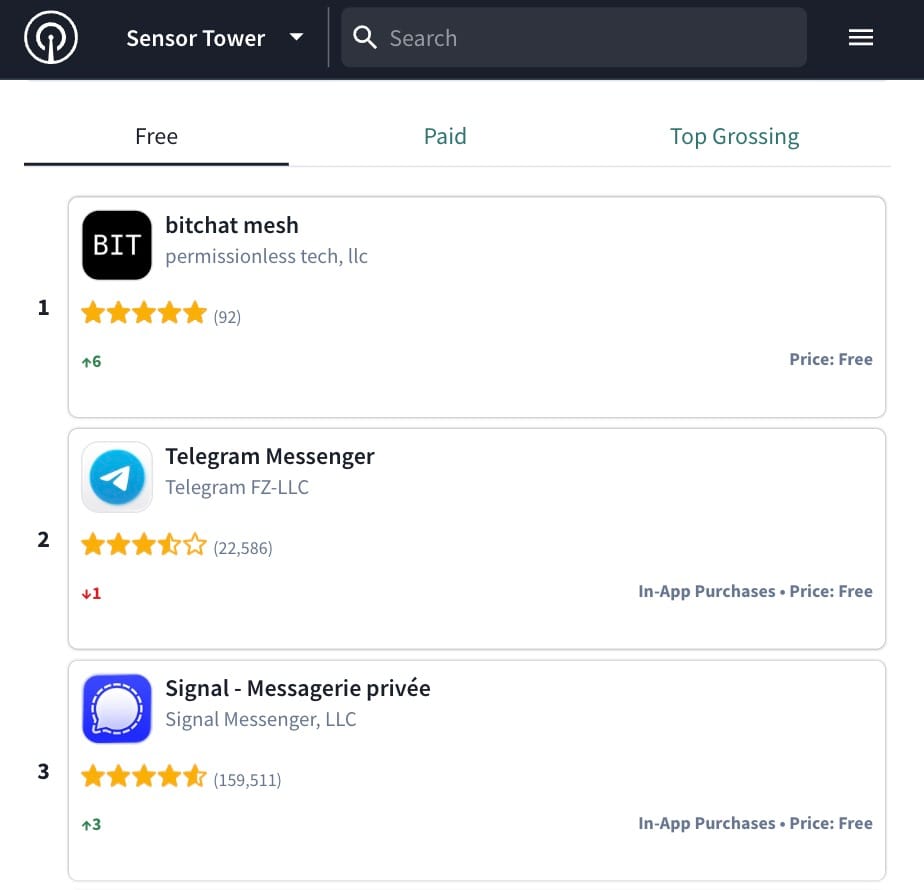
That statement was made on Wednesday, and by the next day, according to Sensor Tower, bitchat was the fourth most downloaded free app in France’s App Store and number one in the social networking category. Over the past 90 days, it rarely made it into the top 150 of all free apps or the top 100 in its own category.
Nuñez also said, “The Conseil d’État in 2025 considered that, in principle, nothing prohibited it under exceptional circumstances, with very strict conditions, and it is something that has obviously not escaped me.”
The reference was to a ruling of the Council of State, France’s highest administrative court, on April 1, 2025, when it found that the block of TikTok in New Caledonia in May 2024, ordered by then-PM Gabriel Attal, was illegal.
The court said that the decision to block the video platform was “a disproportionate infringement of the rights and freedoms” of those who challenged it.
But the court left a door open, ruling that a block can be lawful if it is “indispensable to deal with events of particular gravity” and “no technical means allows alternative measures less harmful to rights and freedoms to be taken immediately” – and “for a limited duration.”
What was wrong with Attal’s decision was that it was “a total interruption of the service for an indefinite period linked solely to the persistence of the disorder.”
BFM, a French broadcaster, reported that for now there are no plans to shut down social media, but calls to download bitchat are multiplying.
The unrest in France started with riots and looting on October 17 and 18, with the government saying that at least 3,000 businesses were damaged or looted, and more than 2,400 people were arrested. More protests are planned for Saturday, October 24.
Attal, now the presidential candidate of the ruling Renaissance party for 2027, spoke about “a temporary, targeted block on the territories where the riots take place” in an interview with RTL on October 19, and on X, he reiterated, “during riots, we must be able to temporarily and selectively block access to certain platforms to stop the herd effect.”
Digital Minister Anne Le Hénanff held an emergency meeting with Discord, Meta, Google, Snapchat, TikTok, and X, to remind them to remove content that the government deems to be inciting violence or looting.
Meanwhile, a European Commission spokesman, Thomas Regnier, also on October 19, invoked the DSA (Digital Services Act) in saying that platforms must “make sure that their algorithms and services are not being misused in this context.”
On October 21, the Orange mobile network was down from 11:20 am to about 9 pm, with the company blaming a failure of core network equipment. It was the third national outage affecting the network this year.
Bitchat, on the other hand, is a messenger that does not depend on the internet or mobile network, and whose GitHub project is described as, “No accounts, no phone numbers, no central servers.”
Journalist Raphael Grably posted on X that the app, which is “encrypted and independent of the mobile network” has become the number one app on the App Store in the “social networking” category. The app’s creator, Jack Dorsey, also posted about it, saying only, “bitchat.”
The app uses Bluetooth Low Energy (BLE) to enable phones to relay messages to each other, with each phone acting as a relay – and with a range of about 30 meters (100 feet) per hop. Private messages are end-to-end encrypted with the Noise protocol. When a phone with the app installed has an internet connection, it switches to the Nostr network.
The App Store’s privacy label states, “The developer does not collect any data from this app.”
Other than being a messenger, the app can also “panic wipe” all data on the phone, and has been downloaded over a million times on Android, BFM is reporting.
Users who want to be able to communicate without the internet can download the app before the internet goes down, but there are limits to the app’s usefulness. “Bitchat is useless if nobody around you has it,” writes iGeneration, and adds that anyone in range who has the app can read the public channel.
This is not the first time that people are installing the app as a way to protect themselves from a possible internet shutdown.
We previously reported about this happening in Uganda in January 2026, where the communications regulator chief Nyombi Thembo warned that “it is very easy for us to switch off such platforms if the need arises.” Installs of the app jumped by several hundred thousand ahead of the election.
In April 2026, Apple pulled the app from the Chinese market at the behest of the Cyberspace Administration.
In July 2026, GitHub received an order to block the app’s code in India, and was given three hours to comply. Dorsey reacted by saying, “the government of India does not like technologies like BitChat and wants it taken down.”
In October 2026, Apple again removed the app from its store, this time in India, per a demand from the Ministry of Electronics and Information Technology (MeitY).
People in France did not wait for the authorities to tell them that a social media and internet shutdown might be in the works; they went ahead and installed the one app that, by virtue of its technology, cannot be shut down at the level of the network. And the government’s own court has already ruled that such a blackout is illegal, yet the authorities are still looking for ways to implement it, reading the ruling as in fact giving them the right to do so under certain conditions.
The weak point of an app like this is not the signal it uses, but the app store from which it is downloaded, and through which it is updated.
Two governments have already managed to have it removed from the Apple store, and in a France that keeps summoning tech platforms for talks, the app store is the next place a ban would likely land. The time to install the app is before anyone asks you to remove it.