India is at it again, and Apple has helped the government with its censorship demands and removed the BitChat app from its store in the country.
This time, the app was not banned for any content shared on it, but because of its capabilities.
“Government of India officially removes BitChat from the App Store,” Jack Dorsey posted on X, sharing the notice Apple’s App Review team sent to the app’s developers.
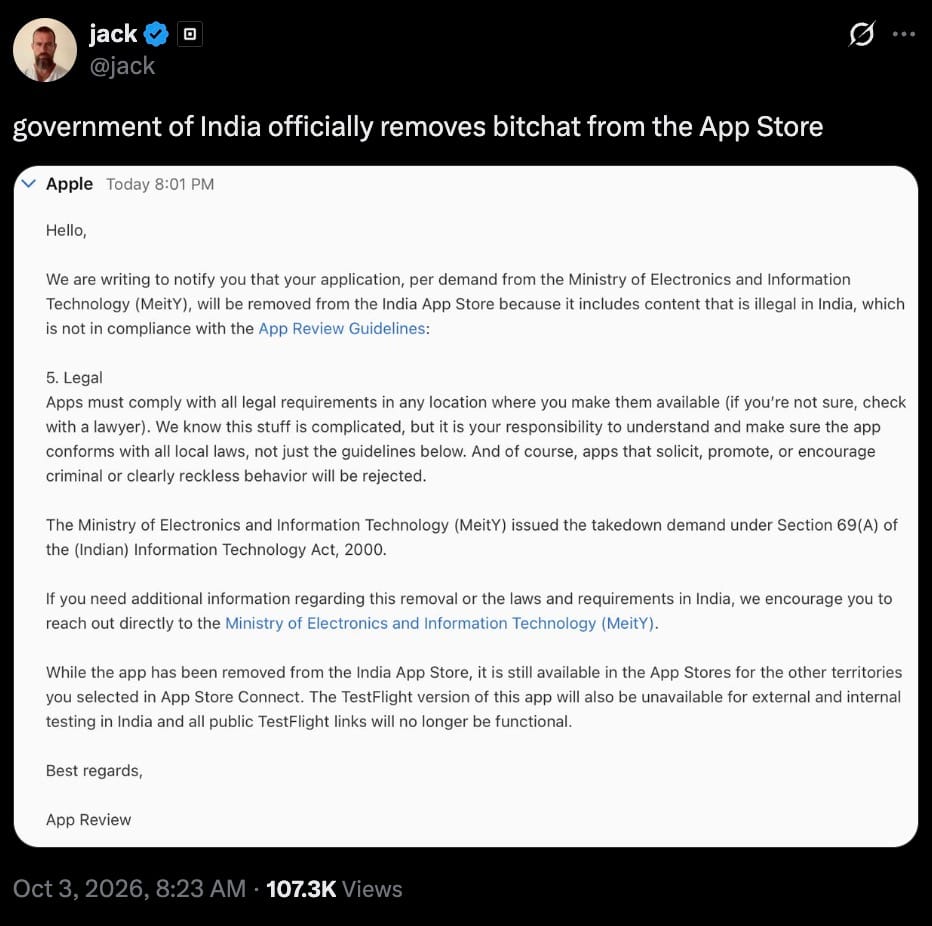
The app has been removed from the India App Store “per demand from the Ministry of Electronics and Information Technology (MeitY),” the Apple notice reads.
Apple was told that the app “includes content that is illegal in India.” But the notice does not go into what that content might be.
Apple this time preferred to play it safe and refer to its guidelines, specifically the one that says apps must “comply with all legal requirements in any location where you make them available.”
The company also told the developers that the ministry “issued the takedown demand under Section 69(A) of the (Indian) Information Technology Act, 2000.”
Apple told the developers that they should “reach out directly to the Ministry of Electronics and Information Technology (MeitY).”
Meanwhile, the app is still available in other countries’ App Stores.
The problem with Apple's walled garden and the App Store being the only way onto the iPhone in most regions means that, for many people, if an app is not on the App Store, they can't download it.
The app’s TestFlight beta testing is also cut off in India, as Apple is preventing all public TestFlight links from working there.
BitChat is an open-source, peer-to-peer (p2p) and end-to-end encrypted messenger that allows its users to send messages over Bluetooth, without the need for a phone number or an account. The app works even when there is no internet, as it passes messages from phone to phone via Bluetooth.
This makes it particularly useful in situations when the authorities cut off the internet and mobile network, as they often do in India.
In fact, this is exactly what happened in July, when the government shut down the network around Jantar Mantar in New Delhi, where students were protesting a leaked medical entrance exam. But the protesters then turned to BitChat to communicate.
That’s why the Indian government wants it gone. In July, the Cyber Crime Coordination Centre ordered GitHub to remove the app’s code, again without naming any content shared on the app that would have violated any laws. Instead, the order said the app “significantly impedes lawful interception, attribution, and investigation.”
The code was mirrored elsewhere within hours. Dorsey then said that “the government of India does not like technologies like BitChat and wants it taken down.”
As for the law used this time to ban the app, Section 69A of the IT Act requires the authorities to hold a hearing and give written reasons for blocking online content. This is in contrast to the previous time, when the Cyber Crime Coordination Centre ordered GitHub to remove the app’s code, citing a different section of the act – 79(3)(b).
Telegram, another app that has been in the crosshairs of the Indian authorities of late, was blocked in June, again under Section 69A, and also over the leaked medical entrance exam. At the time, Telegram’s owner Pavel Durov said that blocking the platform, used by over 150 million people in India, was punishing 150M+ ordinary Telegram users in India for something they had no connection to.
First, the Indian authorities went after the network, then the code, and now the app store – it’s a methodical way of making sure that people in that country have no access to Bitchat, and no way of communicating when the government cuts off the internet.