India’s government has blocked a messaging platform used by more than 150 million people because it couldn’t keep a single exam paper from leaking.
The ban on Telegram, ordered under Section 69A of the Information Technology Act and in effect until June 22, targets cheating tied to the NEET-UG medical entrance exam.
A second order forces Telegram to disable its message-editing feature across India until June 30.
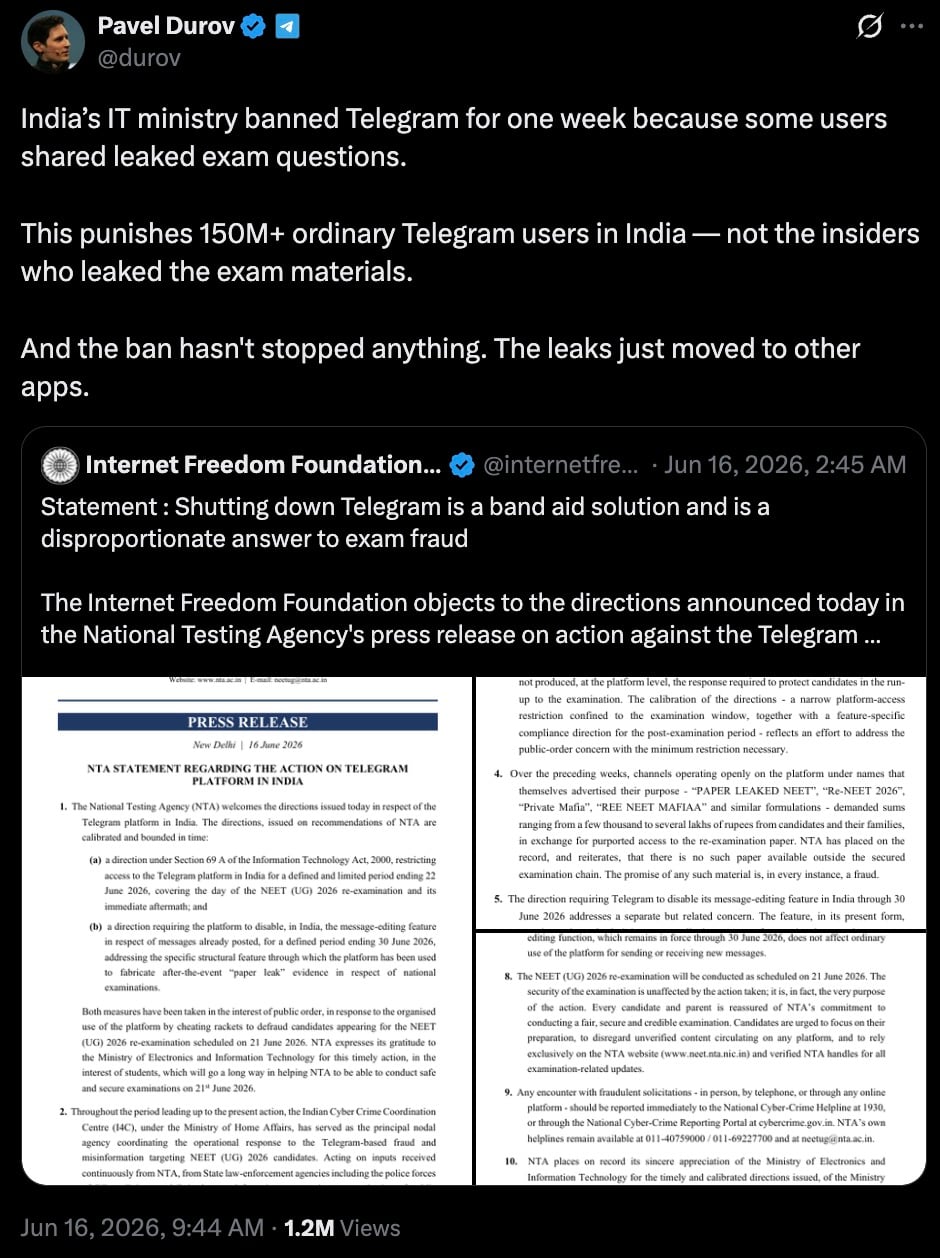
The National Testing Agency said the block was “in response to the organised use of the platform by cheating rackets to defraud candidates appearing for the NEET (UG) 2026 re-examination scheduled on 21 June 2026.”
The re-exam follows the cancellation of the May 3 test, which 2.28 million candidates sat before allegations of a paper leak forced the NTA to scrap results. The CBI arrested more than a dozen people. In 2024, the NEET exam faced a similar scandal involving leaks and irregularities.
Two years running, the exam’s security has failed inside the system that prints and administers the test. The leak originated among insiders, not on Telegram. Blocking the app where screenshots circulate does nothing about the people doing the leaking.
The NTA’s own press release confirms targeted enforcement was already working, acknowledging that India’s Cyber Crime Coordination Centre had taken down “a substantial number of Telegram channels, groups and bots whose names and content openly advertised their fraudulent and misleading purpose.”
The agency confirmed “there is no such paper available outside the secured examination chain.” The scam channels were selling access to something that doesn’t exist, and law enforcement was already shutting them down.
Telegram founder Pavel Durov called the ban a punishment aimed at the wrong people. “This punishes 150M+ ordinary Telegram users in India,” he wrote, “not the insiders who leaked the exam materials.”
The Internet Freedom Foundation called the ban a “band aid solution” and a “disproportionate answer to exam fraud,” arguing that Section 69A permits blocking specific information, not shutting down an entire platform.
“The block of Telegram is reactive and ineffective and will punish ordinary users instead of addressing the systemic source of exam leaks,” IFF said, adding that “thousands of students depend on Telegram for study groups, doubt-clearing, and shared resources” in the final days before the test.
IFF also noted the MeitY order authorizing the block has not been published, violating the Supreme Court’s Anuradha Bhasin ruling that such orders must be made public.
App-level blocks in India run through ISP-level DNS filtering, which anyone with a VPN can route around in minutes. Fraud operators sophisticated enough to run scam channels demanding lakhs of rupees will not be inconvenienced by a DNS block. The students who lost their study groups five days before the exam will be.
The NTA said it regretted “the inconvenience,” an admission buried in bureaucratic language that the government knows most of the people it cut off from Telegram have done nothing wrong.