At New Scotland Yard, the HQ of London's Metropolitan Police, there is a file, opened on November 18, 2025, and closed in February, and its subject is a journalist who sent some emails to a professor.
The man is Jack Grove. He covers universities for Times Higher Education. Historically, that's a beat that leaves the Flying Squad in peace.
On February 3, he was in the Royal Courts of Justice taking shorthand at the University of Sussex's appeal against its fine from the Office for Students. His phone buzzed. Unknown number. He waited for the KC to finish, stepped out of the oak-paneled chamber, and decided to take the voicemail back at his desk in Holborn, about ten minutes away. He has written all of this down himself, in some detail.
The message was from the Met, asking him to call back.
When he did, the officer explained that a complaint had been made against him regarding the Cambridge professor Jason Arday, and that the matter was now closed. He should leave Arday alone from now on, though. It was affecting Arday's mental health.
Grove says he asked what he had actually done. Online posts, said the officer. Grove said he had never posted anything about Arday, and asked whether the officer realized he was speaking to a journalist working on a story. The officer, by Grove's account, did not really respond. He repeated the request that Grove stop.
A thorough piece of police work, then.
Grove did later remember one online post about Arday. February 2023, when Arday was appointed. A congratulatory tweet.
The Met's own account of the whole business runs to two sentences. "On 18 November 2025, the Met received an allegation of harassment. The case was closed in February this year." Four months, that is. In four months, nobody interviewed Grove. He learned that he had been investigated at the moment they told him he no longer was.
On the subject of the emails, Grove says he sent three polite ones directly to Arday over two months, asking about concerns raised by other professors about a 2018 paper, then about discrepancies in the CV, then about when and where the running and charity feats took place. Then, in September, a longer letter putting the allegations to him and inviting an answer. That's a simple right of reply, in other words, and, in any society that supports free speech and freedom of the press, is a valid right.
He says he sent nothing to Arday after that. The file was opened in November.
And who made the complaint? Grove has never been told. Cambridge denies making one, and denies knowing that anyone had - "The university did not make any complaint to the police against Jack Grove in 2025," and, "Neither was it aware of any such complaint being made."
There is a precedent, of a sort. The Committee for Academic Freedom, which has published extracts of the correspondence, says Arday reported Dr David Harris, professor emeritus at Plymouth Marjon, to the Met after Harris emailed him in May 2023 about what he took to be errors in his work. Arday had told Harris not to contact him again - "Anything further from you will be considered bullying and harassment" - and Harris replied anyway, which the Committee itself allows was not prudent. The Telegraph, citing the Guardian, reports that the Met passed that complaint to Devon and Cornwall Police, who declined to investigate it. So one force looked at an academic asking awkward questions and said no thank you, that's not a crime. The other took until February.
Before the police, there were the lawyers. In September 2025, after Grove's email offering the right of reply, Carter-Ruck wrote to Times Higher Education saying the allegations were false and would damage Arday's reputation, and that the publication's "apparent attack" on him "may be … racially motivated." The story remained unpublished. Retraction Watch asked both Carter-Ruck and THE for comment. Both stayed silent.
Arday has denied the narratives around him throughout. He told the Times, "I am accountable for the mistakes I've made", and, "what I am not is a liar." There had been, he said, "a very well orchestrated and co-ordinated campaign" against him, and it was racially motivated.
The errors he puts down to his autism, to inadequate supervision during his PhD, and to not being able to afford a proofreader. The 600 miles in six days took 12 days. The charity money, given as £5.5 million by the Telegraph, he did not raise single-handedly. He was part of a syndicate of about a hundred people, and he cannot name one of them. Non-disclosure agreement. He told the Guardian the money came in with the help of others over twenty years.
Cambridge called him the victim of "a vile campaign to undermine his credibility", and said he had been cleared of "allegations of plagiarism regarding his thesis and journal publications." The 2018 paper was corrected in December 2023, and a second paper the year after.
On August 5, after Cambridge opened an investigation into his qualifications and honorary appointments, he resigned with immediate effect, writing that the decision "should not be interpreted as a loss of faith in scholarship", nor "mistaken for an acceptance of the narratives that have surrounded me". In everything carried here, he stays off the subject of the police investigation into Grove.
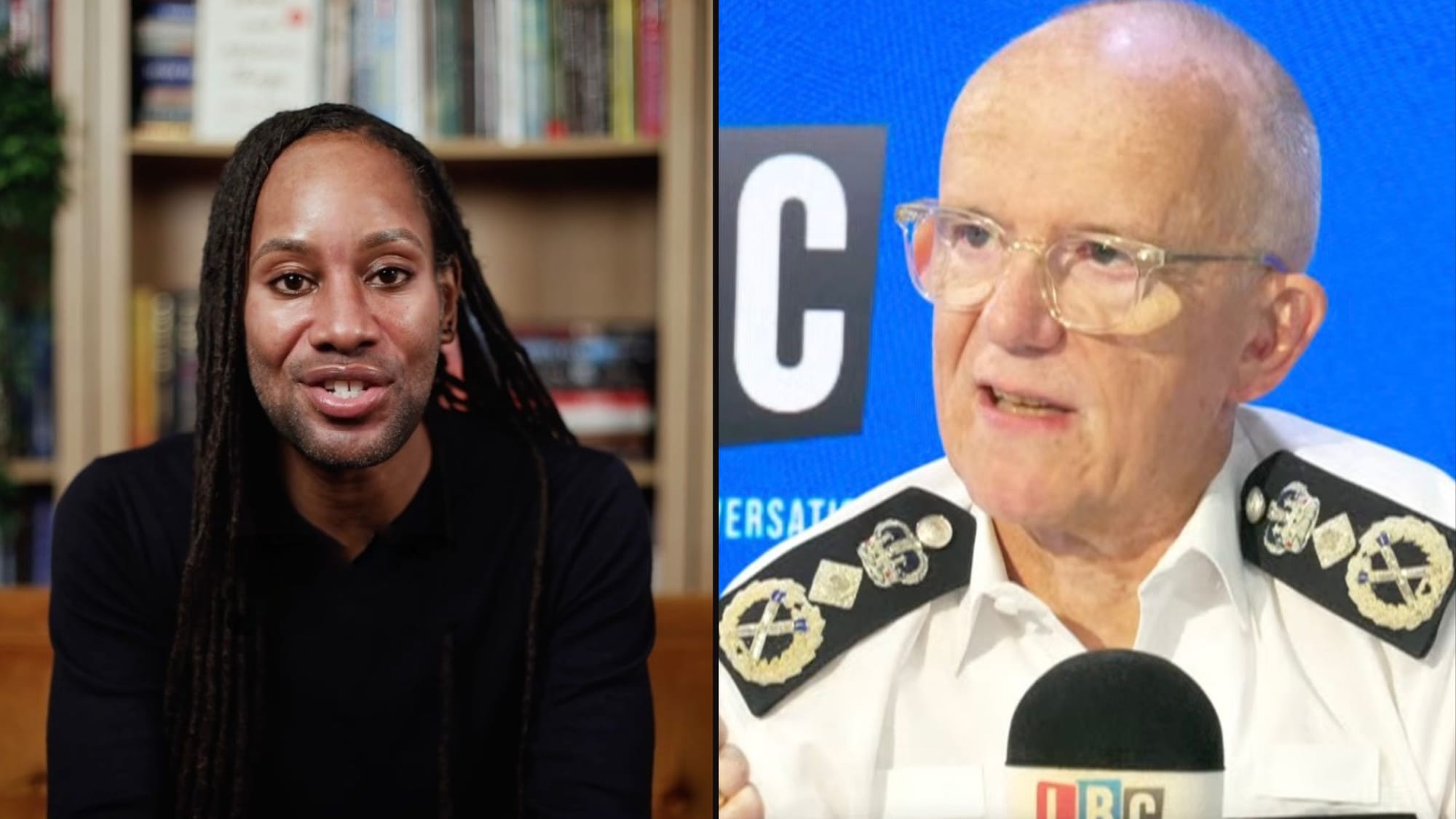
Now to yesterday. Sir Mark Rowley, Commissioner of the Metropolitan Police, went on Nick Ferrari's Breakfast show.
"We dropped the ball on that one - let's not beat around the bush," he said. "It should have been screened out as not requiring police action." Asked why the force had spent four months on it, he added, "In hindsight we shouldn't have done that," and, "We shouldn't have made that call to him."
That's a backtrack that's becoming more and more common in Britain.