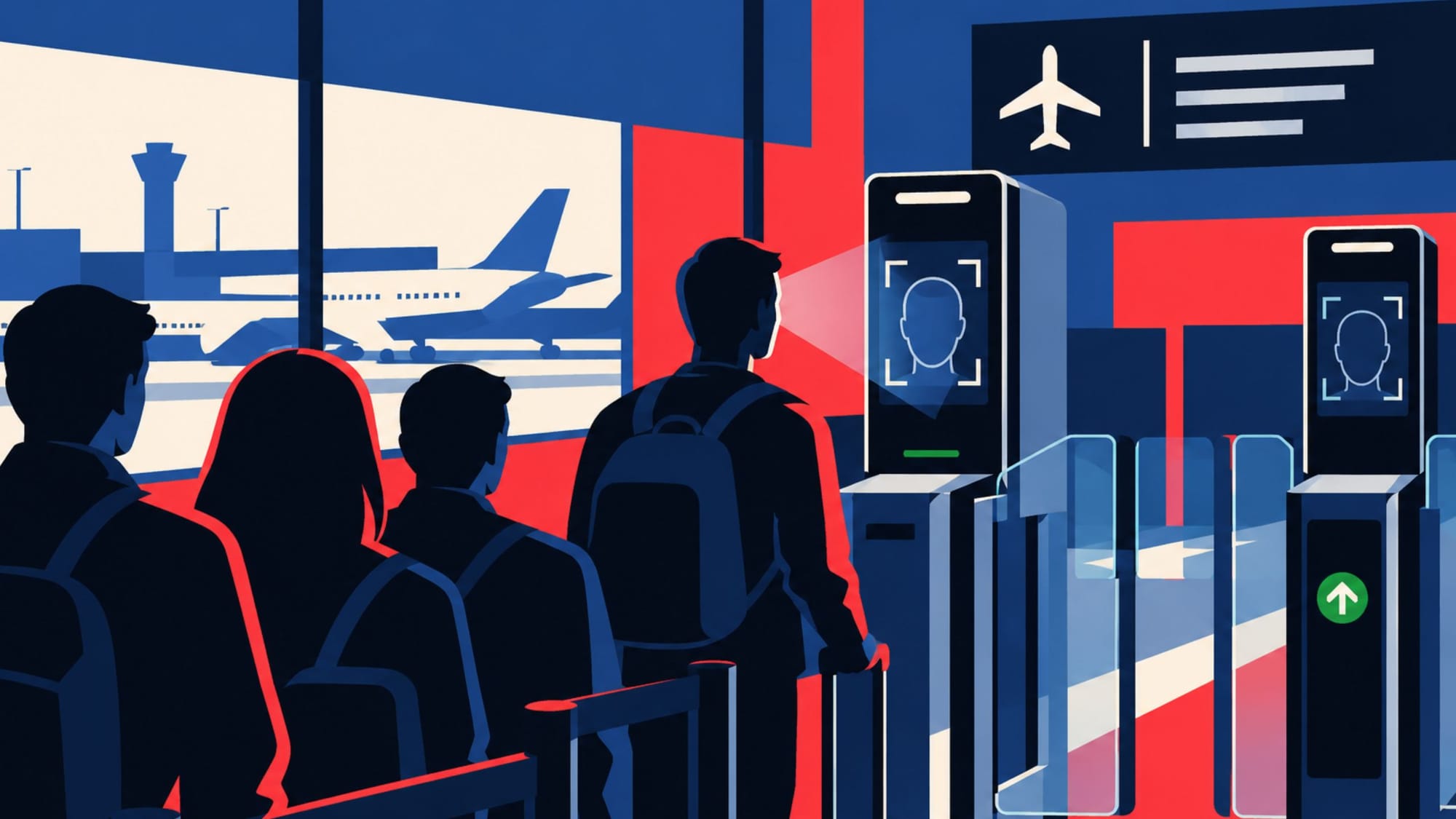
In the UK, the government is now selling a switch to contactless facial recognition at airports as a time-saving measure for travelers.
And a major time-saving it is not – five seconds shaved off the previous 20 to 25 seconds it took to use an eGate.
The process of scanning your face instead of your passport is now in place at East Midlands Airport, and will be expanded to 13 airports by early 2027, the Home Office has announced.
The way it works is that your face is photographed as you approach the gate, and this is then compared to a gallery of passport photographs that the airlines have sent to border control.
But don’t think you can leave your passport at home – the government has made sure to inform citizens that they should keep it with them at all times.
This new “convenience” is available to British citizens first, with other nationalities to be onboarded in the coming months.
And what a win it is – for the government, that is. “This is a win for travelers coming to our brilliant country,” said Phil Douglas, Director General of Border Force.
He added, “Our digital transformation also builds on our work this summer to extend eGates to children aged eight and above, making life a little easier for families.”
The eGates are now available to children as young as eight, provided they are at least 120cm tall, and are traveling with an adult who is using the automated gates.
The government’s announcement was met with enthusiasm by the airports, with East Midlands Airport Managing Director Steve Griffiths declaring his facility to be “delighted” to be the first to introduce contactless eGates.
And AirportsUK chief executive Karen Dee said that this “will be excellent news for the passenger and demonstrates how UK airports continue to be at the forefront of new technologies to keep our borders safe, while improving the traveling experience.”
But at what cost to their privacy, and safety, once they’re out of the airport?
This is the same government that is building a digital ID, and promising that the police will not be able to search it – while at the same time consulting on allowing the police to do just that.
The UK government’s guidance states that facial images of British citizens captured at eGates can be kept for up to 30 days, while those of other nationalities can be stored for up to six years.
So, what have we gained? Five seconds at the gate. And what have we lost? A country that used to check travel documents, now checks faces instead.