
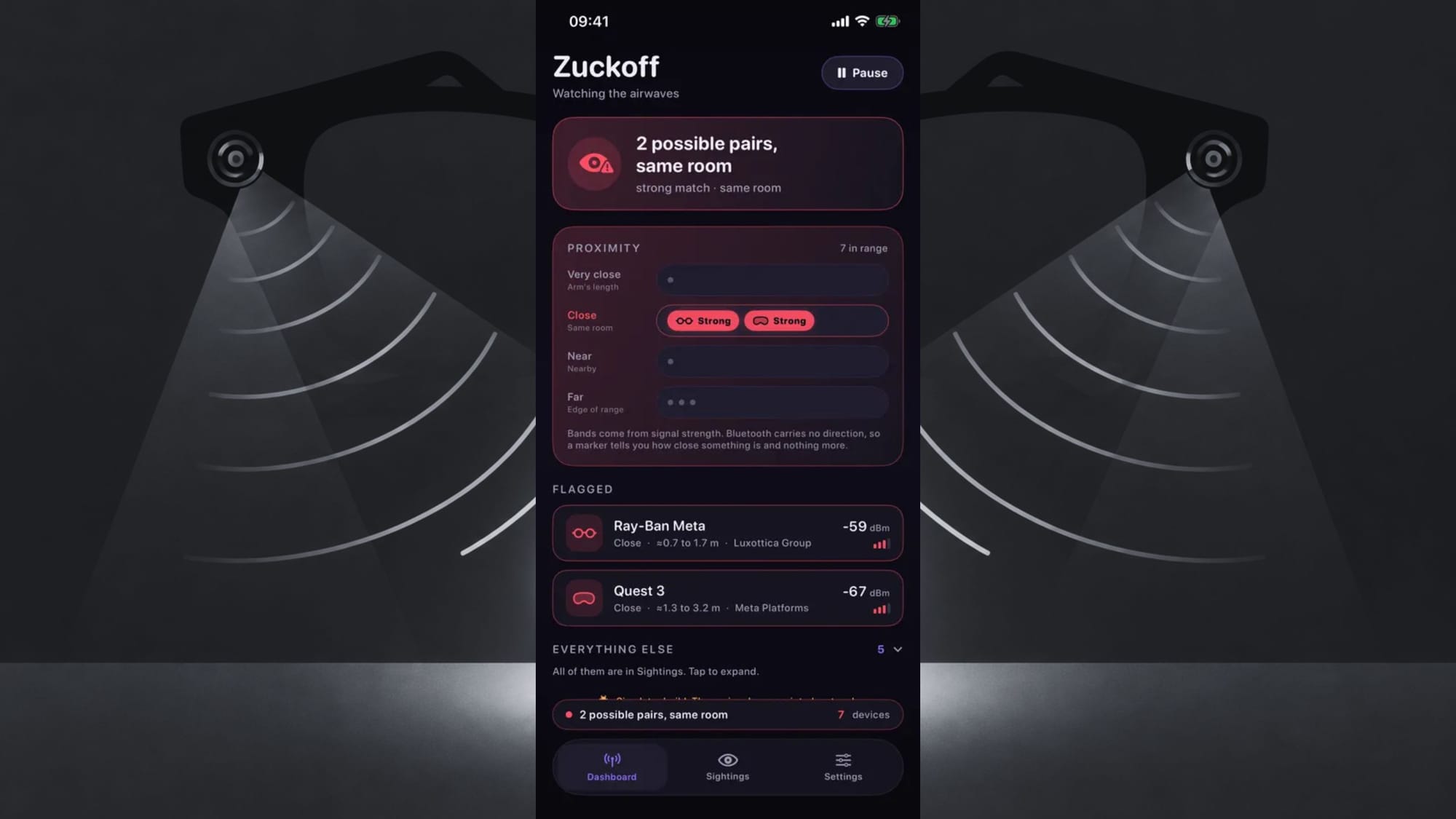
An app for iPhone and Android that can detect if you are near someone wearing camera glasses has been launched by a Polish developer.
The app, ZuckOff, is free, and the creator, Pawel Szydlowski, says he is not affiliated with Meta, and that he made the app because he was disturbed by content created with the glasses and published on the internet.
“With this type of content, I’ve seen a lot of emotions in me,” he said.
“We as a society have the right to at least know that someone is recording,” Szydlowski said.
The app works by listening to the Bluetooth signal that the glasses broadcast, and identifying them by manufacturer signature, i.e., an ID, service UUID, or an advertised device name.
Szydlowski said he came up with the idea after he finished working on a project involving a Bluetooth scanner. Then he saw videos made with Meta’s camera glasses and decided to act.
“People are using it in a bad way,” he said. “That was the first part that annoyed me. I was like, ‘I don’t like it. I just don’t enjoy the content, and I don’t think it’s valid,’ because myself, I wouldn’t have a way to react to being recorded because I’m used to people holding the phone and actually pointing at me. Then I can say, ‘Hold on a second. This is not scrolling. Someone is actually recording.’”
He said he was able to build the app in just a week.
The app detects signals from Ray-Ban Meta and other devices, such as those made by Snap. The log of devices is kept on the phone and can be exported.
ZuckOff can show the proximity of the device it detects (very close, close, near, far) but not the direction.
The app cannot detect if the glasses are actually recording, only if they are in the vicinity. Some camera glasses that work independently can remain silent and thus go undetected, while those that are paired can turn off their signal.
The app’s site states that “quiet is not proof that nobody is recording, and a detection is not proof that anyone is.”
Apple’s iPhone users can turn to the app if they suspect they are being recorded, but in background mode the scan will only look for a fixed list of known Bluetooth service identifiers.
Szydlowski said that Apple is “very strict when it comes to apps working in the background all the time” and that he fought to get the feature in, saying, “This background feature, it’s so crucial.”
In the past, when someone pulled out a phone and pointed it at you, you knew you were being recorded. Now, with the advent of camera glasses, that is no longer the case, and the burden of discovering if you are being filmed is on the person who is not holding the recording device.
“If you wanted to record somebody, you had to take out your phone, shove it in their face,” EFF staff technologist Cooper Quintin said. “And they know they’re being recorded. That is a useful social friction. And the glasses remove that and put the friction on the other end. The friction is now on me, calling you a pervert for wearing glasses and telling you to stop recording my kids.”
And while Meta’s CTO Andrew Bosworth says the company “designed this camera to be noticed by the people around you,” Quintin calls it nearly “useless” and “better than nothing, but not by much.”
“It is completely unsurprising that people are building apps to fight back against Meta glasses and other surreptitious public recording,” he said.
Meta has sold more than 7 million AI glasses in 2025, up from 2 million in the previous two years, and expects at least 20 million a year by the end of 2026.