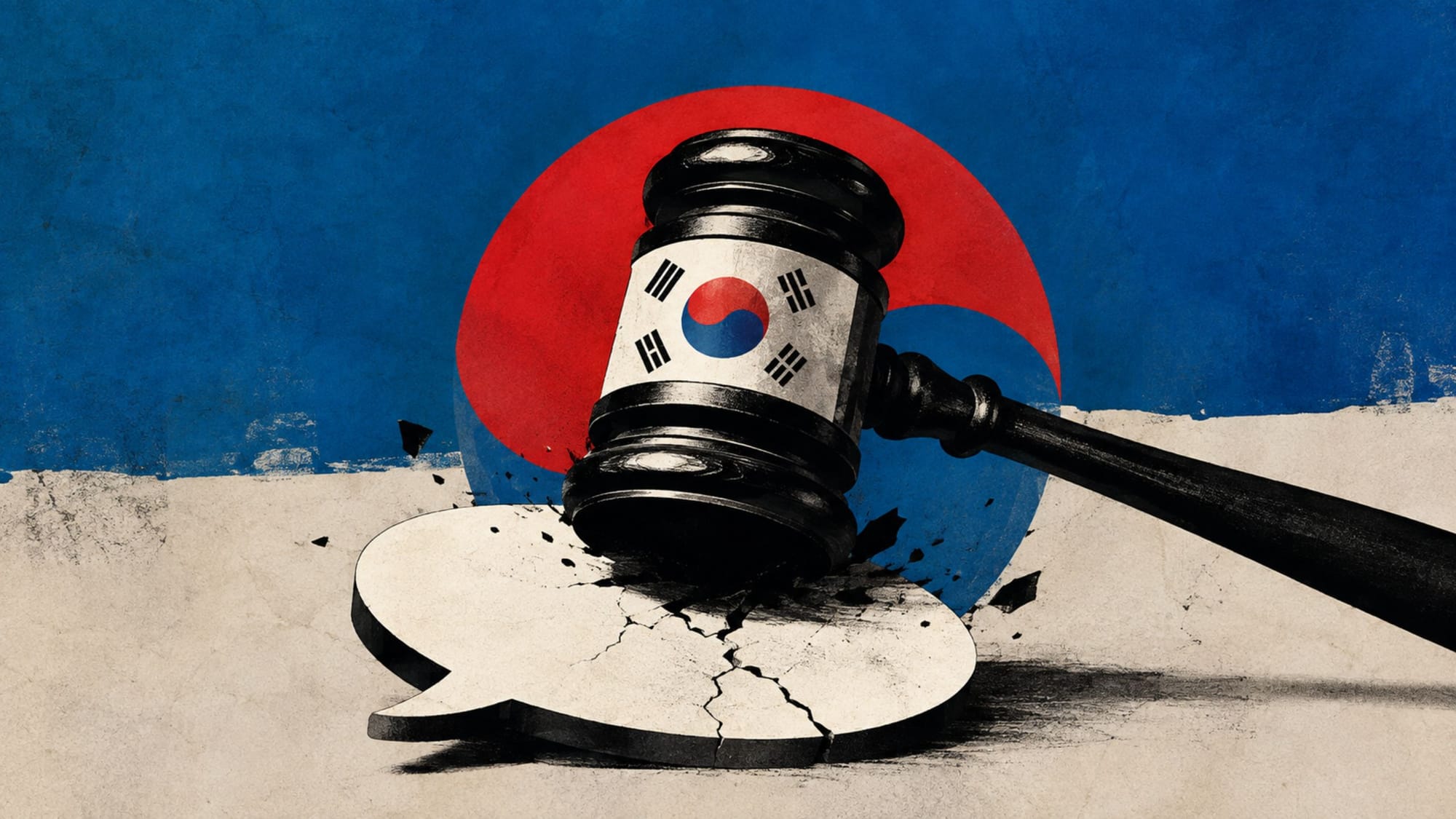
South Korea now lets its courts punish "false or manipulated information" but doesn't say what those words mean. The amended Information and Communications Network Act took effect last month and it makes no attempt to even define the offense or explain how the state will enforce it.
Since the offense is left undefined, a publisher can't tell in advance which online post a court may approve and which it would punish. In situations like this, the safe move for the platforms is to err on the side of caution and delete on suspicion.
No prosecution is even needed for the law to have a major impact on free speech. The People Power Party's chief floor spokesperson, Choi Soo-jin, said as much. "To avoid large damages and fines, platforms will have no choice but to preemptively delete posts even before illegality is clearly determined," she said.
Last week, four Republicans on the House Judiciary Committee wrote to Kim Jong-cheol, chairman of the Korea Media and Communications Commission, asking for more details about how this will affect platforms. Jim Jordan, who chairs the committee, signed the letter, along with Scott Fitzgerald, Darrell Issa, and Michael Baumgartner. Secretary of State Marco Rubio was copied in on the letter.
We obtained a copy of the letter for you here.
A court can order damages of up to five times the proven loss where the content was circulated for profit or with intent to cause harm. If the same content is distributed more than twice after a court has ruled it false, the commission can impose a fine of up to 1 billion won, about $656,000. It has said there will be no grace period.
The law covers content publishers with more than 100,000 subscribers or a monthly average of 100,000 views, along with platforms averaging over a million daily users. Thresholds that low turn a media rule into a speech rule.
A publisher with 100,000 subscribers can be an individual person, not a corporation with a legal department. A creator facing damages of five times a stranger's claimed loss cannot afford to win, so a post likely comes down.
In truth, Seoul imported this model. It was written in Brussels first - the Digital Services Act - and each export arrives with its own local additions. When the country's Democratic Party announced the amendment in September 2025, it said the goal was to "incorporate a strong punitive damages system and a Korean version of the DSA (Digital Services Act)."
The committee tells the story from the eyes of America. The letter is built around harm to American companies and American speech, and it names Facebook, X, Instagram, and YouTube as the platforms at risk. That framing is theirs, and it leaves out who stands closest to the law.
The letter asks for a briefing by 10 a.m. ET on August 20, 2026, but a US congressional committee holds no authority over a Korean regulator, so the deadline carries no power to compel.
Kim has stayed silent, as far as the record shows. Korea's foreign ministry has answered, rejecting the complaint and saying the law "does not contain any provisions that discriminate against U.S. companies."