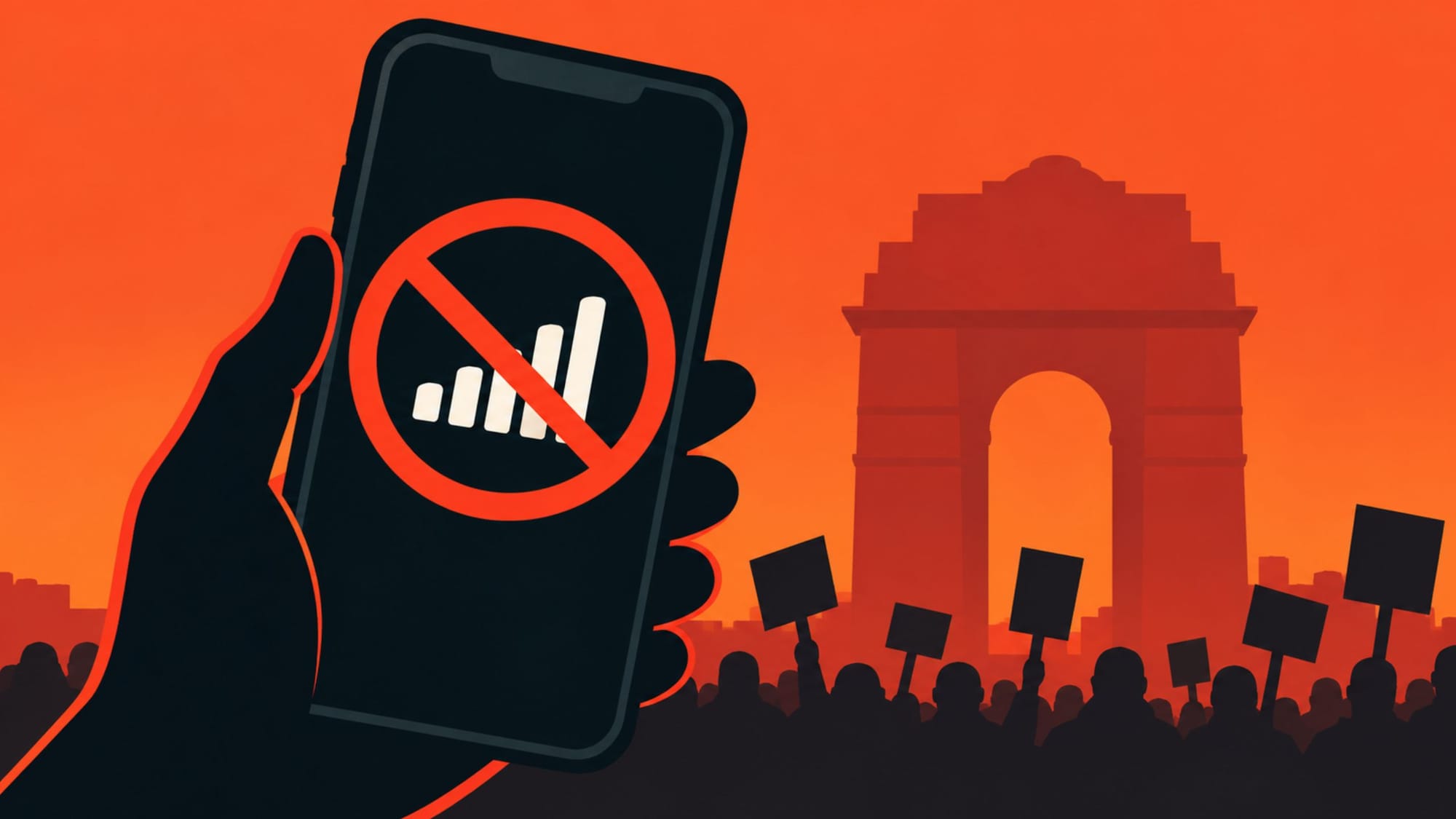
Indian authorities have once again cut off mobile internet in a district of the capital New Delhi, this time for 24 hours, as a youth protest was taking place there.
The movement, organized by the Cockroach Janta Party, is demanding the resignation of Chief Election Commissioner Gyanesh Kumar.
On Saturday, October 10, the internet was down in a four km radius from the Janpath-Kartavya Path crossing, while the protesters were trying to reach Jantar Mantar.
The order to switch off the internet came from Manishi Chandra, Deputy Commissioner of Delhi Police (Special Cell).
The protest is a response to the revision of the voter list, which, according to Reuters, dropped about 130 million voters, while The Independent writes that the revision “had flagged more than 130 million names.”
However, the Election Commission and the BJP deny any wrongdoing, and the police have not given permission for the protest.
The authorities have taken other measures to prevent the protest, shutting down 45 metro stations and cancelling trains arriving at New Delhi and Hazrat Nizamuddin stations.
Police have also warned ride-hailing services Uber and Ola to be on the lookout for “suspicious” persons traveling to Jantar Mantar, while sources said that food delivery apps like Zomato were tracked for bulk orders.
The founder of the CJP, Abhijeet Dipke, was detained along with two other leaders on their plane from Mumbai.
Dipke was heard saying, “I have come to be arrested, arrest me... I am not afraid of you guys.” An officer responded by saying, “No, this is not an arrest.” And, “Please cooperate.”
Before he left for Delhi, Dipke had said, “Why is the prime minister so scared of the country’s youth, the country’s people?”
Meanwhile, at least 12 journalists were detained despite showing their press cards and put on buses.
Newslaundry reported that three of its journalists were detained, and their phones taken. They were told, “Koi media nahin hai” (there is no media).
One of the reporters, from Scroll, was heard asking, “What’s my offense? I was standing on the road.”
Police officers, defending their actions, said: “Everybody claims to be a journalist these days.”
Press bodies in India are now asking on what grounds were they detained and their phones seized.
“Journalists are there to report, not to protest,” they said, adding, “Press freedom in India cannot be conditional on PIB accreditation.”
The digital news association DIGIPUB noted that “Journalism is not a crime, and neither is protest.”
This is not the first time that the internet has been shut down in this part of Delhi during a protest organized by this movement. On October 2, the Home Ministry cut mobile internet for 12 hours within 1.5 km of Jantar Mantar.
In July, the same location was cut off from the internet as the CJP movement protested over the NEET exam leak. The shutdown then took down not only the internet but also digital payments, and caused disruptions in the area.
When protesters then switched to an app that works over Bluetooth, and does not require “internet, servers, phone numbers, or accounts,” India’s authorities went after that app as well – by ordering GitHub to take it down and getting Apple to remove it from its India store.
The authorities in India are not making it easy for anyone to protest, or even to report about the protests, and the shutdowns of mobile internet are not the only way this is happening.