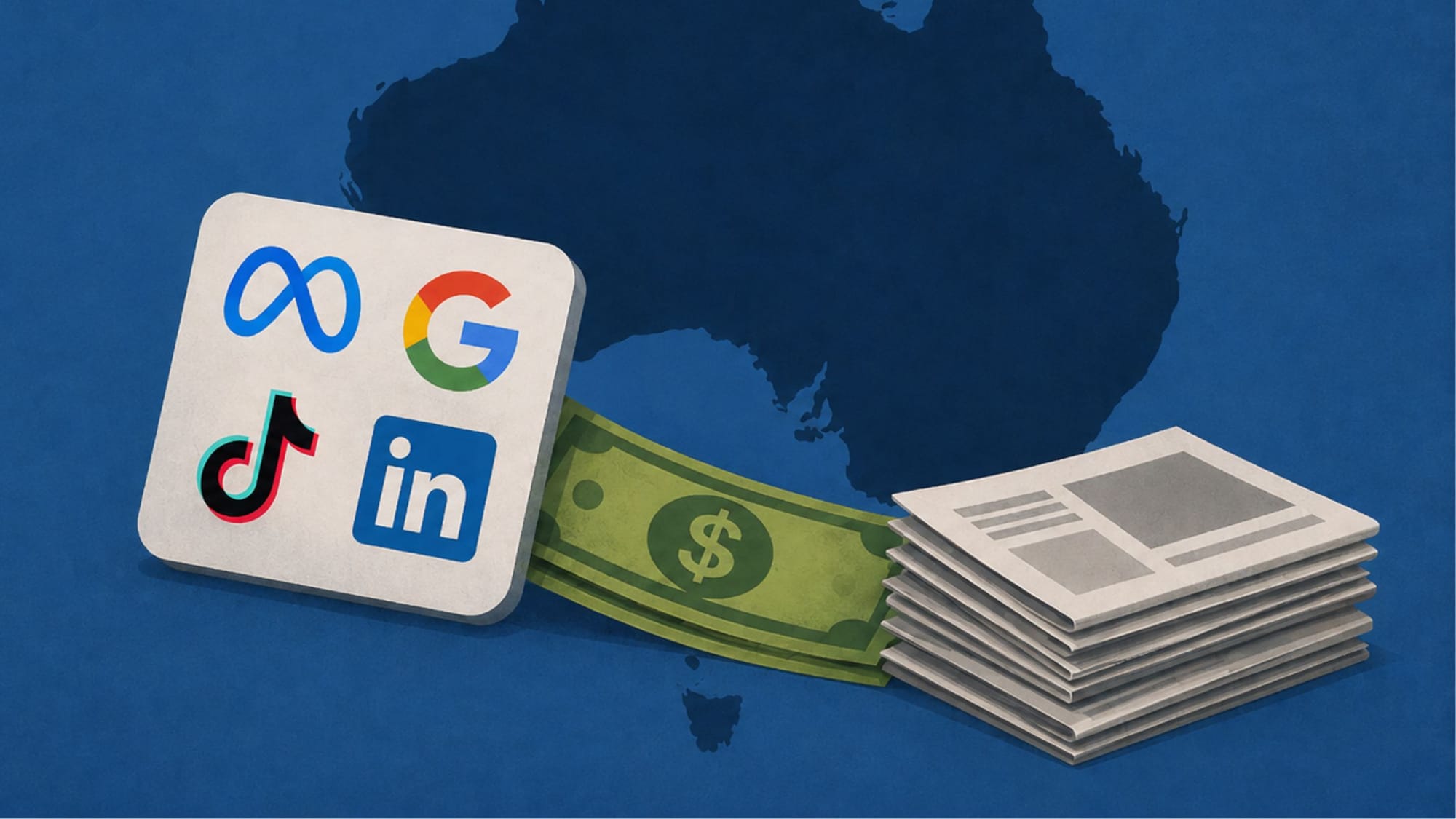
Australia has finalized its News Bargaining Incentive. It's all a way of forcing tech platforms to prop up notably legacy news brands through a 2.5% charge on the digital advertising revenue of any large platform that fails to sign commercial deals with at least six Australian news publishers. Ministers released the final plan Monday, and legislation is expected to reach parliament within weeks.
The charge lands on companies earning at least A$250 million a year in digital advertising revenue from search or social media services in Australia. It is aimed at Meta, Google and TikTok.
The way out is deals. A platform escapes the charge by signing tax-deductible agreements with news publishers. The spending counts against its liability at 150 percent for deals with large media companies and 200 percent for deals with smaller ones, up from 170 percent in the April draft. Clearing the charge in full takes at least six deals, together worth about 1.5 percent of revenue. Sign nothing and the platform pays the full 2.5 percent.
That April draft set the rate at 2.25 percent and applied it to total Australian revenue. Tech companies argued a charge on total revenue was unfair because parts of their operations have nothing to do with news, the Sydney Morning Herald reported. The government gave them the narrower base. But it raised the rate to keep the take the same. And the number of deals needed to clear the charge fully rises from four to six. The finished scheme faces a review after three years, the Canberra Times reported.
LinkedIn had escaped the draft - the platform has claimed it does not carry news, the Herald reported - and now the exemption for professional networking services is gone, bringing Microsoft's platform under the scheme for the first time.
This is Australia's second run at the idea. The 2021 News Media Bargaining Code pushed Google and Meta into deals with local publishers - though Meta first blocked news on Facebook in Australia before relenting. Those deals lapsed in 2024, and the platforms chose not to renew them. Meta has said its users no longer want to consume news on its platforms.
In Canada, Meta walked instead. Rather than pay under the Online News Act, it stopped allowing news links on Facebook and Instagram, and it has held that line ever since. Canadians lost news on those platforms to a standoff their own government started.
Meta called the original proposal a "discriminatory, retroactive tax" that was "grossly unfair." It has accused Australia of breaching the US-Australia free trade agreement and warned that Washington could take trade action, and the White House has described the policy as "foreign extortion."