French President Emmanuel Macron’s remarks about free speech and online regulation have once again exposed the true nature of his policies, and the way he chooses to “explain” the need to restrict people’s freedoms.
In the past, Macron has called online free speech arguments “pure bullshit” – and it’s hard to improve on that as a policy explanation, but he keeps trying.
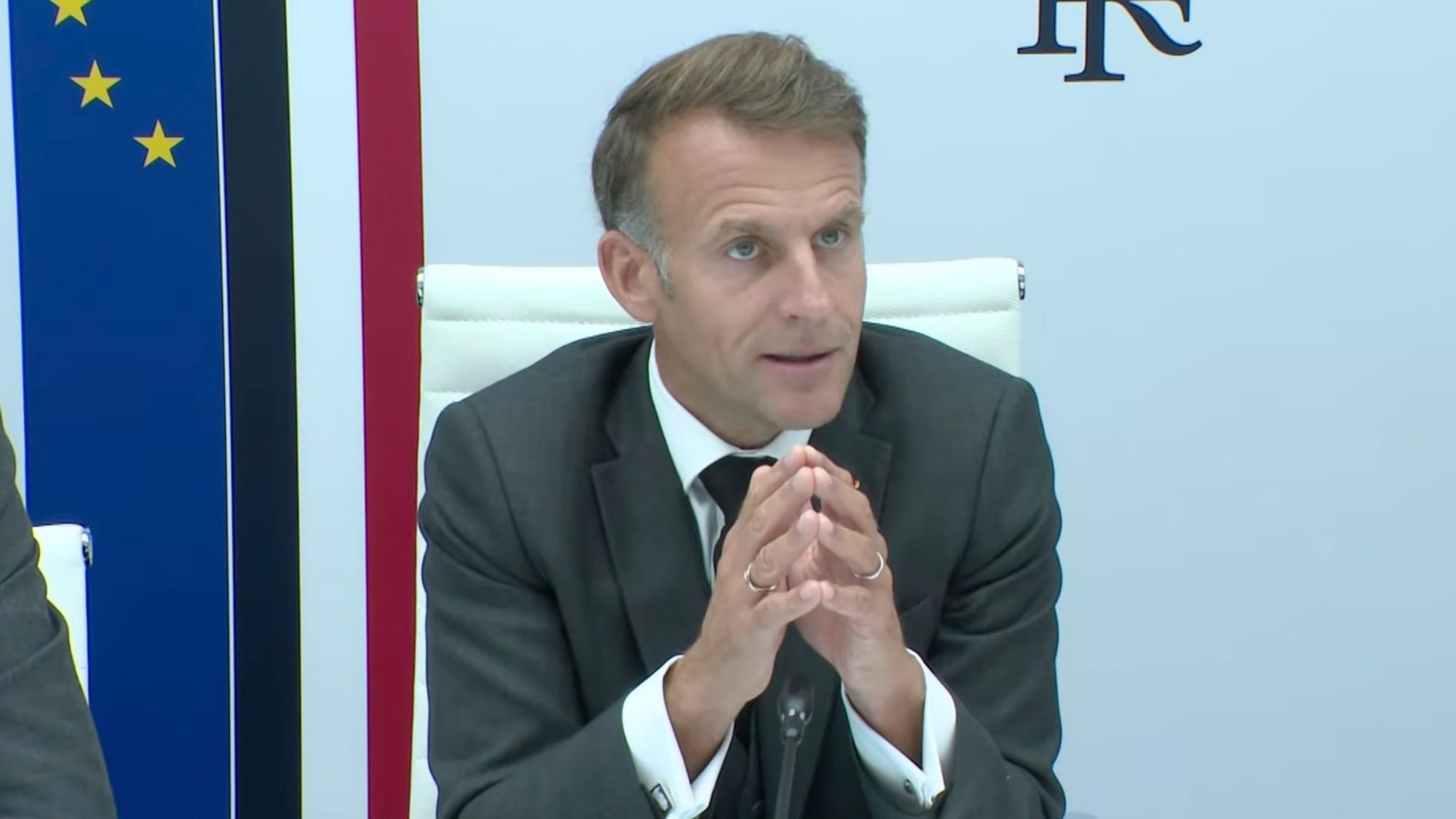
The latest attempt came during a Q&A session at the Complutense University in Madrid on September 29, during a state visit to Spain. The Elysee published the transcript in French; the quotes below are translations of it.
He had some choice words for the American concept of free speech, which he said is “the opposite of free speech.” According to him, “there is no freedom if there is no limit on my freedom, which begins with the freedom of others and respect for a common framework.”
Macron’s idea of freedom is permission granted to individuals by the state, within the confines of what that state at that time happens to define as “public order.”
That’s not a different version of free speech – it’s the absence of free speech.
Macron also tried to use a street scenario to make his point: “I know this when I walk down the street: my freedom cannot be to hit you, to insult you or to wreck the space we all share. That is the idea some people have of free speech.”
This is a false analogy. Insulting someone is not the same as hitting them, and the reason is that the former is speech, while the latter is physical violence.
That is precisely the point – censorship always justifies itself by equating speech with violence, and treating words as if they were physical assault.
Macron also believes that people should be made to answer for “nonsense” they post online – which means that an official, state-approved arbiter will have to be the one to decide what qualifies as “nonsense.”
Not only that – Macron wants to make sure there are no accounts on social media without a real person behind them – and he wants age checks to be carried out to make sure children are kept off these platforms.
The two ideas mean that the only people allowed to speak online would be those who have been identified.
France’s president also thinks that the EU’s censorship law, the DSA, is not being enforced fast enough, and revealed that he had written to European Commission President Ursula von der Leyen to demand more action.
Macron wants more: “We must use the DSA much more, much faster, much more forcefully. We will keep up the pressure. In fact, the pressure means pushing the Commission to do it, and/or in parallel taking national initiatives to shake things up.”
Pressure to do what, exactly? Macron explained: “As long as we don’t go after the responsibility of the people who spread content on social networks, we will not regulate it.”
He then compared this with the way the press works, where a journalist who writes “nonsense” and an editor who publishes it can be “convicted.” Online, he said, “that is not punished.”
What he wants is “trusted third parties, fact-checking structures that make it possible to restore the truth.”
France’s president also touched on the issue of his attempt to ban people under 15 from social media, which was struck down by his country’s Constitutional Council as disproportionately restricting freedom of expression and failing to protect private life.
He said France would prepare a new national law, and that the EU’s coming child protection law was “the fruit of this work.”
He had this to say about the age verification process, and the use of AI in it: “I can guarantee you that it will protect your personal data, much more than most of the things you do on these platforms every day.”
Macron also mentioned “image recognition, technology with the hand, we use AI precisely, but it will be protective and the data will not be retained.”
He also revealed that schools now teach children “to untangle what is true from what is false.”
A president whose own constitutional court has already told him that his age checks are a threat to privacy and expression is now promising to protect personal data. And he’s asking the EU to censor online speech faster.