California’s Assembly Privacy and Consumer Protection Committee voted 11-2 on April 7 to advance a bill that would let employees and volunteers at immigration service organizations demand the deletion of their images and personal information from the internet, backed by civil penalties starting at $4,000 and the threat of criminal charges.
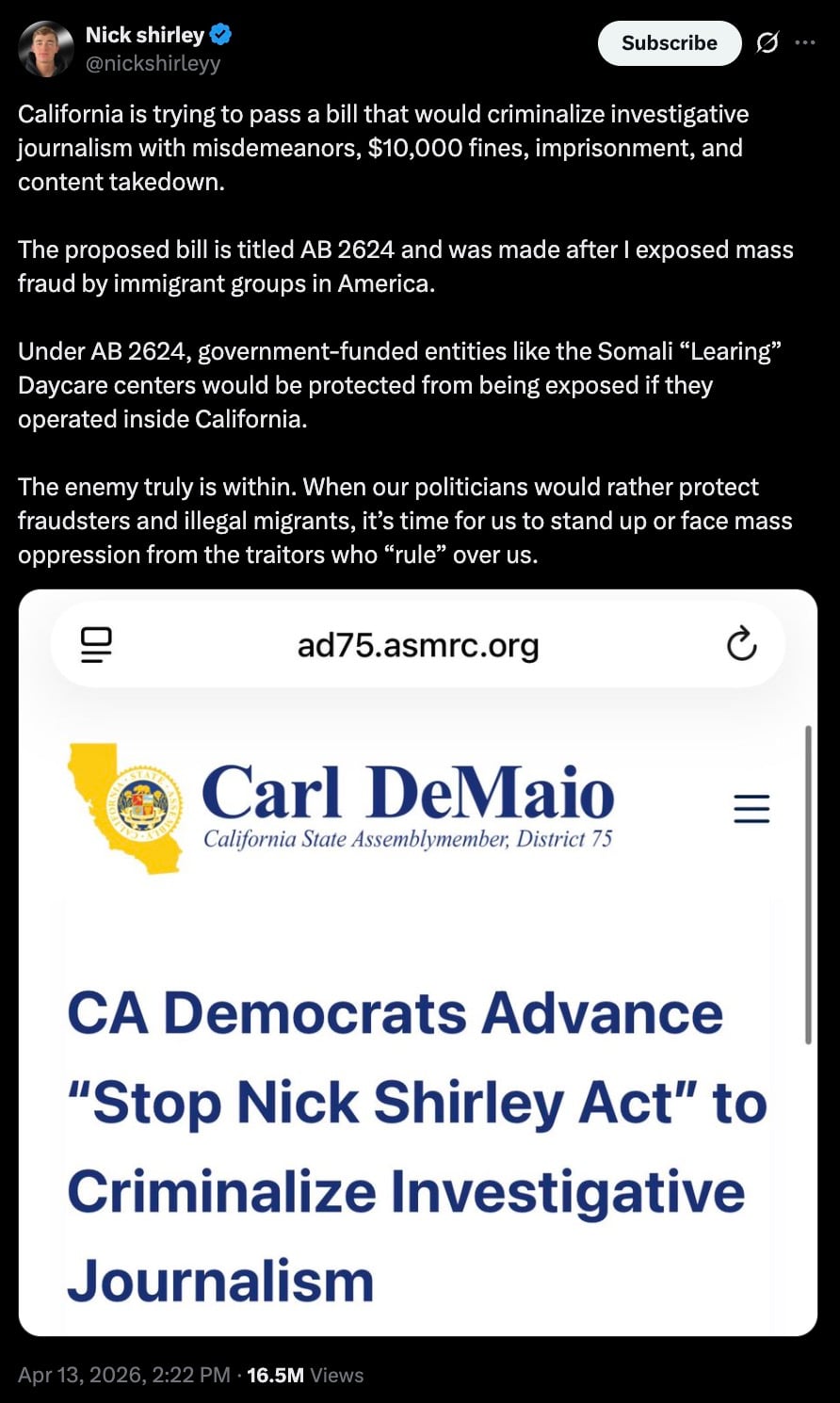
AB 2624, authored by Assemblywoman Mia Bonta, is already being called the “Stop Nick Shirley Act.”
We obtained a copy of the bill for you here.
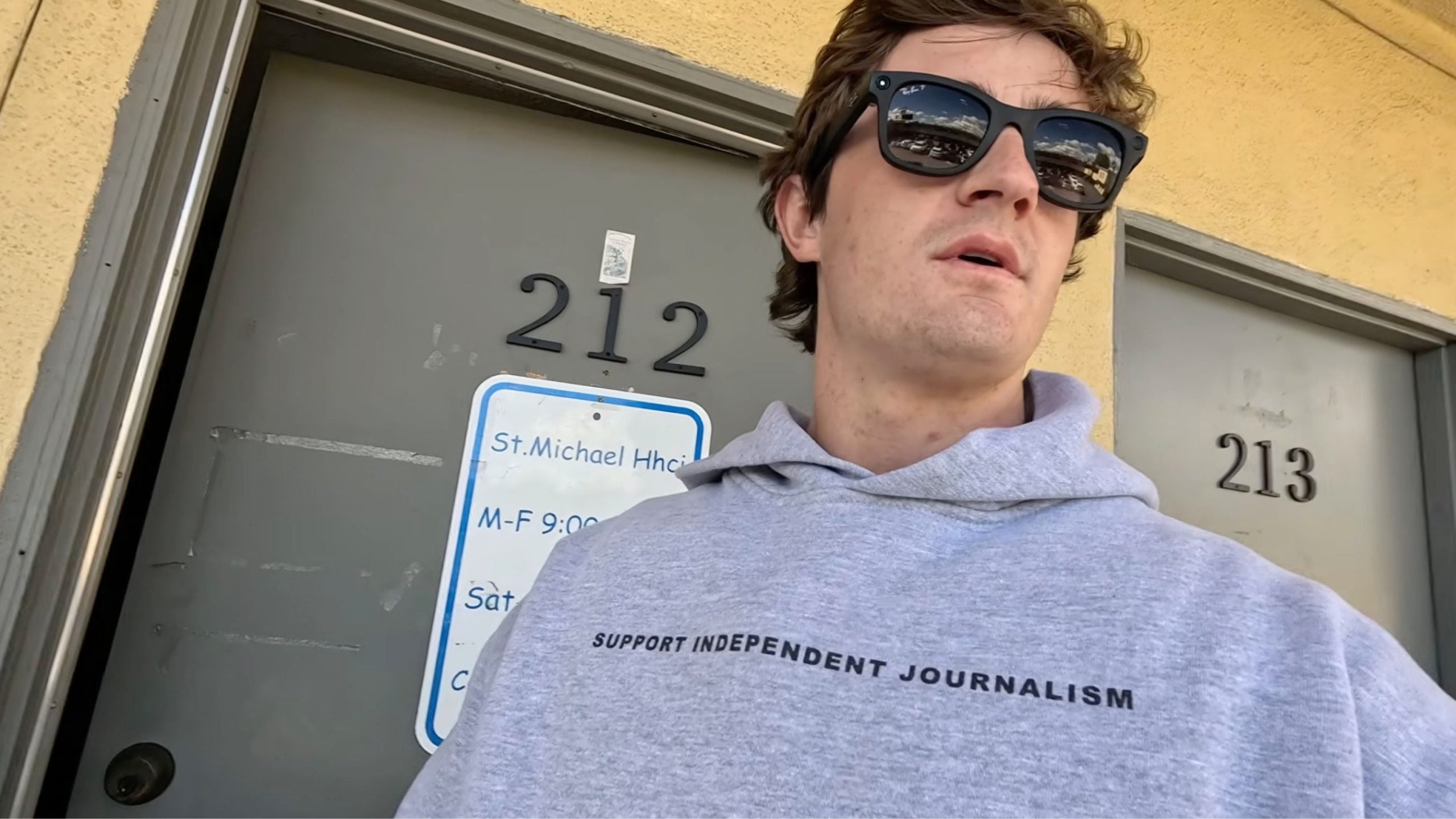
The bill arrives just weeks after investigative video creator Nick Shirley published a 40-minute video on alleged hospice fraud in California that racked up 42 million views on X.
Other investigations have found that a single program is causing the state to lose an alleged $6 billion in fraud annually. Shirley had already reported on over $110 million in Somali daycare fraud in Minnesota in December 2025, with empty facilities billing taxpayers while kids were nowhere to be found.
His California reporting uncovered an alleged $170 million in similar fraud in daycares and hospices, with ghost operations registered to empty lots and strip malls. Sacramento’s response to this flood of documented waste and abuse was not an audit, not an investigation into the programs themselves, but a bill to make it harder to film the people running them.
Under AB 2624, anyone affiliated with an organization providing “designated immigration support services” can send a written demand prohibiting the publication of their personal information or image online.
That demand remains effective for four years, even after the person leaves the organization. If the demand is ignored, the person can go to court for an injunction or declaratory relief.
Fines run up to three times the actual damages, with a floor of $4,000, meaning the minimum penalty triples to $12,000 in cases where a takedown demand is defied. If a journalist or anyone else is accused of posting information with the intent to incite harm, they face criminal charges and fines of $10,000.
The definition of “designated immigration support services” is broad enough to cover almost any organization that touches immigrant communities. The bill defines these services as those provided to the immigrant population, including legal representation, legal assistance, advocacy, case management, humanitarian relief, immigration resources, referrals, translation services, counseling services, and health care. That’s a definition wide enough to include organizations that have been at the center of documented fraud investigations, and to give them a legal tool to suppress the documentation.
The bill also creates an address confidentiality program modeled on California’s existing Safe at Home program for domestic violence survivors.
Bonta defended this at the committee hearing, saying the program “allows participants to keep their home and work addresses out of public records, giving them a critical layer of protection and privacy in an environment where their personal safety is increasingly at risk.” She told the committee that “individuals who provide immigrant support services … are facing targeted harassment” and that “advocates and workers are receiving death threats, being targeted at court houses and facing coordinated online doxxing campaigns.”
There’s a problem with framing the bill as a safety measure, though, and it’s built right into the text. The “reasonable fear” standard required to trigger these protections is defined and enforced by the person claiming the fear, not by a court, not by law enforcement.
Any employee or volunteer at a qualifying organization can send a written demand to suppress publication. They don’t need to prove a threat was made. They don’t need to file a police report. They need to cite a “reasonable fear” and put it in writing. The demand is valid for four years. And the mechanism for enforcing it is a lawsuit against whoever published the information.
What’s missing from the bill is just as telling as what’s in it. There is no exemption for journalists. Assemblymember Carl DeMaio raised this directly during the committee hearing, telling Bonta, “You do not provide an exemption for journalists.”
He pointed to specific investigative work, noting that “posting video, like (Republican Assembly Member Alexandra) Macedo, in her investigation, posted a video of, what, 90 fake hospices, and Mr. Shirley had dozens or, you know, fifty, sixty fake ‘learning’ centers for the Somali community in Minnesota. Posting the video apparently would be punishable under your law.”
DeMaio also said that the bill makes no distinction between independent citizen journalists and reporters at established outlets. “There’s no differentiation,” DeMaio said. “It says any individual who does this, any corporation, any business who posts a video, full stop. There’s no ‘Well, there’s an exemption for journalists.'”
Bonta pushed back on this characterization. “In your scenario, Assemblyman DeMaio, the folks who were investigating that, these were reporters, journalists,” she said during the hearing. “They were not subjecting any particular organization to violence or threats of violence. That is the nature of this bill.”
But the nature of the bill is exactly what’s at issue. The bill doesn’t require that a journalist actually threaten someone. It requires that someone at a covered organization feel threatened enough to send a letter. And once that letter is sent, the journalist faces penalties for publishing.
The organization that receives bad press gets to decide whether the press constitutes a threat, and then the law penalizes the press.
This is prior restraint dressed up as privacy protection. Prior restraint, stopping speech before it happens rather than addressing genuinely harmful speech after the fact, is the form of censorship that sits closest to the core of what the First Amendment was written to prevent.
AB 2624 creates a tool where a letter from a subject of reporting can trigger legal liability for that reporting before any court determines whether the report was harmful, threatening, or even inaccurate.
DeMaio called it bluntly. “California Democrats are trying to intimidate citizen watchdog journalists and protect waste and fraud happening in far-Left-wing NGOs,” he said in a statement. “AB 2624 can only be described as the ‘Stop Nick Shirley Act’ — a bill designed to silence citizen journalists exposing fraud and abuse of taxpayer dollars.” He added that “instead of fixing the fraud problems being uncovered, Sacramento politicians are trying to shut down the people exposing them.”
His full statement went further. “AB 2624 would allow activists and taxpayer-funded organizations to demand the removal of video evidence — even if it captures misconduct in plain view — and threatens journalists with massive financial penalties,” DeMaio said. “If this bill becomes law, the message is clear to every journalist in California: expose corruption and you will be punished. AB 2624 is an unconstitutional direct attack on transparency and the First Amendment – and it needs to be defeated.”
Shirley responded on X with a similar read of the situation. “California is trying to pass a bill that would criminalize investigative journalism with misdemeanors, $10,000 fines, imprisonment, and content takedown,” he wrote. He noted that “under AB 2624, government-funded entities like the Somali ‘Learing’ Daycare centers would be protected from being exposed if they operated inside California.”
The chilling effect here doesn’t even require enforcement. A journalist considering an investigation into a taxpayer-funded immigration services organization now has to weigh the possibility that filming employees in a public space could trigger a written demand, a lawsuit, an injunction, and thousands of dollars in penalties.
The organizations being investigated get a new tool for suppressing coverage that has nothing to do with the merits of the investigation. The question stops being “is the reporting accurate?” and becomes “did someone at the organization feel threatened enough to send a letter?” That’s a standard built for abuse. The organizations with the most to hide are the ones most motivated to send the letter. And the penalty for ignoring it is a lawsuit, which costs money and time even if you win.
The bill passed the Assembly Privacy and Consumer Protection Committee on April 7 with an 11-2 vote, with Republican Assemblymembers Alexandra Macedo and Carl DeMaio casting the only no votes. It was then referred to the Assembly Judiciary Committee and is still working through the California Assembly.