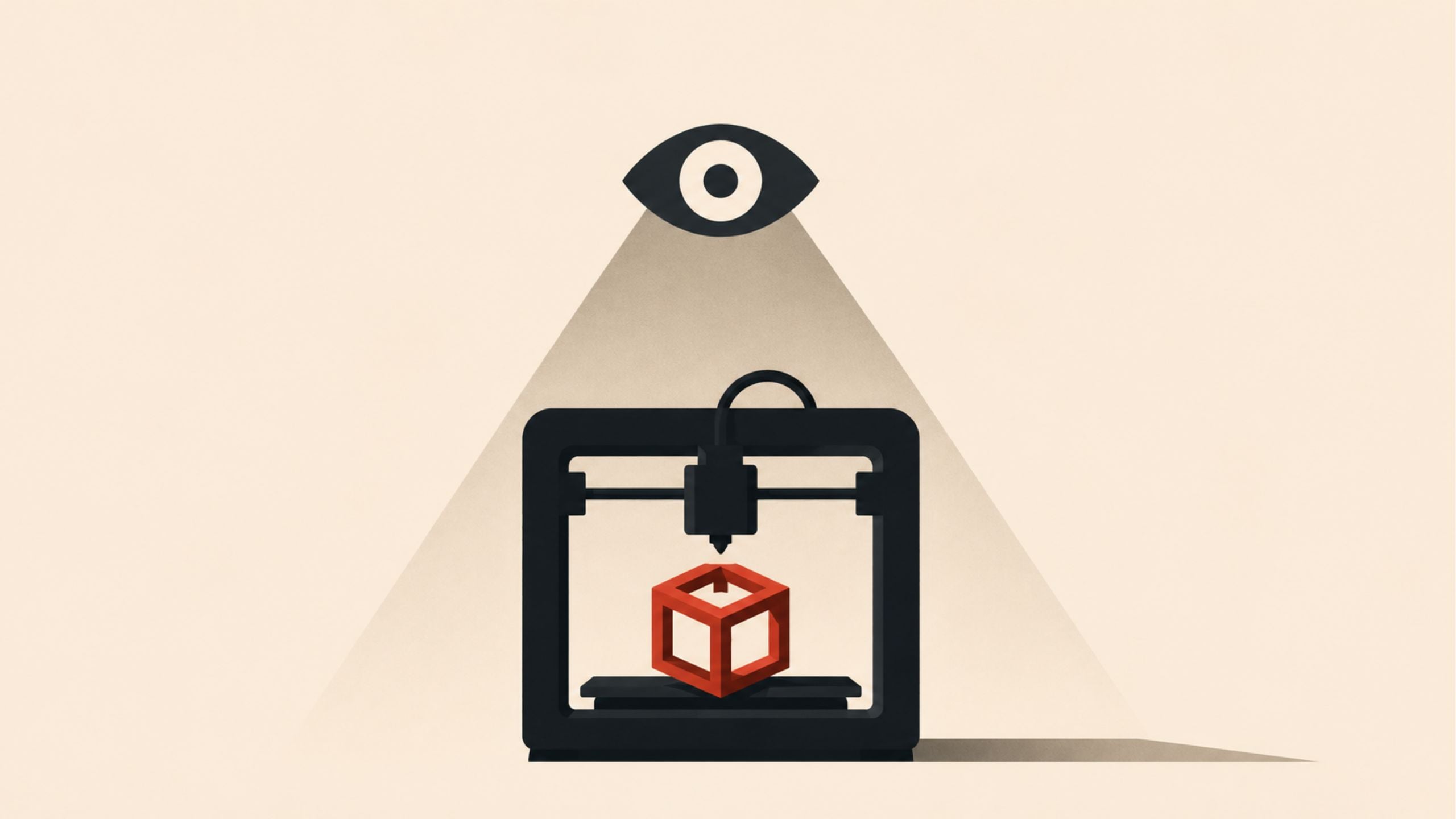
California wants to place a permanent watcher inside every 3D printer sold in the state.
AB 2047 would force manufacturers to install what its authors call “firearm blocking technology,” software that inspects whatever a person tries to print and refuses to build anything a state-approved algorithm flags as a gun part. On June 30 the Senate Public Safety Committee voted the measure forward, moving a home-surveillance requirement closer to becoming California law.
We obtained a copy of the bill for you here.
The scan would run on the machine in your garage or classroom and it would answer to Sacramento rather than to you. Five Democrats backed the bill in committee and one Republican opposed it. It now waits for the Senate Appropriations Committee when lawmakers return from summer recess, after already clearing the Assembly in May and the Senate Judiciary Committee in June.
The Democrat who wrote AB 2047, Assemblymember Rebecca Bauer-Kahan, chairs the California State Assembly Privacy and Consumer Protection Committee. Her own committee exists to shield residents from constant data collection and her signature bill would hardwire always-on scanning into a household device.
The software the bill leans on barely exists outside one company’s sales deck. That company, Physna, sent a representative to testify for the measure.
David Tobin, executive producer for the 3D Printing Nerd YouTube channel, told the committee that he and his peers had already tried it. “There’s one company on the planet that supports this technology, and it’s called Physna,” he said.
“They brought their salesman here last week to talk to you about it. We’ve all used their technology. It does not work and do what they’re saying it does.” He then described the flaw in asking an algorithm to read intent from geometry. “There’s a pen on your desks. That’s an object. That does not have intent. No object has intent. We instill intent. That could be a pen, it could be a tracheotomy tool. It’s a tube.”
Physna’s business ties give the mandate an uglier shape. The company has announced a partnership with Palantir, the data integration contractor, and it won a Missile Defense Agency contract for its 3D data analysis work.
A vendor built around military and intelligence pattern-matching stands to gain a guaranteed market if California requires its scanning inside consumer hardware.
The blocking software would also refuse benign and lifesaving work because a gun part and a medical part can share a shape.
Senator Kelly Seyarto, the only committee member to vote no, argued the law would miss the people it targets while punishing everyone else. Criminals will buy printers out of state or strip the software, he said, and the design leaves room for “way too much collateral damage” among lawful users.
“You need to go after the people that are breaking laws, not after the technology that they use, because they’ll continue to use that technology whether you make new laws that affect everything else or not,” he said.
One yes vote arrived with a startling admission. Senator Sasha Renee Perez said she did not “have a lot of information or knowledge about” 3D printing, then asked whether the bill even applied to all types of 3D printers.
She said she was learning about the measure “in real time” as witnesses were “explaining this to me and as I was reading the bill last night.” She acknowledged a constituent’s surveillance fears and granted that “we have real concerns about privacy and data right now.” Then she voted for it.
More than 200 people showed up to fight the bill, among them engineers, small business owners, disability advocates, medical professionals, and other groups. Much of the open-source printing world came too, from RepRap founder Adrian Bowyer to Prusa Research founder Josef Prusa. They share a refusal to accept the premise sitting at the core of AB 2047, that a machine you own should treat you as a suspect and report to the government about what you make at home.