

The Canadian government drew up a plan to take individual citizens to court over what they post online. That plan sat inside a 35-page internal memo from the Department of Industry, most of it blacked out before the public could see it.
Blacklock’s Reporter pried the document loose through an Access to Information request. Dated March 31 and titled “Misinformation And Disinformation Strategy,” it belongs to the department run by Minister Mélanie Joly, known as ISED. The memo weighs “legal action” against people who post what the government calls “false and misleading information” on Facebook, Twitter, and LinkedIn.
What kind of legal action? The redactions hide that. What survives the black ink is the logic. “This strategy seeks to uphold the integrity of and public trust in government information,” the memo says. The department is appointing itself guardian of its own reputation, with lawsuits as one available tool.
Here is who would decide. ISED itself would judge whether a post is “factually incorrect, misleading or out of context.” The same department that dislikes a post gets to rule on whether the post is true. No court makes that call first and no independent reviewer checks the work. The government writes the definition of misinformation and then enforces it against the people it defines.
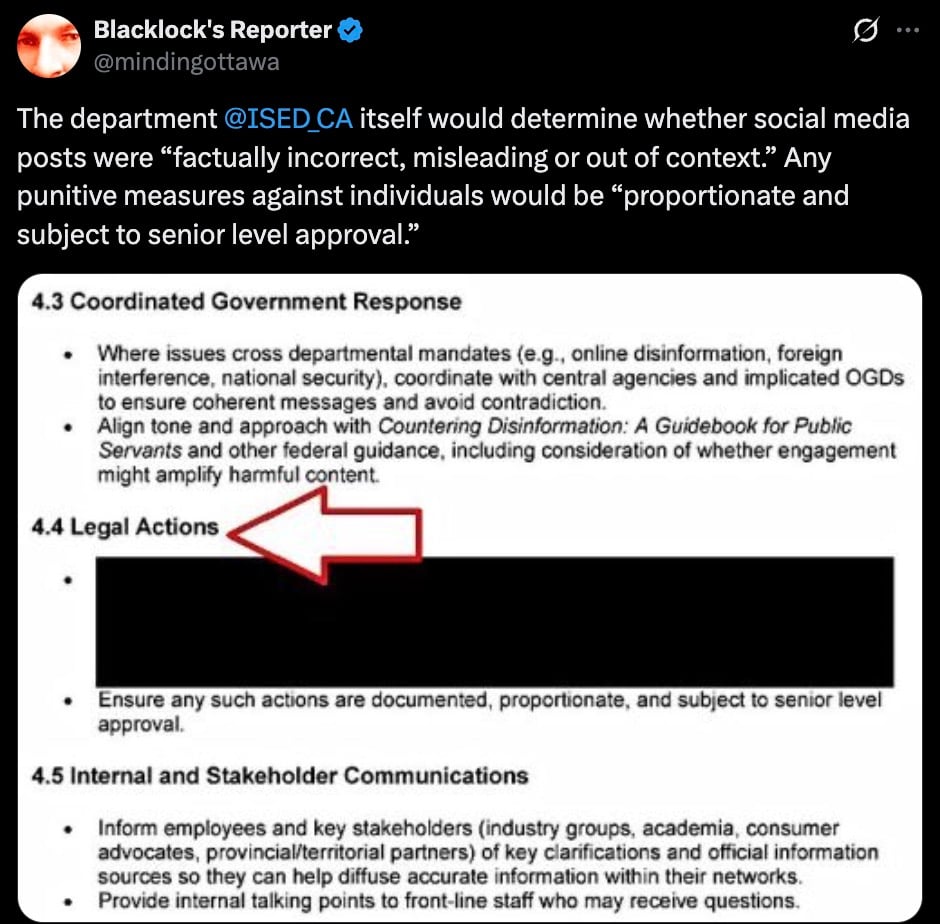
The memo describes any punishment as “proportionate and subject to senior level approval.” That language reassures no one. Proportion gets measured by the same officials pushing the complaint, and senior approval means a manager signs off, not a judge.
Officials already watch. Managers “already monitor the department’s official social media channels and media outlets on a daily basis for comments and recurring inaccuracies,” the memo says. The strategy would push that surveillance from reaction toward “prevention and early detection,” catching disfavored speech earlier in its life.
The chilling effect writes itself. A citizen who knows a federal department is reading posts, grading them for accuracy, and holding a lawsuit in reserve thinks twice before typing. The threat does the work a courtroom never has to.
The government’s own files admit the problem. Its research found Canadians feel capable of spotting fake news and do not want Ottawa “declaring what is true or not.” The memo concedes that answering misinformation can amplify it, and that going after individuals risks “further backlash.” The department understood the public would object and mapped the plan anyway.
Compare the tune from four years back. This same Liberal government declared that “the rights and freedoms that individuals have offline must also be protected online.” That promise reads differently next to a memo about suing people for their posts.
Ottawa has not explained how the monitoring runs, how often lawsuits were floated, or what a post must do to land on the department’s radar. The memo sets no threshold. It names no outside check. It leaves a federal department free to decide which citizens spoke falsely and what the price should be.
A government sure of its facts answers speech with more speech. This one drafted a plan to answer speech with lawyers.