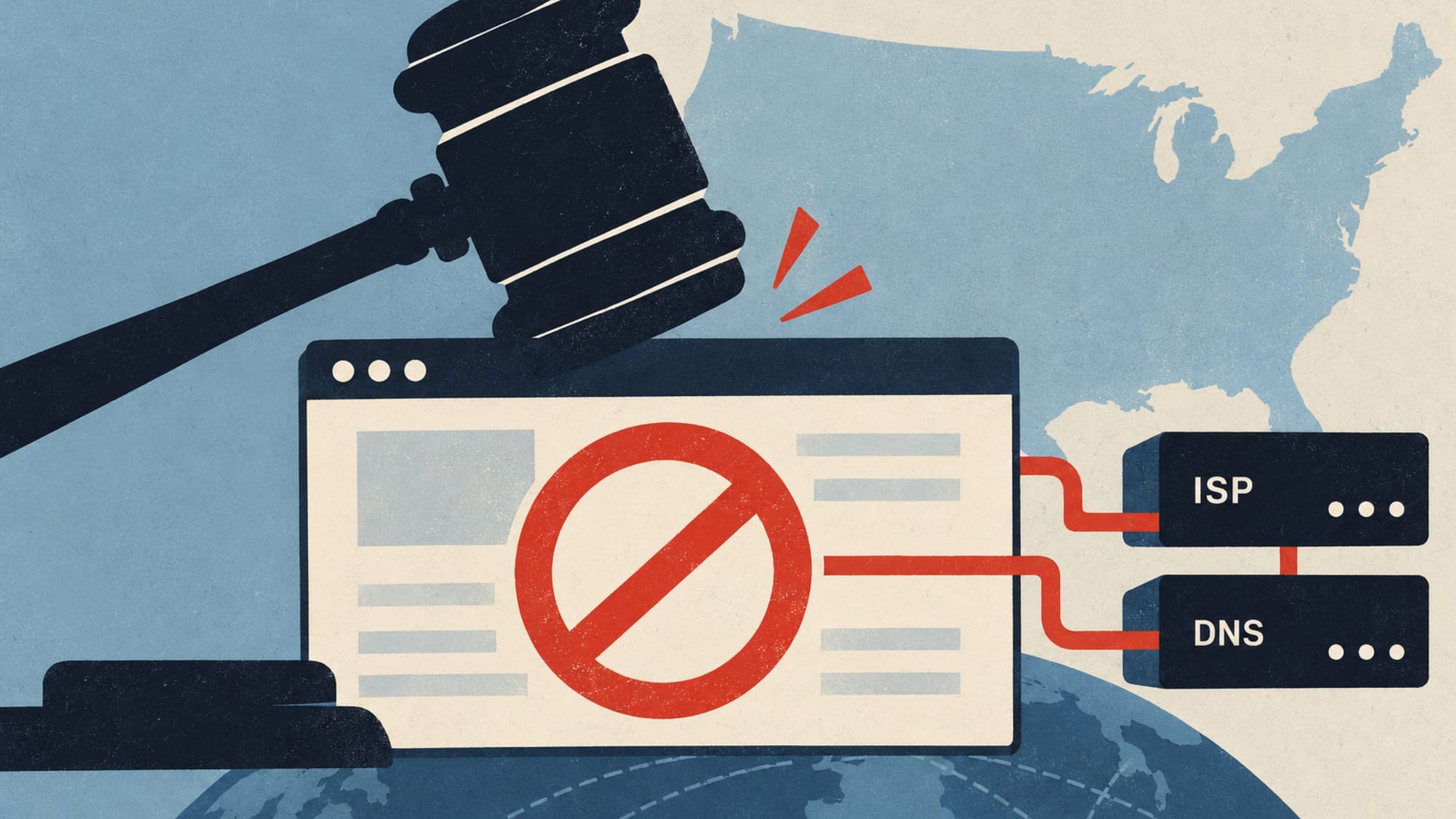
A new bill has been introduced that seeks to have US courts issue site blocking orders, which would then be executed by ISPs and public DNS resolvers.
The bill, Deterring Extraterritorial Foreign Exploitation of Networks Damaging Intellectual Property Act, or DEFEND IP, was introduced by Senator Thom Tillis and Representative Zoe Lofgren, and it combines two earlier proposals: Lofgren's Foreign Anti-Digital Piracy Act, and Tillis's Block BEARD.
Lofgren said in a statement, "I am proud to work across the aisle on this smart, targeted approach to crack down on foreign piracy while protecting Americans' free speech and access to a free and open internet."
The bill was introduced with the support of more than a dozen industry organizations, including the MPA, the RIAA, and the Copyright Alliance.
The proposal is designed to apply to broadband providers serving at least 50,000 subscribers, and public DNS resolvers with an annual revenue of more than $100 million. This would cover Google and Cloudflare. But the definition does not include entities that "exclusively provides virtual private network services or similar service that encrypt and route user traffic through intermediary servers," which means VPNs are exempt, as are resolvers that work "exclusively through encrypted DNS protocols."
The fact that the bill exempts VPNs and encrypted DNS services shows that the intention is not to stop piracy, because these two technologies will allow users to access any site, regardless of whether it has been blocked or not. The intention is to make it easy to block sites, and to make that a common practice.
The process is similar to that of the recently introduced American Copyright Protection Act: a US federal court would first have to designate a site as a "foreign digital piracy site," and then the rightsholder would return to the same court to obtain a blocking order.
The two-step process is meant to provide a check on the system, but the site's operator has only 20 days to appear in court and contest the designation. The court, however, does not have to wait for the operator to show up, and can issue the designation order ex parte.
Once that happens, the rightsholder can get a blocking order. This order can be issued before a live event that is expected to be transmitted illegally, and it can be updated if the site moves to a new domain or address.
The bill also provides for the "immunity from liability for good faith actions and for reliance" on the orders issued by the courts.
A site that is blocked by mistake can ask the court to modify the order, but unlike Issa's bill, this one does not provide compensation for the owner of the site. But digital rights advocates are warning that the bill would build an infrastructure for censorship. As Public Knowledge's Senior Policy Counsel Meredith Rose put it, "For the second time in as many weeks, rightsholders have convinced Congress to build out an expansive infrastructure for censorship rather than go after the root of the problem: operators of overseas piracy websites."
"Let us repeat: Applying blocking orders to global DNS resolvers causes global blocks," she said in a statement.
The orders would, according to her, "conscript any service provider, from the smallest residential ISP all the way up to global DNS resolvers, into playing 'copyright cop' against websites simply accused of copyright infringement."
"There are no penalties for bad faith or abusive blocks. There is no meaningful remedy for businesses caught in the blast radius of a broad, IP-based block," she said. And she noted that in the past, site blocking has resulted in the takedowns of "everything from hotels, to telehealth services, to a literal nunnery."
We recently reported about the American Copyright Protection Act, which would also have US courts order site blocking, but in this case, the order would be binding on VPNs as well.
We also reported about a Spanish court ordering two VPNs to block a site, and about a number of unrelated sites that went dark in Spain when a court ordered ISPs to block IP addresses that were streaming football matches.
In the US, the Supreme Court recently blocked the music industry's bid to cut internet access to millions of people suspected of piracy.
The carve outs in the bill show that the sponsors know that people will look for ways to circumvent the blocks, but this will not stop the sites from being blocked. Instead, it will create a new, generic infrastructure for censorship, that can be used by the government, and not only on copyright grounds.