
Lawmakers in several Western countries are now considering online age verification digital ID systems similar to those that recently came into force in Australia.
The Australian model, which blocks children under sixteen from joining social media platforms and so forces all adults to submit ID to access platforms, has quickly become a reference point for politicians abroad who describe it as a child safety measure, while others warn it could normalize digital identity tracking.
In the United States, Senator Katie Britt of Alabama said she hopes “Australia taking this step…leads the US to actually doing something.”
Britt, a mother of two, is one of the sponsors of the bipartisan Kids Off Social Media Act, which would prevent children under thirteen from using social platforms.
Senator Josh Hawley, a Republican member of the Senate Judiciary Committee, told The Sydney Morning Herald that he supports similar limits. “I like it. I’ve supported age limits here in the US for kids on social media,” he said.
“I say this as a parent…Parents need help, and they feel like they’re swimming upstream when everybody else has social media.”
Hawley, author of The Tyranny of Big Tech, said he has spoken with Australian stakeholders about the ban, though he did not identify them.
In the United Kingdom, several senior figures have also praised the Australian approach. Lord John Nash, a Conservative member of the House of Lords and long-time technology investor, argued that children should be kept off social media until they are older.
“For 40 years, I have been a tech investor. I believe in technology’s power to change lives. I just believe we should give children more time before they can use these platforms,” he wrote. Nash added that his proposed amendment to the Children’s Wellbeing and Schools Bill would replicate the Australian model and enjoys strong public support.
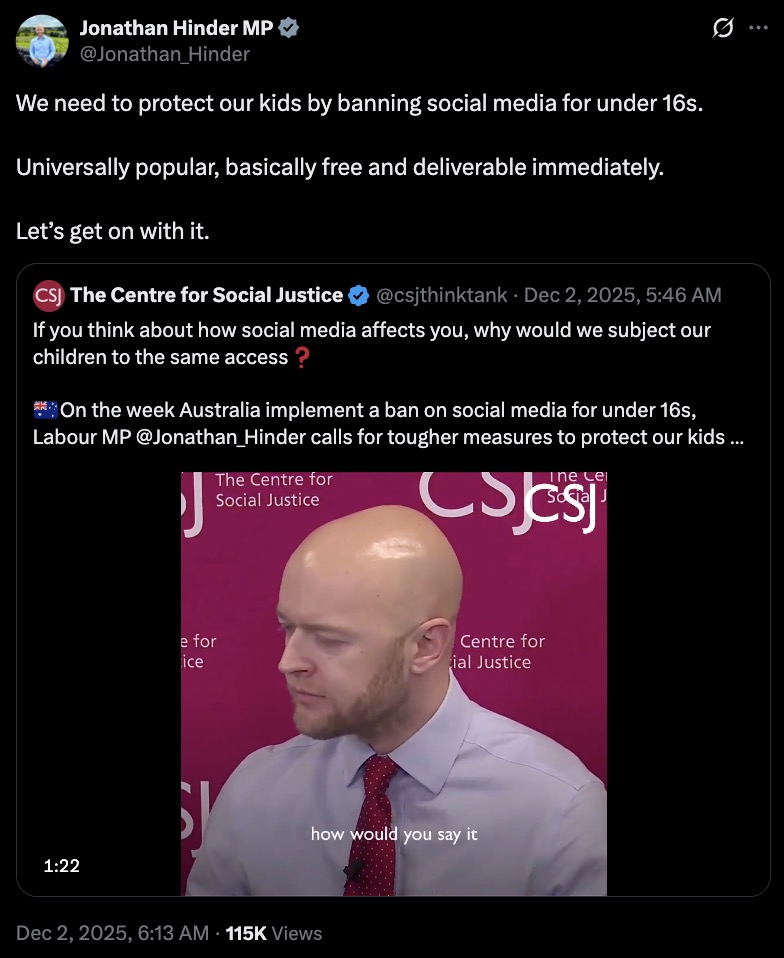
Labour MPs Jonathan Hinder and Joani Reid have both said the UK should consider banning under-16s from social media. Reid criticized the country’s censorship law, the Online Safety Act, saying it does not go far enough, and urged Ofcom to “be bolder” in tackling “online harms” and to issue more fines under the law.
Across Europe, Danish MEP Christel Schaldemose, who led a non-binding European Parliament resolution that endorsed continent-wide age checks for social networks, video sites, and AI systems, praised Australia’s decision.
“I’m happy that they want to protect kids, and I’m happy that we have a chance to see how they do it and see if we can learn from them,” she said.
UK Culture Secretary Lisa Nandy struck a cautious tone. Speaking to BBC Breakfast, she said the government “certainly would consider” a similar ban “if young people… believed that it was working and trusted that that was a solution.” She added that there are no immediate plans due to “enforceability” concerns.
In a later interview with Good Morning Britain, Nandy said the UK “could” introduce such a measure but questioned whether it would be effective and expressed doubts about Australia’s approach.
Mandatory age verification carries significant privacy risks. Systems designed to verify age often rely on sensitive data such as government-issued identification, biometric scans, or facial images.
Once introduced, such data infrastructure can be extended for other purposes, allowing broader forms of monitoring, record-keeping, and speech suppression.