
A federal judge has blocked the Department of Homeland Security (DHS) and Immigration and Customs Enforcement (ICE) from acting on a “warning notice” that two ICE agents hand-delivered to a New York writer because he sent a furious email to ICE acting director Todd Lyons.
The judge found that the notice likely violated the First Amendment, and that the man, David Streever, was within his rights to send the email, as it did not contain a true threat.
The opinion for the US District Court for the District of Columbia, Civil Action No. 26-2356, was written by Judge Rudolph Contreras. The case was brought by the Foundation for Individual Rights and Expression (FIRE) in July on behalf of Streever, who is a writer.
The opinion opens with the words, “Americans have long voiced their displeasure with their government. The Declaration of Independence itself is a list of grievances between Americans and the British government.”
But it was in the 1960s that the US Supreme Court in New York Times v. Sullivan recognized that government officials have long endured “vehement, caustic, and sometimes unpleasantly sharp attacks.”
The difference now, the judge continued, is “how the government responded in this case.”
The email that Streever sent to Lyons came after ICE officers killed two people in Minnesota in January 2026.
Streever, who was not involved in the incident, was furious enough to write to Lyons, calling him “a monstrous human being” who “will go down in history as America’s Reinhard Heydrich, the butcher” – and that was just the beginning of the missive.
But the judge found that the email was not a true threat, but rather “a far cry from a ‘[t]rue threat[ ] of violence’ sufficient for the email to shed its First Amendment protections.”
The judge notes that “political speech is not a crime, so that is hardly a reminder to follow the law.”
The warning notice, however, that ICE sent to Streever is a different matter. The judge writes that it “likely violates Mr. Streever’s First Amendment right to free speech.”
The notice, which was signed by an agent with the Office of Professional Responsibility, requested that Streever “promptly remove and/or discontinue the aforementioned behavior” – and informed him that it was “unlawful to threaten to assault, kidnap, and/or murder a federal official.”
And so, the court granted in part Streever’s motion for a preliminary injunction, enjoining the defendants from “relying on the Warning Notice, issuing similar threats, or making good on the threats in the Warning Notice.”
The judge also found that Streever was suffering “continuing, rather than a past, injury” from the notice, since it speaks of “discontinu[ing]” his political speech and threatens consequences if he “continue[s]” to speak out.
But Contreras decided that at this early stage in the proceedings, enjoining all future investigations “would be inappropriate.”
The court did not, however, dismiss the case, as the defendants had asked for, nor did it transfer it to another venue, as they also requested.
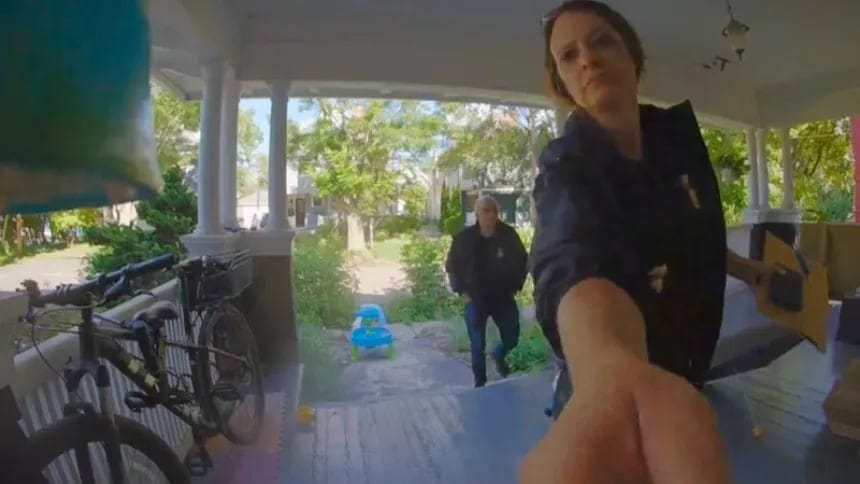
Streever’s email was sent in January, but it took the agency five months to act on it, and then some. The first attempt to hand-deliver the notice was made in June, when two agents went to his house, but nobody was home. They waited and when his wife arrived, they gave it to her, but she told them her husband was abroad.
But when he returned with his seven-year-old, a federal agent showed up at the front desk of their New York hotel, and Streever then received several anonymous voicemails. The investigation was eventually closed, but he was never informed about it.
The effect on Streever was such that he is now self-censoring for fear of the government. As the opinion puts it, his injury is “the loss of his freedom to engage in political speech now because the threat of such an investigation or prosecution looms over him like the sword of Damocles, and he is forced to self-censor under that threat.”