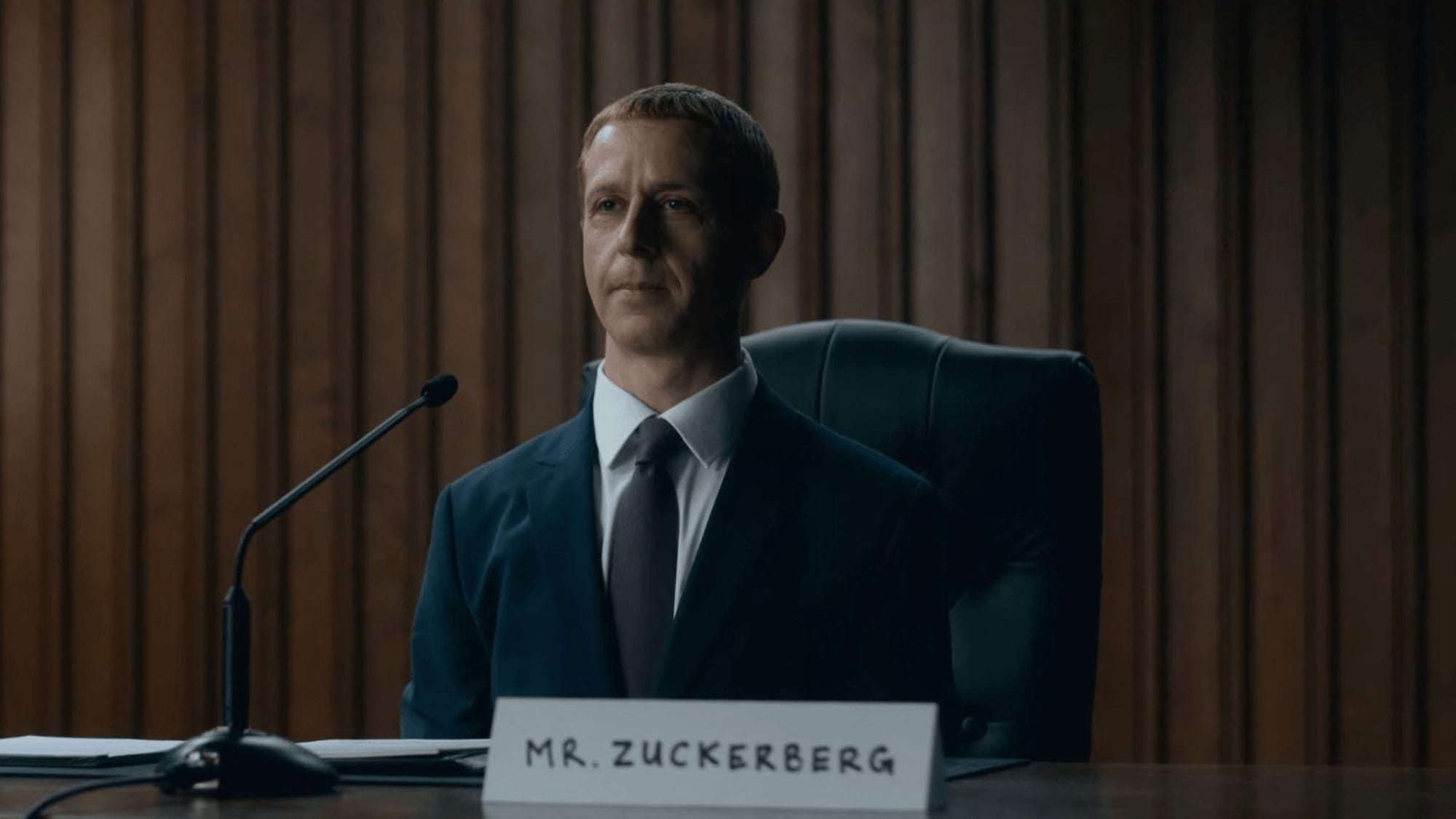
Aaron Sorkin’s The Social Reckoning, written and directed by the prominent screenwriter and produced by Sony, isn't a movie about Facebook, even though it is based on the social media giant's story and its controversial global impact.
This is actually political activism with a running time of 112 minutes.
In April 2024, on The Town podcast, Sorkin said, “I blame Facebook for January 6” – and when asked why, he said, “You’re going to need to buy a movie ticket.”
He didn’t stop there. Sorkin, who is known for his TV series The West Wing and The Newsroom, as well as films like The Social Network, said, “There’s supposed to be a constant tension at Facebook between growth and integrity. There isn’t. There’s just growth.”
On the same podcast, Sorkin referred to the 2024 election as “an election about Trump vs. not-Trump, and there is an existential choice there.”
He directed it himself to get it out before the midterms: “I didn’t want The Social Reckoning to come out a year after the midterm elections,” and “I wanted it to come out now.”
The timing of the movie’s release, and the fact it was directed by Sorkin himself to make that happen, is not the only clue that this is a piece of political persuasion.
Aaron Sorkin and Sony Pictures are trying very hard to sell The Social Reckoning as something it’s not – but in the process, they are also inadvertently revealing what it actually is.
“I’m not going to deny, of course, that the movie is political,” Sorkin told Politico, as reported by TheWrap. “I just think it shouldn’t be.”
On NBC’s Today show, he went for the “anti-truth” angle: “The film shouldn’t be political unless you are somebody who is anti-the truth, okay?”
So those who don’t accept Sorkin’s truth are anti-the-truth.
On CBS, he said that if he ever got the chance to talk to Mark Zuckerberg, he would tell him, “You want to make the world a better place? Don’t make the truth up for grabs.”
Sorkin is not interested in argument. He is interested in selling his movie. And he has a willing partner in Sony, whose CEO, Tom Rothman, said, “I’m a free speech absolutist too, but I know you can’t yell ‘fire!’ in a crowded theater. I know that there is a difference between free speech and falsehood.”
(Yes, you can yell “fire” in a crowded theater.)
As for falsehood – who gets to decide what that is? Sorkin and Rothman? Meta’s “fact-checkers”? The government?
No one has a good track record here, and it’s disingenuous to pretend that there is an easy way to discern falsehoods, and that the people who are currently in power should be the ones to decide.
Meta (Facebook) is not happy about the film at all. Sorkin said the company’s lawyers sent Sony “a strongly worded letter” when they found out about it. Meta has not publicly commented.
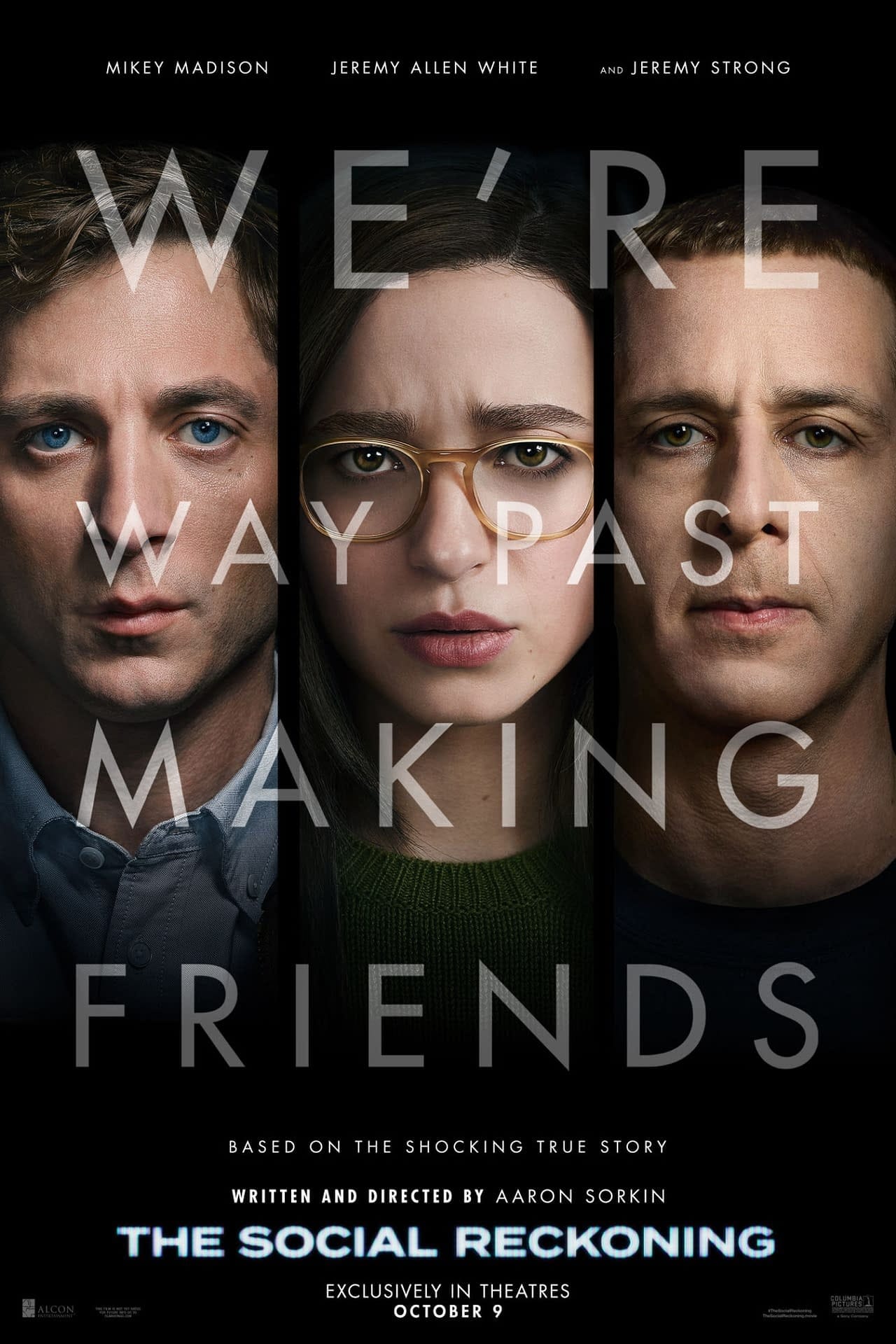
Even if you accept that the film’s politics are spot on – many Hollywood critics who do still found it to be a lecture – and a bad one at that, given its heavy-handed, didactic approach. Barry Hertz writes in The Globe and Mail that it is “an insufferably sanctimonious fantasia of blue-state boomers” – and that it’s “almost as if Sorkin is actively testing his audience’s tolerance for self-righteous didacticism.”
Hertz says the movie is so bad, it “will turn even the most hardcore Facebook hater into a true-blue Facebook believer.”
Some other reviews are just as scathing: IndieWire gave it a D+.
David Rooney, writing for The Hollywood Reporter, did like the film, but even he noted that “Sorkin’s tendency for self-righteous indignation is very much in evidence.”
Variety’s Guy Lodge described the on-screen Zuckerberg as “emotionally constipated to an absurdist degree.”
The ABC in Australia said that Zuckerberg is now “a shell of a person, even ridiculous (apparently he has a bulletproof couch in his office, to hide behind in an attack). The film presents him as a villain, even if Sorkin says he isn’t.”
In the movie, Strong’s Zuckerberg says: “People can post what they want. We’re not the ref. We’re the public square.”
Bill Burr’s character answers: “Are you crazy? You’re like a crossing guard standing in front of a school, but you’re not doing anything with your arms, so the cars are just plowing down the children.”
Facebook was never the "ref," i.e., the government, but the public square. And in a free country, the public square is not a place where the ref gets to shut people up. It should be the other way around. But the film appears to be setting up a narrative that says that Facebook, as a corporate Big Tech giant, should have been that ref and that its failure to act as such is what caused all the problems.
In reality, Zuckerberg has been making similar “public square” statements for years, and so have other Facebook execs. In 2016, two days after the election, Zuckerberg wrote that “we must be extremely cautious about becoming arbiters of truth ourselves.”
In 2019, at Georgetown, he said, “I’m here today because I believe we must continue to stand for free expression.”
Anyone who was paying attention during 2020-2024 knows that Facebook definitely wasn’t a platform for free speech. But, in the film, Zuckerberg’s alleged support of free speech is portrayed as the thought process of a near-sociopath. But that is not the right diagnosis of what went wrong at Facebook, nor is the film’s depiction of Zuckerberg’s character accurate.
In a 2024 interview, Sorkin said, “If Mark Zuckerberg woke up tomorrow morning and realized there is nothing you can buy for $120 billion that you can’t buy for $119 billion dollars, ‘So how about if I make a little bit less money? I will tune up integrity and tune down growth.'”
In August 2024, Zuckerberg himself (belatedly) said that the problem was in fact too much censorship, and that he regrets not pushing back more against government pressure to do just that.
In January 2025, he said that Meta had "reached a point where it's just too many mistakes and too much censorship."
The political-ads obsession continues unabated.
It was Aaron Sorkin who first challenged Facebook CEO Mark Zuckerberg on this, in an open letter in the New York Times in October 2019.
Zuckerberg replied by quoting Sorkin’s own script for The American President: “You want free speech? Let’s see you acknowledge a man whose words make your blood boil.”
In that same letter, Sorkin said that by not fact-checking political ads, Facebook was not defending free speech; it was “assaulting truth.”
Zuckerberg, in the Georgetown speech, explained why this is not a simple issue: “We don’t fact-check political ads. We don’t do this to help politicians, but because we think people should be able to see for themselves what politicians are saying.”
If that is not clear enough, Nick Clegg, Facebook’s global policy chief, put it like this: “Would it be acceptable to society at large to have a private company in effect become a self-appointed referee for everything that politicians say? I don’t believe it would be.”
In January 2020, Facebook’s Rob Leathern said: “Ultimately, we don’t think decisions about political ads should be made by private companies.”
Sorkin and others continue to try to make this an issue of Facebook’s willingness to defend free speech, while at the same time accusing it of being too powerful.
As Zuckerberg told Rep. Alexandria Ocasio-Cortez in October 2019, “Congresswoman, I think lying is bad, and I think if you were to run an ad that had a lie, that would be bad. That is different from it being, in our position, the right thing to do to prevent your constituents or people in an election from seeing that you had lied.”
Ben Wizner of the ACLU made a similar point in 2020: “I don’t think Facebook is capable of doing effective fact-checking, and I don’t think as a society we should want Facebook to be the entity that’s making those kinds of distinctions.”
In truth, most political ads are core political speech. And you cannot argue that Facebook is too powerful and also demand it make editorial calls that silence a candidate.
If the goal is to protect elections, then the best argument is that Facebook should not run political ads at all. But that is hard to implement, and it’s not only because the line is hard to draw, and would sweep in cause and issue advertising, too.
“Banning political ads favors incumbents and whoever the media covers,” Zuckerberg explained in the Georgetown speech.
“Even if we wanted to ban political ads, it’s not clear where we’d draw the line,” he said. “There are many more ads about issues than there are directly about elections. Would we ban all ads about healthcare or immigration or women’s empowerment?”
A study published in 2026 in the journal Nature Human Behaviour, and funded by Meta, had researchers remove political ads from users’ feeds for six weeks before the 2020 election.
The result? “No detectable effects of removing political ads on political knowledge, polarization, perceived legitimacy of the election, political participation (including campaign contributions), candidate favourability and turnout.”
Facebook did pause political ads after the polls closed in November 2020. And now, a film is taking aim at the social media giant, but its own ad on Instagram is an example of the very thing it criticizes.
The film, meanwhile, has been promoted with an ad on Instagram that says, “Instagram doesn’t fact-check most ads. Why should we?”
Facebook is to blame for January 6. That is the central thesis of The Social Reckoning. Even if we’re going only by official records and the most mainstream media framing, this is not the conclusion of the House January 6 Committee. Nor is it the conclusion of the Justice Department, whose seditious conspiracy cases against the Oath Keepers and Proud Boys describe planning over “encrypted and private communications applications.”
Brian Fishman, Facebook’s former head of dangerous organizations, told the committee that while he thought the company should have been more aggressive, broader action would have taken down “much of the conservative movement on the platform, far beyond just groups that said ‘Stop the Steal,’ mainstream conservative commentators.”
That is what those blaming Facebook for January 6 are effectively asking for: that the platform had censored an entire political movement.
Frances Haugen, the Facebook “whistleblower” depicted in The Social Reckoning is now a movie figure. And that means the world will be hearing a lot more from her over the coming weeks and months.
In a series of interviews to promote the movie, Haugen has been at pains to present herself as not being in favor of some of the more controversial and draconian forms of online censorship and surveillance.
She claims to be against bans and in favor of “content-neutral” solutions – that are about design, not speech, she has said.
Let’s look at what she has actually been doing and saying these last years.
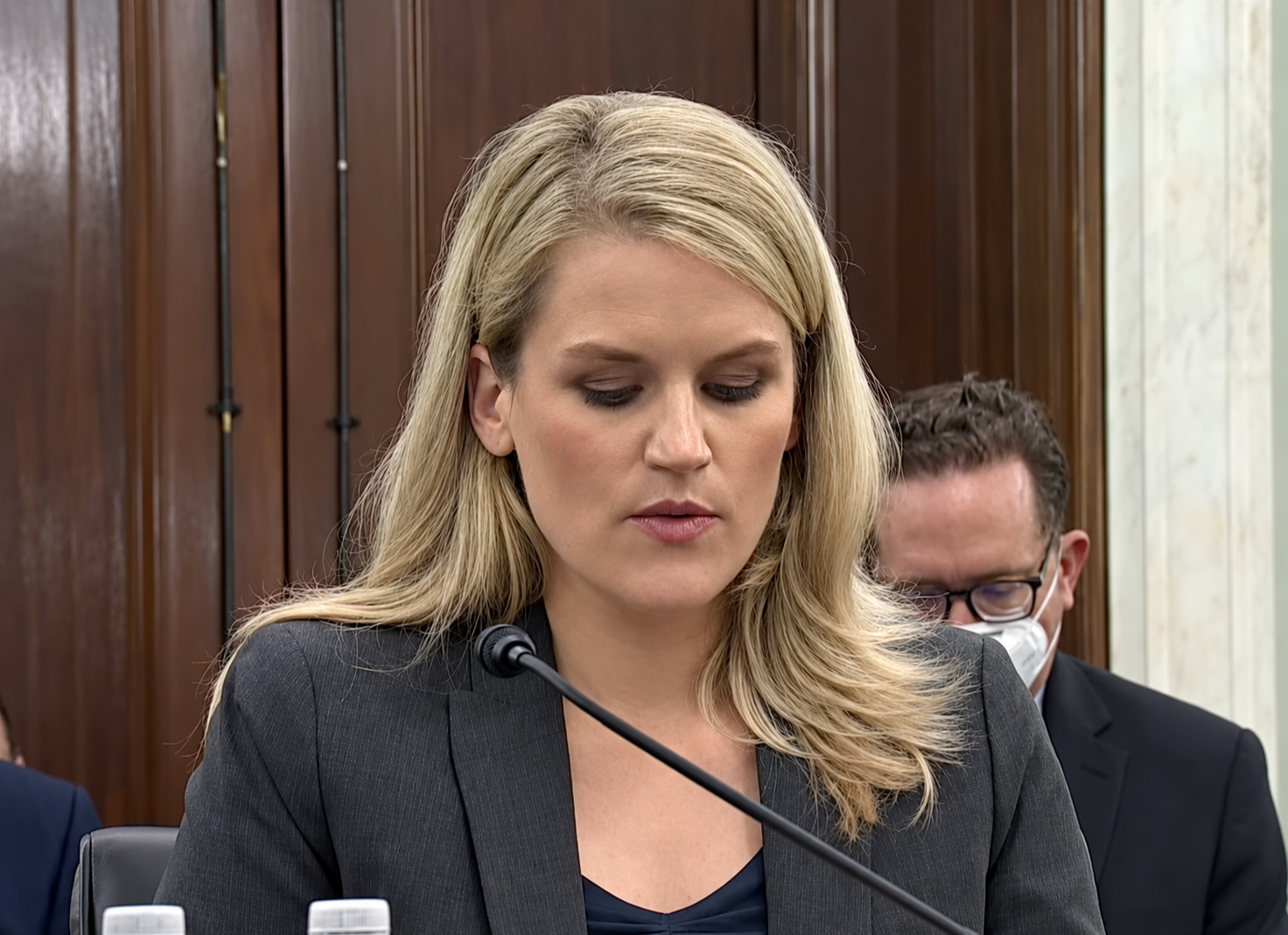
Haugen was the Facebook employee who in 2021 copied internal documents and gave them to the Wall Street Journal, and then went on a media blitz and testified before the US Senate and European Parliament, promoting all of the talking points that the global censors wanted to hear.
At that time, she was in favor of Section 230 reform, specifically to “exempt decisions about algorithms” – and when asked if she meant that a federal regulator should be set up to make those decisions, she said yes.
Haugen was also in favor of raising age limits for using social media to 16 or 18, and spoke in favor of the UK’s “legal but harmful” content policy – which is about censoring speech that is legal, but is deemed “harmful” in the eyes of the government. It would also require platforms to check everyone’s ID before they’re allowed on.
Haugen also supported the EU’s Digital Services Act (DSA), calling it a potential “global gold standard” – and praised the UK’s Online Safety Act, saying she was “incredibly excited and proud of the UK for taking such a world leading stance.”
A year later she joined a pressure group, the Council for Responsible Social Media, that was formed by Issue One, and counts former heads of the CIA, NSA, and DHS’s cybersecurity agency among its members.
The phrase “content neutral” is a favorite among those who push for more online censorship, as it suggests that their proposals are not about controlling and suppressing speech, but something else – like, in this case, “design” rather than “content.”
That is simply a regulator deciding what reaches your screen (and how), no matter what it’s called, or what “neutral” rules it enforces.
Encryption is the one thing that keeps private messages private, and that’s the technology that’s in the crosshairs of those invoking the “think of the children” rhetoric.
In October 2021, Haugen told the Telegraph that end-to-end encryption lets Facebook “sidestep” issues of harmful content on the platform by making it invisible to the company.
In the same month, she told the UK Parliament that end-to-end encryption makes users “feel safe when they might be in danger” and that its introduction should be overseen by a public body.
Techdirt’s Mike Masnick said at the time that this stance opens the door to “all sorts of mischief” since it implies that encryption should only be allowed if a government approves it.
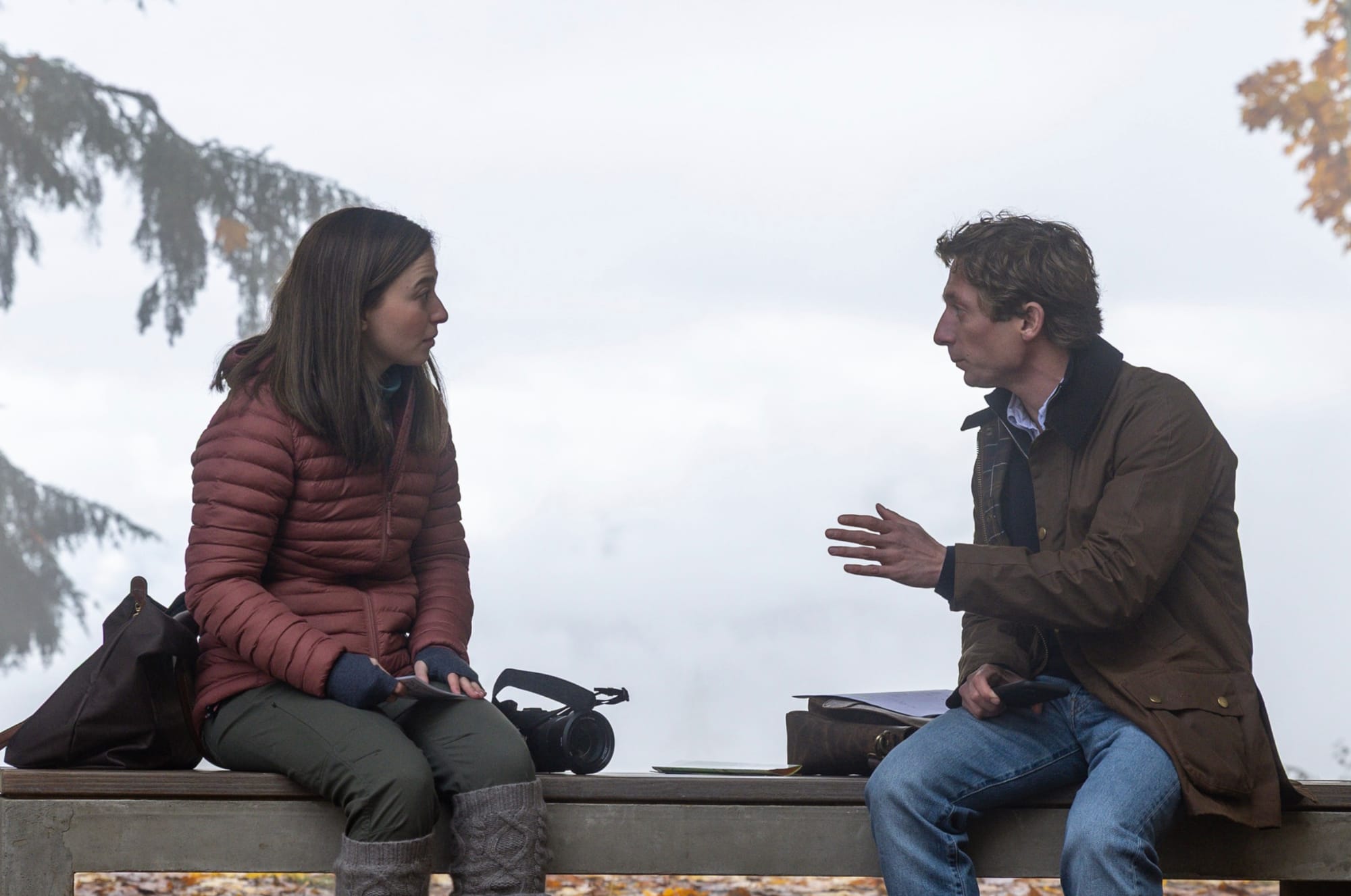
In May 2024, Haugen, with the anti-encryption Heat Initiative and Proxy Impact, moved Proposal 11 at Meta’s annual shareholder meeting, asking for an annual report on child safety that would include how end-to-end encryption affects these efforts.
Haugen then claimed that “law enforcement and child safety experts” believe that expanding encryption on the platform, “without new safety features” would mean hiding “millions of incidents of child sexual abuse.”
The proposal’s lead filer, Lisette Cooper, said in the SEC filing that “all we ask is that Meta focus on protecting our children before protecting user privacy in the immediate term – and delay end-to-end encryption.”
At the time, Reclaim The Net noted that “new safety features” was a euphemism for encryption backdoors.
The movie about Frances Haugen is released in theaters just as laws that would subject every internet user to age verification are being passed on three continents.
In the US, in August, Meta settled with 51 states and territories, and the settlement requires age assurance for every Facebook and Instagram user in those states, by ID verification and facial age estimation.
On October 7, Florida’s attorney general asked a court to order Meta to age-check all users in that state and cut off every under-18 if it can’t do so within 30 days.
In the EU, the KIDS Act was proposed on September 17, and it would require a state-certified age credential to even be able to open a social media account.
Haugen, meanwhile, has been promoting the film and herself, and in an interview with THR said, “With the movie coming out it feels like the culture is now caught up.”
The movie is part of the same push that is now producing the avalanche of laws regulating the internet, including the age verification and digital ID ones. And that push has many components: “fact-checking,” algorithm regulation, and of course, content moderation.
Meta CEO Mark Zuckerberg, in August 2024, in a letter to House Judiciary Chair Jim Jordan, said that the government pressure on his company to censor speech during the pandemic was “wrong,” and that he regretted not pushing back against it harder.
US Supreme Court Justice Samuel Alito, in his dissent in the Murthy v. Missouri case in 2024, said that the government’s campaign to pressure social media to censor speech was “blatantly unconstitutional.”
Sorkin and Sony want these “fact-checkers” back.
Even those who should know better, like the makers of The Social Network, are unaware of the nature of the problem with the way the biggest centralized social platforms have been run these last years.
Even if they don’t understand the problem, they know the solution they like, and it’s the wrong one.
Namely, they want the referees back, and they want to be the ones who choose who will be blowing the whistle.