
A senior Polish official is pressing the European Commission to take action against TikTok, claiming the platform is hosting a growing number of artificial intelligence-generated videos that urge Poland to withdraw from the European Union.
His appeal, directed to Brussels’ top digital regulator, calls for what amounts to a censorship regime over AI-generated speech.
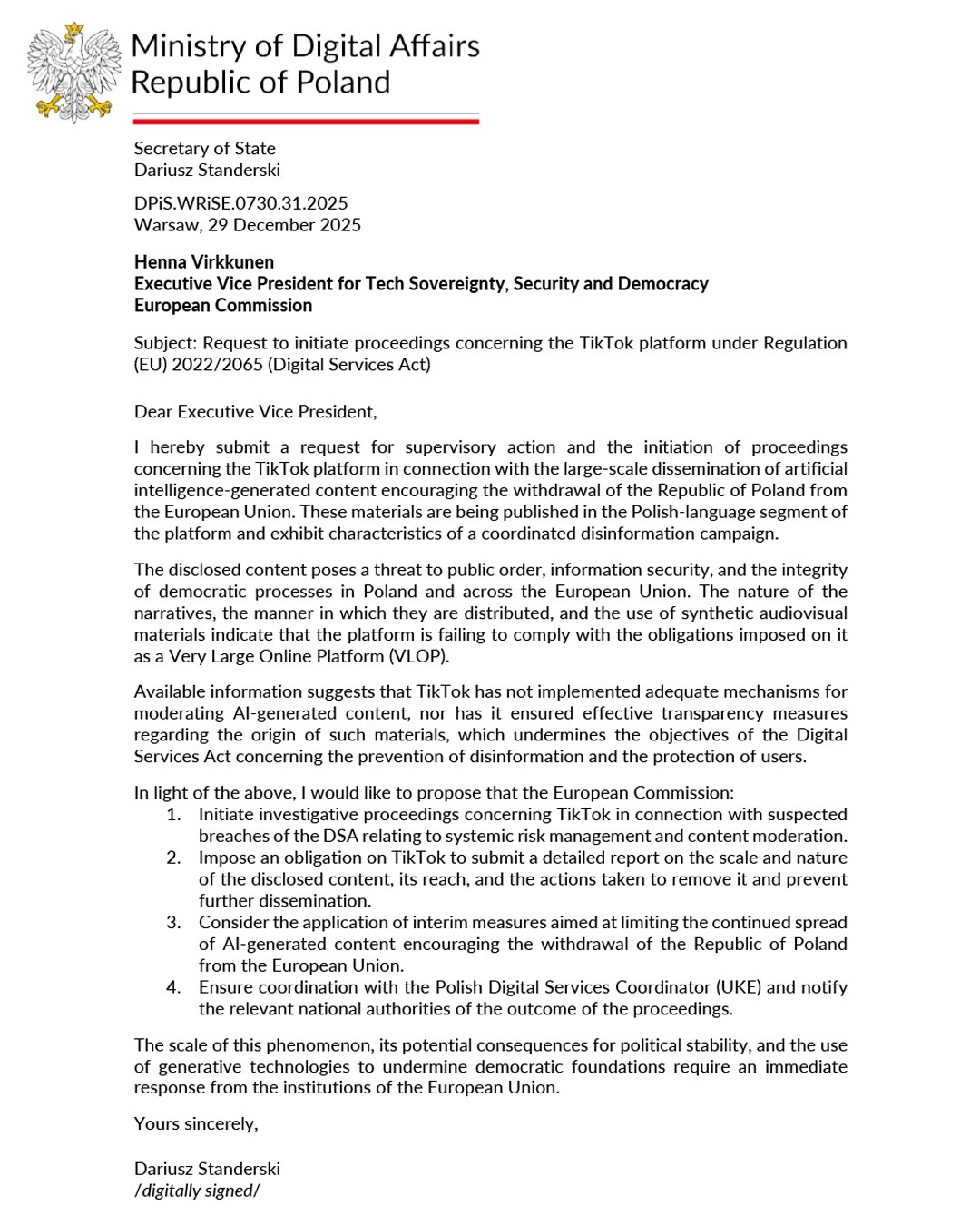
Deputy Minister of Digital Affairs Dariusz Standerski wrote to Executive Vice-President Henna Virkkunen, who oversees the EU’s Tech Sovereignty, Security, and Democracy portfolio, insisting that the European Commission open a Digital Services Act (DSA) investigation into TikTok.
He accused the company of failing to build “appropriate mechanisms” to detect and moderate AI-created content and of neglecting to provide “effective” transparency tools that could trace how such material is produced.
The letter went further, urging the Commission to introduce “interim measures aimed at limiting the further dissemination of artificial intelligence-generated content that encourages Poland to withdraw from the European Union.”
If interpreted literally, this would empower EU authorities to require large-scale filtering of political messages generated or enhanced by AI whenever they express skepticism toward EU membership.
Standerski also called for TikTok to produce a detailed internal report covering the supposed “disinformation,” including its scale, reach, and the steps taken to remove or suppress it.
Soon after his letter was publicized, Reuters reported that a TikTok account featuring “videos of young women dressed in Polish national colors and calling for Poland to leave the EU” had abruptly vanished from the platform.
TikTok, according to the report, had been “in contact with Polish authorities and removed content that violated its rules.”
That account, known online as Prawilne_Polki, had blended seemingly genuine clips with AI-generated ones, accumulating around 200,000 views and 20,000 likes within two weeks.
Polish-language outlets later confirmed that TikTok deleted Prawilne_Polki for breaching its terms of service.
Records suggest that Prawilne_Polki was originally created in May 2023 under a different name and was used for general entertainment videos until mid-December, when it was rebranded and began posting material about leaving the EU.
Reports describe it as part of a broader influence operation, though its removal appears to have been voluntary on TikTok’s part rather than the result of a formal EU order.
The significance of Standerski’s request lies less in the single account and more in the precedent it seeks.
His call for the EC to impose “measures limiting dissemination” would not distinguish between state-backed propaganda and ordinary user content.
Any AI-assisted meme, parody, or political joke about EU membership could be targeted under such a rule.
The DSA, already in effect, gives the European Commission extensive power to demand “systemic risk” assessments and impose moderation obligations on large online platforms.
Enforcement depends on algorithmic filters and opaque reporting systems that encourage platforms to err on the side of deletion rather than debate.
Treating AI-generated material as inherently suspect risks criminalizing or suppressing legitimate political commentary.
Once moderation directives are issued under the DSA, platforms often act preemptively to avoid fines, creating a censorship mechanism that needs no explicit ban.
TikTok has not clarified whether its removal of Prawilne_Polki was related to Standerski’s letter. Still, the sequence of events illustrates how political pressure can shape corporate moderation choices even before any formal legal process begins.
The Polish government’s push now places the European Commission in a position to decide whether “disinformation” about EU membership should be treated as a threat to democracy or as part of the democratic conversation itself.
The outcome could determine how much room remains for dissenting narratives in Europe.